
[Music]
[Applause]
okay what that should be saying is why
21st century India cannot do without
artificial intelligence that’s what I’m
here to talk to you guys about back in
2007 researchers hypothesized that one
of the first signs of the gap closing
between human intelligence and
artificial intelligence would be the day
when machines finally beat humans I’d go
the ancient strategy game from China
that’s more than 2,500 years old to
understand why beating human beings at
strategy games is so difficult for
computers on the draw your attention to
the 1996 1997 match between Garry
Kasparov and deep blue by IBM deep blue
beat Garry Kasparov using a brute-force
approach to explore the set of candidate
moves this is really impressive the
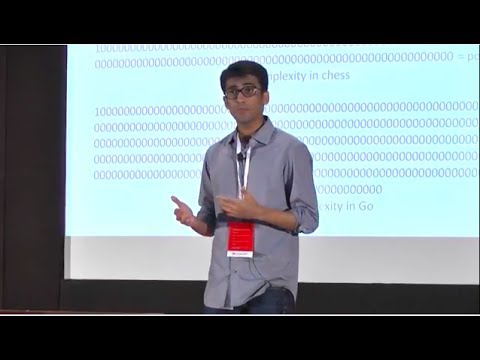
total set of positions that are possible
in chess is 10 ^ 123 the total atoms in
the entire universe is just 10 ^ 80
to put that into context that difference
is larger than the entire age of the
universe in nanoseconds go on the other
hand has a positional complexity of 10
to the power of 360 computer scan even
begin to explore the space necessary to
brute-force it computers have to mimic
ingenuity creativity and intelligence to
come up with the moves that would work
they need to be able to feel and see
patterns just two way humans see them in
2016 alphago built by some of the really
smart people at Google beat one of the
best mankind had to offer
I’d go what surprised people though was
the fact that it wasn’t even close
alphago came up with moves that people
who had played the game for decades had
never even seen before in just a couple
of years alphago had beat someone who
had spent their entire life perfect
in this game this dominance isn’t just
limited to games though today AI follows
us everywhere when you’re stalking your
girlfriend on Facebook it’s AI that
powers the ads that you see AI shows you
which movies you’re likely to want to
watch and knows what songs you prefer
even before you know it yourself it
drives cars better than you do it can
read CT scans better than humans have
ever been able to do it and today it
even directs our traffic the rate at
which investments in artificial
intelligence are increasing it’s almost
certain that almost every job or task
that involves simple logic or involves
basic hand-eye coordination is likely to
be automated away now when I tell this
story or talk about these things to most
people in India the people don’t believe
me usually come from two camps the first
line of thinking goes something like
this yeah it’s coming but it’s still
pretty far away it’s going to take a
long time to get here the thought
process here assumes that until we
actually see it around us it’s actually
not happening the second line of
thinking which is more common is by
experts people who’ve been in industry
for a long time and they tell me that
you know yeah I understand that a is
coming but it’s not coming to my
industry anytime soon the argument here
is that in India labor competitiveness
will stay for a long time and artificial
intelligence is not likely to be
competitive any time soon alternatively
the quality that a I will offer will
never even be close to what humans can
do today this line of thinking is
actually not new at all back in the
early 1900s a very famous banker once
believed that automobiles were just a
fad and actually horse-drawn carriages
would dominate the entire entire world
for a really long time just a few years
later the sale of cars had almost
increased 20x Moore’s law which law
you’ve probably heard about has made
such predictions go in huge numbers for
example in 1977 someone predicted that
personal computers were never really
going to become a thing at all just four
years later IBM had already sold 100,000
personal computers and my favorite one
is by Thomas Watson himself and this one
needs no explanation at all the world
market is much much larger as we all
know than just five computers when we
think about the impact that AI is had
having in the world today this is not to
suggest that these experts or these
industry leaders were naive or ignorant
it’s just that all of us myself included
are really really bad understanding the
effects of an exponential function until
we really forced ourselves to do so the
rate at which investments and artificial
intelligence are growing are indeed
exponential just like Moore’s law was if
we in 1977 19 1997 couldn’t conceive of
a world in which every Indian had a
cellphone with internet one day we
cannot even begin to understand what AI
will make our world look like 20 years
from now the world that AI is gold most
growing effect in India is actually not
represented in this room today India –
or India 3 as this is sometimes known as
our people who live in villages or have
families that still live in villages
these are people who’ve not had the same
educational opportunities that a lot of
us have had these are people who still
work largely in the informal sector and
are still comfortable in their local or
regional languages I recently met a
friend of mine who works with some of
the largest tea gardens in India and I
asked him is technology being used in
any of your processes and he told me
that arpan until very recently we
struggled with the problem where our tea
pickers would go and pick tea leaves and
they would be mixed with really ripe
leaves which would be yellow and less
ripe leaves it should be green and this
mixture actually reduced the price of
the tea because the quality wasn’t as
pure anymore
and we had to hand separate this out he
told me that they’d recently purchased a
machine that used simple computer vision
to actually separate out these leaves
for them and these machines were doing
it better and faster than any human had
ever done this change isn’t just
happening to tea in agriculture alone
which employs almost 50 percent of the
Indian population already you have
autonomous tractors you have drones that
can spread pesticides and you have crop
harvesting autonomous robots that are
already available in the markets today
there’s not just limited to agriculture
of course in manufacturing as we try to
stay more competitive with our
counterparts in China which are heavily
investing in autonomous technologies and
AI the forcing function forces
manufacturers to adopt more and more
automated processes in the service
sector call centers which employ
hundreds of thousands of Indians every
single year are already seeing growth
stagnate chatbots which you must have
all heard about are no longer just
mimicking the way we talk they’re doing
it better than us the cart they can draw
up on a much wider set of facts and are
able to be a lot more persistent and
patient with angry customers than we
could ever be all of this becomes very
very relevant when we think about the
statistics of what the workforce of
India looks like today and numbers are
chilling almost 92 percent of India’s
workforces in the informal sector with
30 percent of these people being daily
wage laborers only 2 percent of India’s
workforce is said to be skilled and only
30 percent of us are actually graduates
if artificial intelligence completely
destroyed some of the best minds that we
have at purely intellectual tasks you
can imagine what it’s going to do to
entire industries that are largely
manually focused now as you can imagine
the challenges that we face with this
upcoming AI wave are pretty serious and
unfortunately India is not ready for the
from a policy perspective we’re
investing heavily into increasing our
manufacturing with schemes like making
India but what is absent from the debate
completely is the role that autonomous
vehicles may I or synthetic
intelligences are likely to pay play the
more we automate which is going to
become the requirement to remain
competitive in a global economy the
lesser and lesser will require people to
actually do these tasks while we will
increase a lot of value and generate it
it is unlikely that it will actually
solve the employment problems that India
is likely to see in the future usually
in a lot of other economies the private
sector steps in here and actually
provides and may create their jobs and
the roles that actually are created in
the new economic structure that emerges
in other countries like the US and China
you have companies such as Google Amazon
Netflix that are investing heavily into
artificial intelligence they invest
billions of dollars literally billions
of dollars into the hardware human
capital and software to enable such
products and technologies to actually
take place in India we are very very
very far behind the biggest companies in
India very often are not even looking at
this sector and the startups are not
globally competitive at all when we look
at the funding that countries receive
India is nowhere in the list
similarly the patterns that are
generated globally in the field of
artificial intelligence again India is
nowhere on this list at all just this
year alone three billion dollars of
money is going to be invested into just
in the startups that are based on
artificial intelligence almost zero of
these dollars will actually reach India
I want to focus a little bit more on the
fact that a large percentage of what
enables countries and enables economies
to actually do a lot of AI work is the
research facilities and even here our
research institutes are largely falling
behind their global competitors now I
can see all the really sad faces in this
room and I don’t want to depress you
guys any further and I want to be very
clear
I’m actually very very optimistic for
what AI will mean for India just like
the previous wealth generating periods
that have existed in mankind but there
was the Industrial Revolution or the age
of computers and the Internet
even though India did not lead the
development of these revolutions we
benefited from them greatly and the same
will be true of the artificial
intelligence revolution a great example
that I like to always talk about is how
since the 1960’s farms in India have
become increasingly mechanized use of
tractors has drawn almost 60 fold and
the labor participation has fallen
drastically over the same period in the
same time though Indians have actually
increased their food output and we are
better fed than we ever were before we
must look at AI in the same way the
debate is much more nuanced as Ola and
uber continue to bring autonomous
vehicles the costs of transportation
will fall drastically as Foxconn
replaces their workers with robots our
smartphones will become cheaper and
cheaper
today’s Indians can afford more things
than Indians ever did in history and a
large part of this is because of the
automate autonomous processes that has
driven costs down exponentially this
benefit will extend over time in the
future as well the other thing I want to
focus on is the fact that in terms of
where we are we’re in the equivalent of
the 1950’s of the computer revolution
most companies do not dominate the
entire space of artificial intelligence
they do what we call a narrow AI or weak
AI which is very specialized and focused
artificial intelligence developments and
very sport forecast fields Google is
great at presenting you ads and it’s
great at autonomous vehicles Amazon is
great at giving recommendations they
don’t do everything really well
this leaves tremendous room for
companies to come in and add a lot of
value in a very short amount of time my
favourite example here is Baidu the
chinese search giant until 5 years ago
was not known at all for their work in
artificial intelligence at that point in
time they created by do research and
hired one of the top minds in artificial
intelligence in the entire
just in the last five years alone they
have broken numerous world records in
machine translation and speech-to-text
technologies today they have their own
self-driving car project as well
all of this was achieved in just five
years that’s how quickly this field is
moving that’s how much scope there is
today finally I think we’re really
fortunate to be in India amongst a group
of people who are really really
forward-looking optimistic and our
students are really really vibrant and
thinking about machine learning very
actively the interest that Indian
students have deeply displayed is almost
one of the largest in the entire world
if you look if you look at the courses
that are taken on global platforms in
this in this extremely flat economy that
we have today
Indians are one of the largest consumers
of courses on Coursera and machine
learning is one of the topmost courses
they’re increasingly doing machine
machine learning research with
technologies that have released such as
tensorflow and using the Amazon Cloud
services or other cloud services enables
almost any one of us should start
contributing to this field and this
brings me to why I’m most excited to be
speaking with you today artificial
intelligence is not just about the
technology and the algorithms it’s just
as much about the data Peter Norvig who
was head of Google research once Emily’s
famously said we don’t have better
algorithms we just have much more data
when we look at India – and India 3 no
one has this data today the products
that were designed by people thousands
of miles away for Indians were designed
for people like us in this room today
they do not have to think about how we
use the products because we were just
like them when it comes to the next 700
million Indians who are going to come
online things are going to be very
different the products are going to be
very different and the use cases are
going to be very very different this is
a remarkable opportunity for Indian
companies people like you and I to step
in understand what would provide value
and generate a new wave of development
in this economy
just over the next three four to four
years until 2020 AI is expected to add
1.2 trillion dollars in global GDP some
companies fortunately in India are
already realizing this Reliance Geo is a
fantastic example of a long-term data
play by creating a subscriber base of
100 million users in very quick time it
doesn’t just control the Gateway to the
internet for these people it has a
front-row seat onto which apps these
people are using and how they’re using
their data India missed out on the boat
and did not get a chance to lead the
Industrial Revolution and it did not get
the chance to lead the internet
revolution we must not miss the chance
to lead the artificial intelligence
revolution thank you
you
Please follow and like us: