
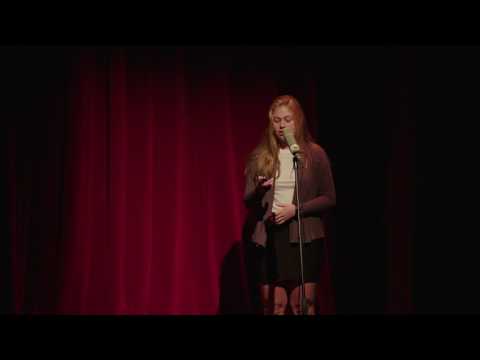
rapid breathing blurry vision shaking
knees and sweaty palms these are just a
few of the many things that I’m
experiencing right now it all started
two years ago when giving my first
memorize speech to a crowd it was a
simple three-minute talk on why
materialistic objects won’t make you as
happy as experience as well I had
practiced for about two hours a night
before and the days before so I felt
really confident when going in to
perform it but once I actually got up
there and was standing in front of
everyone it seemed as though every
single thing that I had practiced had
completely escaped my brain and ever
since then I’ve developed this huge fear
state of public speaking so when I was
presented with the opportunity to join
TEDx rcs I thought what better way to
face my biggest fear than join this club
so I’ve done a little bit of research so
what actually happens when someone
thinks about negative or scary
consequences the hypothalamus triggers
the pituitary gland at the base of your
brain secreting the hormone ACTH ACTH
then stimulates the adrenal glands in
your kidneys allowing the release of
adrenaline into your blood flow now this
is where someone like you or me would
experience some of the common side
effects of stage fright such as your
muscles contracting which forces you to
wanna tighten your posture but because
this position is so uncomfortable you
try to resist it but when you try to
resist it the muscles in your arms and
legs begin to shake and as if all of
that isn’t enough your pupils dilate
making it hard to see things that are up
close like a note card that could help
you with your presentation and easier to
see it’s easier to see things that are
far away like the audience’s facial
expressions so what effect stage fright
there are too many things that effect
stage fright the first are the stakes
it’s the first is how much you’ve
practiced obviously if you’ve practiced
a lot it’s going to relieve some of the
pressure of going on stage and
completely weighing it the second are
the stakes of the situation it’s going
to be a lot less scary if you’re up on
stage if you’re up performing in front
of a group of people that you’re
familiar with and it’s a small group of
people then if you
to perform in front of a large group of
people that you don’t know so obviously
after doing all this research and
experienced the side effects of stage
fright I want to find a quick solution
but I knew it the only way to how my
fear was to practice a few simple
activities over time the first
visualizing success to prove this
psychologist Alan Richardson did an
experiment in which he had three groups
of basketball players the first group
didn’t practice at all
the second group went into the gym every
day to practice and the third group just
imagined themselves going into the gym
and making all the baskets that they
shot after about two weeks he measured
their success the first group did
impractical the first group didn’t
improve at all
the second group who actually went into
the gym in practice improved by 24% and
the group that just visualized
themselves succeeding and making all the
baskets that they scored improved by 23%
24% 23% pretty close thus proving how
helpful visualizing success can be for
someone with any given fear and the last
thing is meditation there have been a
lot of studies done to show that
meditation leads to increased relaxation
decreased stress and pre-crease
self-confidence and an improved ability
to focus so after doing all this
research and presenting it you all here
today I can confidently say that the
best way to deal with your fears is to
face them directly and head-on thank you
[Applause]
Please follow and like us: