
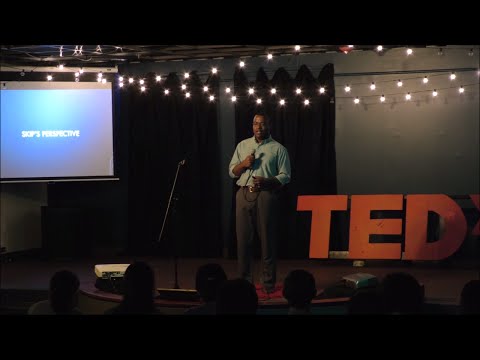
I am a lawyer political scientist and a
mediator and what I want to talk to you
tonight is I want to talk to you about
racial reconciliation and we’re going to
focus mostly on black/white relations
here in the context of the United States
but much of what follows can be applied
more broadly as well issues of race in
the u.s. can be so difficult to think
because in any given exchange there is a
reality that we observe on the surface
and there’s a dense substratum of
meaning and insecurity that that is
really lodged beneath that surface all
right so what I want to do today is I
want to tell a simple story first we’re
going to focus solely on surface level
detail I know we’re going to take a
moment and step back and domini that
surface and look at the meaning social
historical meaning that lay beneath that
surface and finally we want to talk
about some of the ways
standing that substratum of being can
help us engage one another in more
productive ways all right so let’s start
off by talking about a guy named skip
now imagine your skip and you were on at
home one day you arrived home early from
a work trip you you cut your trip short
because of illness
so you’re sick you’re tired from your
travels you get to your front door of
your home and the door is stuck so you
have to shoulder your way so you’re you
sick you’re tired you have to force your
way into your home shortly after you
arrive at the lease arrive
now the police are in your home and they
say they’re investigating a burglary and
they want you to show them some
identification and verify that you’re
the rightful occupant of that Club now
recall you’re sick you’re tired you have
to force your way into your own home and
now you haven’t to justify your
existence there in your own home the
police are there and they want you to
prove that you’re not a burglar you are
livid in fact you decide to let the
police officer have it you hurl insults
at the police officer you insult a
police officer so much that the officer
eventually arrest you right there on the
front steps of your home the charge is
disorderly conduct now back up just a
moment and imagine your name is Jimmy
you’re an officer on patrol you’re
driving down the street and a call comes
on or dispatch that
suspected burglary in the neighborhood
now you’re nearby so you respond you’re
just doing your job when you’re on the
scene you encounter remain that you
suspect is a rightful occupants of the
dwelling but doing your due diligence
you tell the men at the home that you
need to see his identification you need
to verify that he’s a rifle occupant of
the dwelling
he’s reluctant to comply in fact he
starts hurling insults at you in fact
even though he ultimately shows you is
identification you decide that you don’t
have to take this with disrespect you
arrest him anyway you arrest him right
there on the front steps of his home ok
now I think we can all understand the
the basic facts of this situation but it
gets a little bit more complicated see
skip is known to skip among his friends
when he’s actually dr. Henry Louis Gates
a african-american professor of history
at Harvard University go Harvard right
and and skip is is is the man involved
in this situation a citizen involved in
this situation and Jim here is a police
officer with the Cambridge Massachusetts
Police Department he is sergeant James
proud of the police department and this
incident made national news in the
summer of 2009 and dr. gates was
arrested by sergeant fry on the front
steps of his home
even though he was there in his own and
on a very vague and nebulous charge of
disorderly conduct this became the first
real test of the so-called post-racial
America and the early Obama
administration in fact President Obama
had dr. gates and sergeant Crowley to
the White House for beer and what we
came knowing czar Peter summit so there
they are having a beer together they
now what’s you you know one level on a
surface level you can think that this
incident is a good opportunity to talk
about where the appropriate boundary is
between the citizen I exercising their
free their rights even even it rights to
be rude in certain instances and in law
enforcement officials ability to
investigate crime and keep the peace and
on one level that is certainly an
important conversation to be had on
another level power we might wonder why
was it that nothing was so upset why did
he feel obliged to to hurl insults at a
police officer on the other hand we
might also wonder why sergeant probably
why the insults were able to get so
under his skin that you made an arrest
even though he had already there
dr. Kayson was the rightful occupant as
well in order to understand why some of
these racial exchanges can be so
difficult we might want to consider the
the substratum of insecurity both black
insecurity and white insecurity and
let’s say some things about the nature
of black insecurity this is an excerpt
from remarks made by Senator James Henry
Hammond before the US Senate and 1858
and look at some of the things he says
here he says we do not think that whites
should be slaves either by law or
necessity our slaves are black of
another and inferior race the status in
which we have placed them is an
elevation they are elevated from the
condition which God first created them
by they made our slaves
none of that race on the whole face of
the globe can be compared for the slaves
of the south they are happy content on
aspiring and utterly incapable from
intellectual weakness ever to give us
any trouble by their aspirations so it
remarks me before the US Senate we have
senator from South Carolina here saying
blacks of money we’re in nature inferior
so much so in fact that for them to be
the slaves of whites is an elevation for
them consider just a few years later
South Carolina and what eventually
the civil war decides to withdraw from
the Union and South Carolina makes it
very clear in their declaration of
secession why it is that were drawn from
you they say we feel as though the
Constitution was a contract in which the
most important clause was the one where
we get to keep our property and slaves
and the non-slaveholding states will
leave us alone they go on to say these
ends these ends and endeavour to
accomplish by a federal government in
which each state has separate control
over its own institutions the right of
property and slaves was recognized by
giving to free persons distinct
political rights by giving them the
right to represent and by stipulating
for the rendition of fugitives from Lake
in other words what the Constitution is
really all about from the perspective of
the South Carolina here is it’s about
returning returning fugitive slaves even
if they make their way into
non-slaveholding territory South
Carolina goes on to say the in ins from
which this government was instituted
have been defeated and the government
itself has been made destructive of them
non-slaveholding states those states
have denounced as sinful the institution
of slavery
they’ve permitted open establishment
among them of societies whose avowed
object is to disturb the peace and to
align the property of the citizens of
other states as far as South Carolina is
concerned in this declaration the real
problem is that slaves are not only
naturally inferior but that the whole
constitutional order that we establish
under the Constitution and the main
design as far as South Carolina is
concerned is to keep the slaves just
that enslaved South Carolina feels
strongly enough of value that they go on
to say we therefore the people of South
Carolina buy our delegates and
convention assembled appealing to the
supreme judge of the world for the
rectitude of our intentions have
solemnly declared that the Union
heretofore existing between this state
and other states of North America is
dissolved this is an important enough
issue that it needs to lead to the
dissolution of a Union rather than to
relinquish the slaves in fact they
appeal to the supreme judge of the world
for the rectitude of their intentions
this is good and right as far as South
Carolina concern so notice that even a
hundred years after the Civil War we as
we might imagine it is not the case that
simply because the law has changed in
slaves and slave persons are now legally
free and now elevated to co-equal legal
status with
majority of white population it is not
the case that that many of these folks
who believe in the rectitude of their
intentions just just accept the new
reality and go and start treating black
Americans as co-equal partners in its
great country I know you might imagine
that there’s a lot of bitter resentment
you might imagine that going forward
there’s a sort of resentment that is
created from the idea that you can
elevate in legal terms those whom we
regard as our rightful our natural
inferiors and so for generations
following the Civil War you still see
that this resentment manifests itself in
different ways and you still see both
law and custom both conspiring to keep
the previously enslaved persons in their
and their children in their rightful
place and you might imagine what this
sort of sentiment does to the black
population consider what that does of
that population over subsequent
generations here is an excerpt from WB
Dubois 1903 book where he recalls an
early childhood experience where some of
his playmates some of his white
playmates first make him aware of the
fact that he’s different and that he’s
regarded as somehow other and and
inferior to me he says then it dawned
upon me with a certain suddenness that I
was different from the others or like
they have in heart and life and longing
but shut up and there were
by a fascinating okay and we might
wonder what effect that that has on on
the psyche of a person but what effect
does this have them on for lack of a
better term the black American psyche
well Du Bois tells us he says I had
thereafter no desire to tear down that
favor to creep through rather I held all
beyond it and a common contempt I think
we can I think we can imagine what it’s
like to experience rejection and the
natural human response to rejection we
often want to reject those who have
rejected us with equal or greater force
and that which they rejected us when
someone says we don’t want you a part of
our group we we we feel as though you
are not worthy to be a part of our group
sometimes our response is to say well I
don’t want to be a part of your group in
fact maybe I will do all sorts of things
that indicate that I don’t want to be a
part of you right maybe in many
different wings and adopting different
patterns of speech patterns and dress
patterns of behavior maybe I want to
indicate that there is no way on the
face of this planet that I want to
belong with you imagine this sense
in a sense of wine it’s a it’s a
humiliation to be rejected its yet a
further humiliation to long for or to
appear too long for acceptance in a
so black insecurity might be somewhat
easy to understand might be easier to
understand than the nature of light and
security we might say we might say white
white Americans are the imputed masters
of the Western world what do they have
to be insecure but therein
I think lay some of the issue as imputed
masters of the Western world in any
criticism that we have of the west and
of America in particular become
criticisms of the white majority
population consider the feminist
movement which at its heart says that
men are not the measure of all things
and many abuses have been suffered by
women at the hands of men consider the
anti-war which says at his heart that
perhaps the projection of American force
abroad has not been a force primarily
for good perhaps it’s been destructive
and abusive or absolutely abused the
world in a projection of our power
consider the environmental movement
which says that much of our allowed in
economic
growth may have come at the expense of
our environment maybe we’ve degraded the
the planet so we’ve abused not only the
maybe the peoples of the world of the
planet itself and of course consider the
civil rights movement which at is core
if you think about some of the speeches
of Martin Luther King for example think
about the I have a dream speech where he
makes reference to the Declaration of
Independence and those promises of
freedom and justice and equality and say
how he attempts to shame the nation to
live up to some of his highest
aspirations notice what each of these
movements have in common is that over
the last several generations what
they’ve done is they launched a
fundamental critique of American culture
of our society and they said maybe some
of that American self confidence is
misplaced maybe we are not so great as
we think we are you think that might
make the masters of this society feel a
little bit insecure
perhaps here’s a notable recent example
colin kaepernick decided to protest the
treatment of blacks at the hands of
police officers by kneeling and refusing
to render honor to either the emir
or the national anthem and he said he
will refuse to do so until such time as
justice has been done and the issue he
wants to bring awareness to and think
about the National Dialogue much of a
name that was sparked by this particular
action Colin perhaps tapped into this
sentiment pollution disgusting according
to black Twitter and I call it black
Twitter because that’s what they refer
to themselves as by the way black songs
about black struggle black culture or
black features should be off-limits to
the melanin deprived wait what now songs
are off-limits too can white people do
anything anymore
can white people do anything and of
course the remarks these remarks by
Tommy Boy are perhaps easy to laugh at
in a way that she expressed them and yet
the sentiment is something that is very
indicative of what we’re talking about
there is a notion among many white
Americans of can I do anything can I say
anything without bringing blame or shame
or disrepute upon its own is there
anything that I can say and not being
somehow alive for now we might say that
if the nature of black secure insecurity
and its core is a matter of we might
call it unrealized dignity as yet
unrealized dignity then we might say the
nature of white and
security may boil down to maybe a lost
video or a diminished degree and so what
I want to call your attention to is you
know as we return back to dr. gates and
sergeant problem you might consider that
both of these men had several
opportunities when of course of their
exchange complying to de-escalate the
situation that either of them at any
point in their exchange with one another
could have taken steps to take some of
the heat out of their exchange and yet
neither chose to do so and I posit to
you that perhaps neither chose to do so
because they’re responding to one
another out of their competing and to
one another their mutually
incomprehensible insecurities and maybe
that made this exchange more volatile
and it otherwise would have been so what
can we do to make these situations go
more smoothly well for one thing we can
keep in mind we can realize that often
exchanges such as this one are made more
difficult because of insecurity and we
can recognize that the other side is
responding to us in ways that may appear
to us to be hostile but they really are
born out of a deeply ingrained
insecurity that maybe they themselves
are not even aware of you see in this
situation dr. gates could not fathom why
this was happening
and it was all too easy for him to think
that this was happening because of his
race and he called sergeant Crowley a
racist now given all the social
historical baggage we just talked about
a racist is probably one of the worst
thing sort of probably can be called and
he responded out of that so maybe one of
the things we should do is keep in mind
that what we’re often doing these
exchanges was responding out of our own
insecurities and with them recognize
that we can empathize more open up
excuse me
the other thing is to keep this in mind
in our approach one another I’ll give
two examples one think about the black
lives matter movement and it responds to
a parent abuses of blacks in the hands
of police we may often hear ring out the
assertion black lives matter now we may
regard that as a hostile State and we
might be inclined to respond with all
lives net but what I want to get you to
see is if black lives matter arises out
of a deeply ingrained sense that
black lives are not considered the equal
counterpart to live lives the responding
with all lives matter is non responsible
it doesn’t come perhaps affirm that yes
black lives do matter can be helpful
consider also the calling happening
protests and we might think that any
form of protest is likely to be viewed
in an offensive man on the other hand if
we compare politics refusal to render to
render our to the flag into the anthem
and compare that with dr. King’s
positive reference in the Declaration of
Independence and the aspirational values
embodied in a declaration we might see a
better way forward we might think that
perhaps Colin could have pointed to some
of our common cultural touchstones and
the values embodied in those and called
us higher to live out those aspirational
values embodied in our national touchstones