
a couple of years ago I did a piece of
consulting work for a large
multinational company which will remain
nameless I charge them five thousand
pounds I sent off the invoice 30 days to
be paid I received the money two years
later for the first six months I didn’t
even register that was a problem and
then I realized that this was an unpaid
invoice so I started chasing this
company my wife helped me out she helped
me to run the business
we called call centers in India in
Poland in Scotland various parts the
accounts payable Department of this
company London headquarters everybody
was very polite I’m sorry we haven’t
paid your invoice nobody questions for a
second that this invoice needed to be
paid they were all completely powerless
to actually do anything about it there
had been a glitch somehow and the
invoice had fallen into her into a bit
of a black hole and no one could
retrieve it if I’d been doing the work
for a small company the chief executive
could have got out his checkbook in the
old days I guess today he would probably
get out his mobile phone and just
transfer the money money immediately but
because it was a big multinational
nobody had the authority to actually
make such an action did I get angry at
this state of affairs no I became
fascinated I became fascinated that this
huge company with profits in the
billions couldn’t pay a 5,000 pound
invoice and the question I asked myself
was who is accountable for this problem
is it the person I did the original
piece of work for he was deeply
embarrassed he was apologetic but of
course he was powerless to do anything
about it and all he could do really was
just to sort of tell me to speak to
somebody else
was it the Accounts Payable
Department or process who were
accountable yes at some level they were
absolutely were that was why we were
calling : in Scotland and India
but we never found out who the
individual who shall we say was
responsible for that process what some
of the people didn’t know others were
probably deliberately keeping him or her
out of out of our way as it were
perhaps it’s the person right at the top
the chief executive that she financial
officer ultimately everything goes back
to that individual but of course that
person’s got rather bigger things to
worry about than my 5,000 pound invoice
so as I thought about the problem I
realized that but they were all
accountable but none of them were
accountable none of them felt any
accountability they had out sourced the
problem to me they’d outsource the
problem to a third party it wasn’t even
part of that company was the money
eventually made yes it was and the
reason it was paid I’d still to this day
don’t know exactly how it got paid I
think somebody shows it took pity on me
and found a way of putting in a little
bit of extra effort to find the source
of the problem but the reason I tell you
this story of course is an illustration
of this massive problem of our time
which is that we create these huge
corporations which are complex they are
incredibly complex by design and there’s
nothing wrong with some level of
complexity in the business world but the
trouble with complexity is it creates a
deficit of accountability it’s very easy
for people to fall back on formal rules
and procedures and not take any
responsibility for what happens when you
see these famous examples of corporate
scandals it’s a very different story
than somebody not paying their invoice
but in some ways the root causes are
similar because we have big companies
like Wells Fargo like Volkswagen like
all the companies during the financial
crisis where bad stuff happened because
people didn’t feel personal
accountability we blame the chief
executives and to sunderson that’s
rightly so but many of these chief
executives were genuinely oblivious to
the problems that were happening three
or four or five levels below them so
we’ve got this problem of complexity we
create companies that are too big to
fail but at the same time they’re also
too complex to manage and for me this is
a problem that we need to find a way
addressing so that’s what I’m going to
talk to you about for the next ten
minutes
the starting point for that
investigation about how to overcome the
problems of complexity is the following
should we fight complexity with
complexity if we are operating in a
global business well with clients in
multiple countries should we create
complex matrix structures to serve their
needs at some level that feels like an
attractive way of doing it and there’s a
whole bunch of academic theory that says
that’s a good thing to do I believe that
that’s the wrong approach because it
creates all the problems we’ve been
talking about it’s slow it’s inert its
demotivating it lacks creativity instead
we should be pushing in exactly the
opposite direction we should be fighting
complexity with simplicity what do I
mean by that I mean we should be
deliberately finding ways of increasing
the accountability and ownership lower
down our organization simplifying our
structures in order that people have the
discretion to make the right decisions
to pay the five thousand pounds that
they owe me and to make the right
judgment calls on issues of a moral or
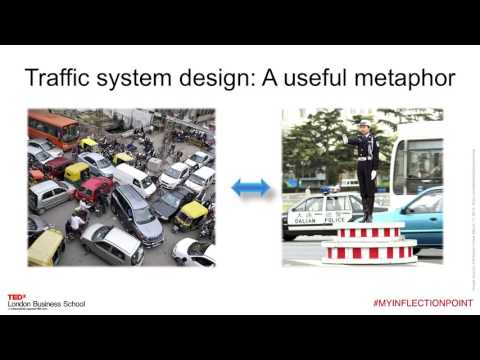
ethical basis the metaphor I like to use
here is one of traffic system design and
many of us have traveled in many parts
of the world and we’ve seen different
approaches to how to manage the traffic
systems in the world and the choice
comes down to essentially on the left
side a complete free-for-all
when we’ve got too many cars on the road
a free fall leads to complete gridlock
on the old on the right hand side we
have the the traffic cop and around the
traffic cop we’ve got the traffic lights
and we’ve got the one-way systems and
we’ve got the markings in the road
everything is done to order on the
right-hand side we follow the rules and
we can essentially ignore any sort of
thoughts about what we should do for
ourselves it turns out in that debate
and that sort of conversation there have
been some innovations and one that I
just like to point you point out to you
is a famous one from Holland a gentleman
called hands Mondamin he came up with
this notion of shared space you could
see a beautiful example of shared space
there where they got rid of the
distinction between this
the pedestrians and the cars it’s all
open space it is a free-for-all indeed
exhibition Road just immediately outside
this building is another such example of
shared space the shared space model
basically says if we take away the
structures and we assume a certain level
of smartness and the rule of law in a
country or in a place we will allow
everybody to figure out for themselves
the right way of getting through this
intersection and Hounds malam improve
that very quickly a set of emergence
norms of behavior take place whereby
everybody gets through this intersection
quicker than if it’s paved with traffic
lights and signals and markings and so
forth so that is the metaphor that I
think we need to apply to the
organizational world we need to start
using this shared space concept within
our organizations so that leads me to a
particular point of view about
overcoming the costs of complexity
through alternative organizing models we
all understand that bureaucracy would
not without its merits as an organizing
method bureaucracy is the source of
inertia and slowness and and
dissemination in the way that work gets
done in large companies what is the
alternative to block bureaucracy well
one very popular emerging concept is the
notion of meritocracy what is a
meritocracy
it’s an organizing model where rather
than falling back on rules and
procedures for doing everything or
falling back on just listening to our
boss we are actually privileged
acknowledge and expertise and judgment
in a meritocracy the smartest people
actually are the ones that make
decisions and we try to make sure that
everyone stands what needs to be done
through debate and discussion that is
what a meritocracy does unfortunately
meritocracies can also be a little bit
slow you think of it in terms of
analysis paralysis we’ve all been in
meetings where we decided that we would
try to get to the bottom of things by
just having a
debate around it we tried to build
consensus I work at London Business
School when we don’t know what to do in
London Business School we form a
committee and after nine months and four
to five meetings of that committee we’ve
essentially figured out what the problem
was but we’ve actually changed nothing
it’s a very very common scenario in
professional service of companies in
universities meritocracy you’re not bad
but it’s not the end of the story so
what is next I believe that we should
give it a name another name I like is
adhocracy adhocracy privileges action
okay in a bureaucracy we’re privileged
in formal position and status in a
meritocracy we’re privileged
acknowledged adhocracy says that when we
don’t know the right way forward the
best thing to do is to actually do
something is to actually take action to
experiment to try something out build a
prototype talk to our customers to
understand what really their needs might
be and then going back to my story about
my unpaid invoice in an ad hoc recei
somebody takes responsibility for
helping me to solve that problem that is
adhocracy it is not falling back on
rules now what is ad hoc Racine look
like in practice it has many many guises
okay the whole thing purpose of this
concept is that it is done to be
designed to be an overarching way of
looking at the world an autocracy a
classic example would be the famous
Apple Macintosh many of you have heard
this story many times before Steve Jobs
took a bunch of his brightest engineers
he put them in a separate building the
farther the Apple campus they were
pirates above corporate law their job
was essentially just to create the
world’s greatest computer in a
ridiculously short period of time and of
course they they succeeded they
transformed the way that we think about
computers today so that’s a classical
example of a special team created to do
this a very contemporary example is ING
Bank than in the Netherlands ING Bank
has 10,000 employees their central
offices in the Netherlands three and a
half thousand people they took it upon
themselves to years ago to say as we try
to
invent ourselves for a digital world for
an omni-channel operating environment we
need to have a completely new way of
organizing they took three and a half
thousand people and they broke them down
into ten person agile teams it’s a form
of self-organizing where the teams are
the unit of analysis they own their
particular customers their particular
challenges their job is to figure out
how to work there is a structure above
them to keep them in place
but ultimately those teams are
completely accountable for their users
and their customers and we know that
many technology companies have gone down
this route of creating so called agile
systems but this is the first time I’ve
seen a traditional Bank of all things
reinventing itself in this agile way
just for avoidance of doubt the whole
bunch of stuff around compliance and
legal stuff and regulatory affairs that
was left in a traditional structure that
was left as if bureaucracy they took the
rest of the organization that’s the bit
that became the adhocracy so that is my
key message is that increasingly in
today’s fast-paced business world we run
the risk of getting stuck in analysis
paralysis because almost in love with
this sort of flow of information that’s
washing over us for me the companies
that succeed in the future of course
they will do analysis they will use
analytics they will use big data but
what they will do more than anything
else is they will put a premium on
decisive action that is the arrow point
here and it will be infused with what I
call emotional conviction they will not
be afraid of falling into a discussion
around intuition and gut feeling an
emotional belief wrapped around an
understanding of the hard data so we
need formal structuring companies we
need knowledge but action and adhocracy
must be the sort of decisive part of the
story now my final few minutes let me
just acknowledge the challenges of doing
this for us as individuals what does
this mean for us as individuals working
in these large companies adhocracy is a
certain set of behaviours by the
initiative taking is about
experimentation and collaboration
these are skills that many of us have
this is the world of entrepreneurship
and enterprise and of course it’s a
slightly challenging set of skills and
behaviors to coexist within a large
company we all know about people like
Elon Musk these days these unreasonable
people who actually have a point of view
which does not couldn’t go inside neatly
with the way that everybody thinks we
need to find a place for the Elon Musk’s
of this world to find a home for
themselves within our companies in order
for this adhocracy notion to actually
take off and that’s difficult because
these people are subversive they are
Mavericks they have to be allowed to
fail as often as they succeed and as
leaders of such people our job
absolutely
is to find ways of nurturing them so
what we actually need it turns out for
this new adhocracy like model to work is
we actually need ambidextrous leaders
will lead leaders who are on the one
hand extremely good at empowering people
getting others to take responsibility to
trust the gut feeling of the people who
are working for us providing support and
assistance giving them what we often
call psychological safety but at the
same time as such leaders we have to be
prepared occasionally to step in and act
decisively ourselves Jeff Bezos of
Amazon of course is a very famous
example of somebody who doesn’t just
leave things to his team neither does he
only acts on the data he’s often making
these sort of gut-wrenching decisions
about taking Amazon in a new direction
so to succeed in this very fast-paced
world the leaders of the future have to
be able to do these two different things
equally well so to summarize the
classical bureaucracy this multinational
company that I mentioned at the start
it’s there’s a place for bureaucracies
there’s absolutely a place for these
things to happen but there is a risk
that they become very very slow and
inert and they make our lives difficult
and they are unable to do even ordinary
things well the meritocracy has a place
there are many knowledge intensive
openes out there that actually require
the sort of debate in deliberation that
is necessary for success but
increasingly I believe we need to start
thinking in terms of infusing our
organisations with a great deal more of
an action mindset and adhocracy as I
call it which is about flexibility and
decisiveness where people feel that they
have the freedom the discretion to take
judgments based on their own personal
accountability for me the firm’s that
succeed in the future will have overcome
these costs of complexity by essentially
building organic self-organizing systems
where that sort of initiative and
entrepreneurship is encouraged thank you
[Applause]
[Music]
[Applause]
consulting work for a large
multinational company which will remain
nameless I charge them five thousand
pounds I sent off the invoice 30 days to
be paid I received the money two years
later for the first six months I didn’t
even register that was a problem and
then I realized that this was an unpaid
invoice so I started chasing this
company my wife helped me out she helped
me to run the business
we called call centers in India in
Poland in Scotland various parts the
accounts payable Department of this
company London headquarters everybody
was very polite I’m sorry we haven’t
paid your invoice nobody questions for a
second that this invoice needed to be
paid they were all completely powerless
to actually do anything about it there
had been a glitch somehow and the
invoice had fallen into her into a bit
of a black hole and no one could
retrieve it if I’d been doing the work
for a small company the chief executive
could have got out his checkbook in the
old days I guess today he would probably
get out his mobile phone and just
transfer the money money immediately but
because it was a big multinational
nobody had the authority to actually
make such an action did I get angry at
this state of affairs no I became
fascinated I became fascinated that this
huge company with profits in the
billions couldn’t pay a 5,000 pound
invoice and the question I asked myself
was who is accountable for this problem
is it the person I did the original
piece of work for he was deeply
embarrassed he was apologetic but of
course he was powerless to do anything
about it and all he could do really was
just to sort of tell me to speak to
somebody else
was it the Accounts Payable
Department or process who were
accountable yes at some level they were
absolutely were that was why we were
calling : in Scotland and India
but we never found out who the
individual who shall we say was
responsible for that process what some
of the people didn’t know others were
probably deliberately keeping him or her
out of out of our way as it were
perhaps it’s the person right at the top
the chief executive that she financial
officer ultimately everything goes back
to that individual but of course that
person’s got rather bigger things to
worry about than my 5,000 pound invoice
so as I thought about the problem I
realized that but they were all
accountable but none of them were
accountable none of them felt any
accountability they had out sourced the
problem to me they’d outsource the
problem to a third party it wasn’t even
part of that company was the money
eventually made yes it was and the
reason it was paid I’d still to this day
don’t know exactly how it got paid I
think somebody shows it took pity on me
and found a way of putting in a little
bit of extra effort to find the source
of the problem but the reason I tell you
this story of course is an illustration
of this massive problem of our time
which is that we create these huge
corporations which are complex they are
incredibly complex by design and there’s
nothing wrong with some level of
complexity in the business world but the
trouble with complexity is it creates a
deficit of accountability it’s very easy
for people to fall back on formal rules
and procedures and not take any
responsibility for what happens when you
see these famous examples of corporate
scandals it’s a very different story
than somebody not paying their invoice
but in some ways the root causes are
similar because we have big companies
like Wells Fargo like Volkswagen like
all the companies during the financial
crisis where bad stuff happened because
people didn’t feel personal
accountability we blame the chief
executives and to sunderson that’s
rightly so but many of these chief
executives were genuinely oblivious to
the problems that were happening three
or four or five levels below them so
we’ve got this problem of complexity we
create companies that are too big to
fail but at the same time they’re also
too complex to manage and for me this is
a problem that we need to find a way
addressing so that’s what I’m going to
talk to you about for the next ten
minutes
the starting point for that
investigation about how to overcome the
problems of complexity is the following
should we fight complexity with
complexity if we are operating in a
global business well with clients in
multiple countries should we create
complex matrix structures to serve their
needs at some level that feels like an
attractive way of doing it and there’s a
whole bunch of academic theory that says
that’s a good thing to do I believe that
that’s the wrong approach because it
creates all the problems we’ve been
talking about it’s slow it’s inert its
demotivating it lacks creativity instead
we should be pushing in exactly the
opposite direction we should be fighting
complexity with simplicity what do I
mean by that I mean we should be
deliberately finding ways of increasing
the accountability and ownership lower
down our organization simplifying our
structures in order that people have the
discretion to make the right decisions
to pay the five thousand pounds that
they owe me and to make the right
judgment calls on issues of a moral or
ethical basis the metaphor I like to use
here is one of traffic system design and
many of us have traveled in many parts
of the world and we’ve seen different
approaches to how to manage the traffic
systems in the world and the choice
comes down to essentially on the left
side a complete free-for-all
when we’ve got too many cars on the road
a free fall leads to complete gridlock
on the old on the right hand side we
have the the traffic cop and around the
traffic cop we’ve got the traffic lights
and we’ve got the one-way systems and
we’ve got the markings in the road
everything is done to order on the
right-hand side we follow the rules and
we can essentially ignore any sort of
thoughts about what we should do for
ourselves it turns out in that debate
and that sort of conversation there have
been some innovations and one that I
just like to point you point out to you
is a famous one from Holland a gentleman
called hands Mondamin he came up with
this notion of shared space you could
see a beautiful example of shared space
there where they got rid of the
distinction between this
the pedestrians and the cars it’s all
open space it is a free-for-all indeed
exhibition Road just immediately outside
this building is another such example of
shared space the shared space model
basically says if we take away the
structures and we assume a certain level
of smartness and the rule of law in a
country or in a place we will allow
everybody to figure out for themselves
the right way of getting through this
intersection and Hounds malam improve
that very quickly a set of emergence
norms of behavior take place whereby
everybody gets through this intersection
quicker than if it’s paved with traffic
lights and signals and markings and so
forth so that is the metaphor that I
think we need to apply to the
organizational world we need to start
using this shared space concept within
our organizations so that leads me to a
particular point of view about
overcoming the costs of complexity
through alternative organizing models we
all understand that bureaucracy would
not without its merits as an organizing
method bureaucracy is the source of
inertia and slowness and and
dissemination in the way that work gets
done in large companies what is the
alternative to block bureaucracy well
one very popular emerging concept is the
notion of meritocracy what is a
meritocracy
it’s an organizing model where rather
than falling back on rules and
procedures for doing everything or
falling back on just listening to our
boss we are actually privileged
acknowledge and expertise and judgment
in a meritocracy the smartest people
actually are the ones that make
decisions and we try to make sure that
everyone stands what needs to be done
through debate and discussion that is
what a meritocracy does unfortunately
meritocracies can also be a little bit
slow you think of it in terms of
analysis paralysis we’ve all been in
meetings where we decided that we would
try to get to the bottom of things by
just having a
debate around it we tried to build
consensus I work at London Business
School when we don’t know what to do in
London Business School we form a
committee and after nine months and four
to five meetings of that committee we’ve
essentially figured out what the problem
was but we’ve actually changed nothing
it’s a very very common scenario in
professional service of companies in
universities meritocracy you’re not bad
but it’s not the end of the story so
what is next I believe that we should
give it a name another name I like is
adhocracy adhocracy privileges action
okay in a bureaucracy we’re privileged
in formal position and status in a
meritocracy we’re privileged
acknowledged adhocracy says that when we
don’t know the right way forward the
best thing to do is to actually do
something is to actually take action to
experiment to try something out build a
prototype talk to our customers to
understand what really their needs might
be and then going back to my story about
my unpaid invoice in an ad hoc recei
somebody takes responsibility for
helping me to solve that problem that is
adhocracy it is not falling back on
rules now what is ad hoc Racine look
like in practice it has many many guises
okay the whole thing purpose of this
concept is that it is done to be
designed to be an overarching way of
looking at the world an autocracy a
classic example would be the famous
Apple Macintosh many of you have heard
this story many times before Steve Jobs
took a bunch of his brightest engineers
he put them in a separate building the
farther the Apple campus they were
pirates above corporate law their job
was essentially just to create the
world’s greatest computer in a
ridiculously short period of time and of
course they they succeeded they
transformed the way that we think about
computers today so that’s a classical
example of a special team created to do
this a very contemporary example is ING
Bank than in the Netherlands ING Bank
has 10,000 employees their central
offices in the Netherlands three and a
half thousand people they took it upon
themselves to years ago to say as we try
to
invent ourselves for a digital world for
an omni-channel operating environment we
need to have a completely new way of
organizing they took three and a half
thousand people and they broke them down
into ten person agile teams it’s a form
of self-organizing where the teams are
the unit of analysis they own their
particular customers their particular
challenges their job is to figure out
how to work there is a structure above
them to keep them in place
but ultimately those teams are
completely accountable for their users
and their customers and we know that
many technology companies have gone down
this route of creating so called agile
systems but this is the first time I’ve
seen a traditional Bank of all things
reinventing itself in this agile way
just for avoidance of doubt the whole
bunch of stuff around compliance and
legal stuff and regulatory affairs that
was left in a traditional structure that
was left as if bureaucracy they took the
rest of the organization that’s the bit
that became the adhocracy so that is my
key message is that increasingly in
today’s fast-paced business world we run
the risk of getting stuck in analysis
paralysis because almost in love with
this sort of flow of information that’s
washing over us for me the companies
that succeed in the future of course
they will do analysis they will use
analytics they will use big data but
what they will do more than anything
else is they will put a premium on
decisive action that is the arrow point
here and it will be infused with what I
call emotional conviction they will not
be afraid of falling into a discussion
around intuition and gut feeling an
emotional belief wrapped around an
understanding of the hard data so we
need formal structuring companies we
need knowledge but action and adhocracy
must be the sort of decisive part of the
story now my final few minutes let me
just acknowledge the challenges of doing
this for us as individuals what does
this mean for us as individuals working
in these large companies adhocracy is a
certain set of behaviours by the
initiative taking is about
experimentation and collaboration
these are skills that many of us have
this is the world of entrepreneurship
and enterprise and of course it’s a
slightly challenging set of skills and
behaviors to coexist within a large
company we all know about people like
Elon Musk these days these unreasonable
people who actually have a point of view
which does not couldn’t go inside neatly
with the way that everybody thinks we
need to find a place for the Elon Musk’s
of this world to find a home for
themselves within our companies in order
for this adhocracy notion to actually
take off and that’s difficult because
these people are subversive they are
Mavericks they have to be allowed to
fail as often as they succeed and as
leaders of such people our job
absolutely
is to find ways of nurturing them so
what we actually need it turns out for
this new adhocracy like model to work is
we actually need ambidextrous leaders
will lead leaders who are on the one
hand extremely good at empowering people
getting others to take responsibility to
trust the gut feeling of the people who
are working for us providing support and
assistance giving them what we often
call psychological safety but at the
same time as such leaders we have to be
prepared occasionally to step in and act
decisively ourselves Jeff Bezos of
Amazon of course is a very famous
example of somebody who doesn’t just
leave things to his team neither does he
only acts on the data he’s often making
these sort of gut-wrenching decisions
about taking Amazon in a new direction
so to succeed in this very fast-paced
world the leaders of the future have to
be able to do these two different things
equally well so to summarize the
classical bureaucracy this multinational
company that I mentioned at the start
it’s there’s a place for bureaucracies
there’s absolutely a place for these
things to happen but there is a risk
that they become very very slow and
inert and they make our lives difficult
and they are unable to do even ordinary
things well the meritocracy has a place
there are many knowledge intensive
openes out there that actually require
the sort of debate in deliberation that
is necessary for success but
increasingly I believe we need to start
thinking in terms of infusing our
organisations with a great deal more of
an action mindset and adhocracy as I
call it which is about flexibility and
decisiveness where people feel that they
have the freedom the discretion to take
judgments based on their own personal
accountability for me the firm’s that
succeed in the future will have overcome
these costs of complexity by essentially
building organic self-organizing systems
where that sort of initiative and
entrepreneurship is encouraged thank you
[Applause]
[Music]
[Applause]
Please follow and like us: