
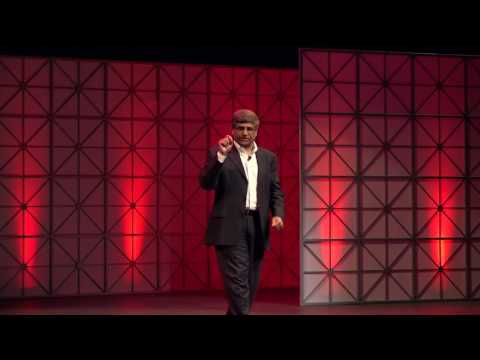
good evening to all of you my name is
Seto Rahman punch Anathem and I promise
that will be the most difficult thing
that you will hear this evening so
that’s why people call me punch I am the
chief research and innovation officer
Arizona State University and the
executive vice president what I want to
do in keeping with the spirit of TEDx is
talk to you about a story of a student
so this students name is David Haden so
one day David walks into my office and
he says punch I have a problem my
problem is that I am visually impaired
and legally blind I am a double major in
math and computer science and I am in
the freshman year getting into the
sophomore year what I’m finding really
hard is when I go to my math and
computer science lectures specifically
when things go from step one to step two
to step n I don’t have any access to
that information on the board even if I
sit in the very first row in the class
and he said can you help me I said David
how about this instead of me helping you
you have the innovative mindset you have
identified a problem which is a
challenge for you you might want to come
and work in my lab with other graduate
students undergraduate students like you
and even high school students I said who
better understands the impediment that
you face then you David
so David took me up on that suggestion
and join a lab and now he is in the
sophomore year so the first thing that
he did was took a tablet PC connected it
through a USB interface to a pan tilt
zoom camera of the Shelf camera and the
lecture that was not accessible to him
he was now able to get the lecture piped
in through the camera into his
tablet PC he was able to control the
features of pan tilt and zoom and he did
something even more clever he split his
tablet PC into two halves the screen on
the left half was this video of the
lecture piping in on the right half of
the screen
he developed a notes interface he then
started linking the course notes to the
video and the captured images and he
formed his fantastic lecture notes that
is sighted counterparts at the end of
the lecture would come and tell him
David will you please share your course
notes with us you have much richer
course notes than any one of us now he
perfected this he took it to his class
all the classes and subsequently gave it
to other visually impaired students so
they can give him suggestions in terms
of improving this device and build this
fantastic device now if you look at a
time for innovation that time is now you
take any grand challenge of the society
improving the health providing energy
sources or even providing jobs for
people which is something that has
become very you know very much in the
forefront these days whatever that might
be these challenges require us to see
how we might bring out our innovative
thinking to be able to solve these grand
challenges therefore higher education
institutions have a responsibility to
solve these challenges and it turns out
that many higher education institutions
are taking up these challenges and
increasingly solving them as you know in
higher education institutions we have
faculty students staff researchers in
partnership with people inside the
university and outside the university
trying to address some of these grand
challenges
so therefore the responsibility of the
higher education institutions are to be
to provide an environment that empowers
people to exercise their creativity and
their innovative spirit that is the
responsibility of higher education
institutions what do I mean if you take
faculty for example faculty are
inherently innovators they have the
innovative spirit which they express in
so many ways every day of their faculty
life that’s what gets them going so how
do you then provide an environment for
faculty to then express this innovative
spirit and be recognized be rewarded be
invested in these are things that higher
education institutions need to do in
order to bring out the creative element
out of the faculty at scale the other
thing is when you want to solve Grand
Challenges that stick water for example
water is not just a science problem or
an engineering problem or a legal
problem or an ethical problem or a
cultural problem or social problem or a
behavioral problem or a business problem
it is all of the above and more so which
means that higher education institutions
should inherently provide an environment
that allows people to work in teams this
is something that’s not often done you
need to break down barriers and silos
you need invest in people working
together solving Grand Challenges you
need to recognize them you need to
reward them all of these are very
important things to do and more
importantly if you want innovation
proliferating the campus what you need
is not only celebrating success which we
all do very well but celebrating
failures to honoring failures because if
you want innovation chances are that you
will try you will fail and then you will
try you will fail and then you will try
and you will succeed for possibly so
generating an environment that allow
people to fail and fail fast which is
what typically entrepreneurial
environments provide is something that
universities increasingly need to do
higher education institutions same thing
is to students students have this
inherent ability to be innovative and
they have this can-do spirit again
create an environment they look to
faculty as role models how might you
then provide them that ecosystem that
allows them to express their creativity
let us talk about David again go back to
the story one easy solution for David’s
problem would have been David there is a
device out there we can get it for you
one solution or David there is a
Disability Resource Center on campus if
you go there they will help you give you
a device or do something for the
environment for you instead of doing
that which would have curbed David’s
innovative ability in this situation
david was challenged to express his
innovative ability and that is what we
need to do in higher education
institutions provide the environment
challenge the students so that they can
express their innovativeness and they
look to faculty as role models that’s
what we need to do more and more of if
you want to create an innovative
ecosystem in higher educational
institutions and to solve these global
grand challenges when David came to see
me first I asked him David what is it
that you want to do with your life he
told me punch I want to be like you a
faculty member who can inspire many
students but the only difference is that
that I would perceive a liberal
impediment I am able to do it and that I
can demonstrate that any student with
any impediment can do whatever they wish
to do and be successful so that is David
now he’s finishing his PhD at MIT he
submitted when he was a student this
prototype that he built just two years
into the program in the lab to the
Microsoft Imagine Cup which is a
worldwide competition there were three
hundred thousand entries in this
competition under 11 categories one of
them are the touchin tab
category and David won the regional
competition the national competition and
the world competition an undergraduate
research student who apparently had an
impediment that you wanted help with and
here is what happened when you unleash
that potential the next year he
challenged himself invent again the
software design category challenge
themselves even more won the national
competition so this is what we need to
do for our students so David now is not
only finishing his ph.d but I spun out a
company to manufacture this device so
that it might help other students to be
successful and so they can take this and
build more upon this to create an
environment for success so therefore I
challenge all of you today every one of
you has got the innovative spirit within
you exercise that innovative spirit
within you take on a challenge whatever
the challenge might be that you are
passionate about solve the challenge and
give your innovative spirit a chance and
that means that you need to demand
innovation of yourself demand innovation
thank you [Applause]