
[Music]
I want you to think about a date in your
lifetime an important date in your story
something that after that date the world
wasn’t the same anymore and I don’t want
you to think about the day you were born
or the day you were married because
those are somewhat predictable what I’m
imagining is a date in which in the
morning you woke up it seemed to be an
ordinary day it was just going to be a
boring day but then something happened
that changed things forever and for me
that date was June 13th in 2013 and what
happened quite unexpectedly it was an
ordinary day and I came home a little
bit early and I turned on the television
news which I don’t do very often and for
some reason I i–listen and there was a
news story that the United Nations had
released a report talking about global
population two years before in 2011
global population hit seven billion
people and this new report was
projecting where we would be by the year
2050 projecting global population beyond
nine billion people and so what’s
interesting to me is why that wasn’t
noise why it suddenly became signal in
my life but what started as a very
simple thought this concept that by the
year 2050 the world would be different
and it would be bigger but the year 2050
that concept stuck with me and it stuck
with the news it was amazing even now
you see references many references to
the year 2050
perhaps the symmetry of it halfway
through the century oil companies food
companies governments are projecting to
the year 2050 but for me what made me
stop was the recognition that all of the
stories associated with the year 2050
were about pessimism and about fear
about how terrible the world would look
it was about division the stories were
interviews of environmentalists talking
that we needed to stop our behavior we
needed to reverse things and it was fear
and pessimism and division and that was
typical for the news but what paralyzed
me what stopped me in my tracks was the
recognition
that people that were children in 2013
would grow up to be middle-aged and
running the world by the year 2050 and
in fact my children at the time that
were in middle school would be my
current age they would be running the
world and by the year 2050 I would be
elderly and even more arthritic than I
am and the man on my left the
grandfather in this picture likely
wouldn’t be there I would reach a point
in my life of being reflective and
wondering had I done enough and the
question was all this negative news
stories the pessimism the fear the
division in thinking is this the way
that we should be educating the future
leaders of the world sometimes these
futuristic stories are focused on time
points that are so far off that we think
well that’s not going to be my problem
but the problem was that the kids would
be running the world responsible what
the world looked like were actually in
our schools and they were born it wasn’t
some far-off future state and we the
middle-aged crowd now would likely still
be around to bear witness to that and
that little thought became this idea
that grew in me and eventually developed
into a plan and actually took over what
became my life’s work in my profession
and why instead of just being noise it
became signaled for my life I still
don’t understand today so that’s one
reference point and it made me sort of
think about our education systems what
kind of messaging are we empowering our
youth with when it’s talking about
division and fear and pessimism and I
reflected back being an educator I
reflected back on our journeys as human
beings and in fact when we’re very young
kids are incredibly creative they find
cardboard boxes or in this case this kid
on a swing finds a sword and is
attacking you know this mystery villain
who’s a burlap sack just hanging next to
a tree so kids create their own
realities they’re full of creativity
such potential in the world and then
what happens we send them to school
and what happens in school as schools
have evolved instead of teaching kids to
sort of interact in a world where
science and humanities and languages and
play are all mixed together instead we
break up those things into 50-minute
sections of life and as they get older
and once they get into high school it’s
not that every child is actually taking
the same subjects in high school we
asked students to start making choices
about what courses they want to take and
if they go on to college or university
those choices become even more extreme
so you make one of these choices and the
challenge becomes that institutions of
Education sort of put up barriers to say
well if you’re in the program of you
know Electrical Engineering it’d be very
difficult be very difficult for you to
get a secondary degree in languages
you’d have to do more time it’s a
payment punitive in some ways but also
the other thing that we do is we take
the prospect that although at the end of
education we want students who graduate
who can think and tackle the world in
this complex environment we take the
attitude in education to say before you
can think we need to fill you with
knowledge so what’s happened as
education systems has evolved is that
knowledge and skills have become King
and thinking has been kicked out of the
castle despite that’s where education
started so those were the two things the
notion that our kids are be tackling the
world in our school systems and thinking
about how are we educating them in a
particularly in a world in which some of
the global challenges we face are so
interdisciplinary there’s cultural
components to climate change there’s
biological components to that there’s
all of these things we’re not educating
people in a way to be able to tackle
that and yet we hope when people
graduate having been trained in this way
they work together in government or in
our communities to make good decisions
to be comfortable in that kind of messy
world so as an educator Shane started to
kick in and many people have talked
about this the sort of the crisis in the
education system where information and
skills or knowledge and skills have
become King and we’ve taken creative
thinking and solution oriented and
dialogue
the curriculums and so when we’re tackle
complex problems like climate change
that are so complex things are so
connected that culture and science are
colliding and there’s a wonderful book
written by Mike Hill I’m a climate
change scientists based on the UK who
wrote a book called why we disagree
about climate change he’s a hardcore
scientist and what he realized in trying
to convince governments and people that
pay attention to climate change is that
our culture’s our beliefs get in the way
and so he wrote a book that really says
that climate change isn’t just about
nature it’s about bringing together of
of culture and nature so there are many
people that are writing about this
challenge and for me as an educator
though I wasn’t satisfied just to be you
know tolling and pointing out what the
problems were
it was bugging me so much I wanted to
try to find solutions related to that
and there’s this wonderful quote from a
philosopher Yeti Needleman is that life
shouldn’t just be about rubbing ideas
together people want to be able to grasp
onto a solution something they can do in
their own lives and this became a
motivator for me and so the question was
how could we rethink how we’re educating
and engaging students in a way to make
the story about the year 2050 a positive
one
instead of being one that was based on
fear and pessimism and division was that
too too naive a notion to even imagine
and so I conceived of the idea of
wanting to put my life’s work into a
different way of engaging students so
that we were nurturing the development
of critical thinking in creativity and
innovation oriented thinking and if that
meant having to step away from filling
them with knowledge and skills maybe we
needed to do that because this was so
fundamentally important and so the
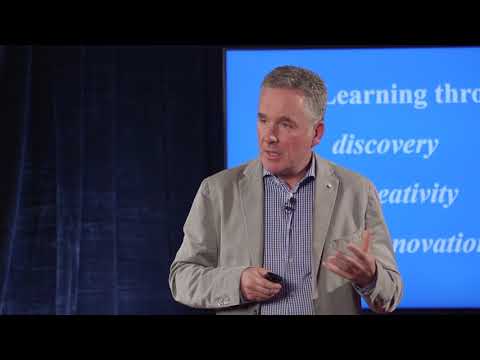
notion of using
the processes of discovery creativity
and innovation as being the backdrop for
learning the backbone of learning on
which we can tack skills and knowledge
but this is being fundamental and that’s
what’s driving my work and interest as
we go as we go forward
so in fact there’s a lot of literature
in the education space related to the
power of learning in this kind of way
the term experiential learning refers to
the learning that comes by actually
doing something instead of just sitting
in a classroom and hearing about it
actually trying something you know it’s
the notion they learn to swim throw you
into the into the pool first
so experiencial learning is is like that
but it’s not learning just by doing
something and potentially failing you’ve
got as an educator you’ve got a built in
time for reflection careful reflection
the learning comes from the reflection I
bumped my head and walking under a beam
why did I do that I reflect because
maybe I need to duck down to make that
happen but there’s a specialized
emerging field of experiential learning
that I like to call and is called in in
the literature authentic learning so
it’s experiential learning so it’s
learning by doing things but in a way
which involves real world with real
world players and so it’s the notion of
students being engaged in a project and
if there’s something related to work in
the poverty space that they’re working
with an NGO that’s working in the
poverty space and it’s authentic
learning just raises the stakes the
partner is very interested in the
learning that happens potentially as a
future employee or a partner in
promoting it in innovation and certainly
the stakes are raised for the student
but they’re highly engaged because this
is a real business real world and so the
test of that becomes how do we how do we
operationalize this and it’s that
backdrop that I developed this idea in
amongst this world a pessimism and fear
and division I imagined what if we
created a project initially for high
school students was my idea before we
start to pigeonhole them they call the
2050 project and that what the project
was really simple in thinking I’m not
involved in high school education so it
was easy for me to imagine this so the
idea was well if we want students to be
involved in critical thinking and
creativity let’s get them to imagine
what the world is going to look like in
the year 2050 so they’re gonna have to
go learn some history and some science
and some language arts related to that
and then they’re going to identify an
innovation and they’re gonna work in
that within a group because teamwork and
collaboration is a critical part of that
so
put a little bit of a constraint and
then what what about if we could bring
students together that are working in
different schools and ideally from
different parts of the country
perspectives of different parts of the
country so that was my idea and I
sheepishly went off and I thought
knocked in the front door of a
principal’s office a locally independent
school and he bit into the idea right
away and so what happened is we actually
titled piloted this last fall the 2050
project happening in four schools across
Canada one in New Brunswick Montreal one
in Ontario and one here locally and
groups of students working in different
ways and how the school fitted into
their curriculum or how it was
extracurricular it was different that
was part of the experiment too and then
the the carrot was that these students
were going to come together and present
their ideas and so they did that
in in made it mid-april had them for a
few days in Calgary and then took him up
to the Banff Centre no better place like
the Banff Centre your mind has opened up
with all these mountains and blue skies
around you and some magic happened and
so the magic happened when the students
actually early in the week they
presented their ideas a pitch like this
but the magic was this was never about
it being a competition so you pitch your
ideas there are lots of things out there
you pitch your idea and there’s a winner
and there’s some losers this was about
presenting your ideas early in the week
because in addition to the students that
were there we had people from the
business community artists there from
the communications industry that were
there some graduate students business
people that were there to listen to
these ideas and the initial
presentations were celebratory that was
awesome group from Montreal thinking
about urban design things local group
here focused on a food computer
celebratory congratulations but in the
students listening to each other’s
projects the wheels were turning maybe
it was professional jealousy or fear of
being embarrassed right and they
developed this appetite for continuing
to learn and so by what happened by the
end of the week these students were
going learning from each other
networking with the advisors the mentors
that we had in the crowd and they came
up with something incredibly special the
second project that was involved with is
actually at the universe
and it was the idea of creating a course
that was actually launched this past
January called global challenges and the
idea is I can bit naive only first-year
students but from any faculty and so we
had students from engineering political
science English literature
astrophysics even broad group of
students that came together and their
task was simple come up with an
innovation to address this global
challenge the global challenge of
feeding nine billion people by the year
2050 so day one we had them for a
workshop and then it was like okay go
come up with an innovation and you got
three and a half months to sort of
figure figure this out there was
structure that was built built into that
the vehicle for learning was inquiry
everybody came to this task with an
opinion about food food insecurity food
preferences were shaped by culture by
health or whatever everybody had an
opinion that was related to that we
could take advantage of that but they
had to understand what their
perspectives were they had to understand
each other’s perspectives in that and
work together in a team of collaboration
to make something happen
the real test as to whether they were
good at looking at different
perspectives came in mid-march where we
had an event called the feeding 9
billion people dinner
it wasn’t 9 billion people but it was
200 people about a third were students
and the other two-thirds were some
faculty and also people in the community
we have farmers we had chefs NGOs people
interested in food waste and the
students facilitated the discussions
there were 22 tables of conversations
that were happening and everyone walked
away from that event saying I learned
more in that one dinner than I did in
anything else that I did in school that
this year that’s a big lesson
why couldn’t we imagine if we had 20
dinners like that and students were
responsible for hosting 5 and attending
5 or 15 maybe that would constitute a
degree why not why are we stuck to this
notion that courses have to be semester
long and there are quizzes and term
papers if there’s a credible mental
learning that happens in an event like
this so this is where we’re going with
this idea what developed in these two
projects was incredible critical
thinking creativity
the kinds of skills we want to walk away
because we weren’t pushing knowledge we
weren’t pressing skills the students
were had a taste for that because they
knew they needed that in order to
develop their ideas so what was the
magic ingredient that made this happen
and there I think a few magic
ingredients and this work is going to
continue but here’s my initial
reflections on this the first is how you
define the theme and it really needs to
be a broad theme which is welcoming for
different kinds of perspectives that
make sure that you’ve got science
clashing with culture with engineering
with public policy altogether whether
within the context of one project or the
collective of projects and that’s what
happened the second is building
authentic experiences so the students
are interacting with businesspeople
cultural leaders people from different
religions people who are impoverished
and rely on food banks raising mistakes
in that way it makes an incredible
difference the third thing is the
development and consistent use of a
language which stresses the importance
of inquiry and backing up opinions on
the basis of information so it’s not
just empty claims that where we enter
into a Twitter war with but also
language that promotes collaboration the
the next thing that was absolutely key
and I talked about it in past was the
pitch is not the is not the final event
it comes near the end because there’s an
incredible amount of learning that
happens after that and that was
absolutely key to success and then the
final thing is the change in nature of
the work of the teachers the teachers
became mentors and guides for
information gathering and development of
innovations not pushing any information
so the final thing I want to leave you
with is change our education systems
it’s very challenging work it’s a
challenging way for students certainly
for teachers but imagine for
institutions to change the nature of
their practice and so it takes a lot of
work and courage to be able to do this
kind of work but remember if what we
want to instill in students is the
ability to critically think and to
collaborate and to be creative
kids before they went to school had all
those things so our job as educators is
to act like gardeners or farmers and to
cultivate those skills rather than
letting them wither away thank you very
much
[Applause]
I want you to think about a date in your
lifetime an important date in your story
something that after that date the world
wasn’t the same anymore and I don’t want
you to think about the day you were born
or the day you were married because
those are somewhat predictable what I’m
imagining is a date in which in the
morning you woke up it seemed to be an
ordinary day it was just going to be a
boring day but then something happened
that changed things forever and for me
that date was June 13th in 2013 and what
happened quite unexpectedly it was an
ordinary day and I came home a little
bit early and I turned on the television
news which I don’t do very often and for
some reason I i–listen and there was a
news story that the United Nations had
released a report talking about global
population two years before in 2011
global population hit seven billion
people and this new report was
projecting where we would be by the year
2050 projecting global population beyond
nine billion people and so what’s
interesting to me is why that wasn’t
noise why it suddenly became signal in
my life but what started as a very
simple thought this concept that by the
year 2050 the world would be different
and it would be bigger but the year 2050
that concept stuck with me and it stuck
with the news it was amazing even now
you see references many references to
the year 2050
perhaps the symmetry of it halfway
through the century oil companies food
companies governments are projecting to
the year 2050 but for me what made me
stop was the recognition that all of the
stories associated with the year 2050
were about pessimism and about fear
about how terrible the world would look
it was about division the stories were
interviews of environmentalists talking
that we needed to stop our behavior we
needed to reverse things and it was fear
and pessimism and division and that was
typical for the news but what paralyzed
me what stopped me in my tracks was the
recognition
that people that were children in 2013
would grow up to be middle-aged and
running the world by the year 2050 and
in fact my children at the time that
were in middle school would be my
current age they would be running the
world and by the year 2050 I would be
elderly and even more arthritic than I
am and the man on my left the
grandfather in this picture likely
wouldn’t be there I would reach a point
in my life of being reflective and
wondering had I done enough and the
question was all this negative news
stories the pessimism the fear the
division in thinking is this the way
that we should be educating the future
leaders of the world sometimes these
futuristic stories are focused on time
points that are so far off that we think
well that’s not going to be my problem
but the problem was that the kids would
be running the world responsible what
the world looked like were actually in
our schools and they were born it wasn’t
some far-off future state and we the
middle-aged crowd now would likely still
be around to bear witness to that and
that little thought became this idea
that grew in me and eventually developed
into a plan and actually took over what
became my life’s work in my profession
and why instead of just being noise it
became signaled for my life I still
don’t understand today so that’s one
reference point and it made me sort of
think about our education systems what
kind of messaging are we empowering our
youth with when it’s talking about
division and fear and pessimism and I
reflected back being an educator I
reflected back on our journeys as human
beings and in fact when we’re very young
kids are incredibly creative they find
cardboard boxes or in this case this kid
on a swing finds a sword and is
attacking you know this mystery villain
who’s a burlap sack just hanging next to
a tree so kids create their own
realities they’re full of creativity
such potential in the world and then
what happens we send them to school
and what happens in school as schools
have evolved instead of teaching kids to
sort of interact in a world where
science and humanities and languages and
play are all mixed together instead we
break up those things into 50-minute
sections of life and as they get older
and once they get into high school it’s
not that every child is actually taking
the same subjects in high school we
asked students to start making choices
about what courses they want to take and
if they go on to college or university
those choices become even more extreme
so you make one of these choices and the
challenge becomes that institutions of
Education sort of put up barriers to say
well if you’re in the program of you
know Electrical Engineering it’d be very
difficult be very difficult for you to
get a secondary degree in languages
you’d have to do more time it’s a
payment punitive in some ways but also
the other thing that we do is we take
the prospect that although at the end of
education we want students who graduate
who can think and tackle the world in
this complex environment we take the
attitude in education to say before you
can think we need to fill you with
knowledge so what’s happened as
education systems has evolved is that
knowledge and skills have become King
and thinking has been kicked out of the
castle despite that’s where education
started so those were the two things the
notion that our kids are be tackling the
world in our school systems and thinking
about how are we educating them in a
particularly in a world in which some of
the global challenges we face are so
interdisciplinary there’s cultural
components to climate change there’s
biological components to that there’s
all of these things we’re not educating
people in a way to be able to tackle
that and yet we hope when people
graduate having been trained in this way
they work together in government or in
our communities to make good decisions
to be comfortable in that kind of messy
world so as an educator Shane started to
kick in and many people have talked
about this the sort of the crisis in the
education system where information and
skills or knowledge and skills have
become King and we’ve taken creative
thinking and solution oriented and
dialogue
the curriculums and so when we’re tackle
complex problems like climate change
that are so complex things are so
connected that culture and science are
colliding and there’s a wonderful book
written by Mike Hill I’m a climate
change scientists based on the UK who
wrote a book called why we disagree
about climate change he’s a hardcore
scientist and what he realized in trying
to convince governments and people that
pay attention to climate change is that
our culture’s our beliefs get in the way
and so he wrote a book that really says
that climate change isn’t just about
nature it’s about bringing together of
of culture and nature so there are many
people that are writing about this
challenge and for me as an educator
though I wasn’t satisfied just to be you
know tolling and pointing out what the
problems were
it was bugging me so much I wanted to
try to find solutions related to that
and there’s this wonderful quote from a
philosopher Yeti Needleman is that life
shouldn’t just be about rubbing ideas
together people want to be able to grasp
onto a solution something they can do in
their own lives and this became a
motivator for me and so the question was
how could we rethink how we’re educating
and engaging students in a way to make
the story about the year 2050 a positive
one
instead of being one that was based on
fear and pessimism and division was that
too too naive a notion to even imagine
and so I conceived of the idea of
wanting to put my life’s work into a
different way of engaging students so
that we were nurturing the development
of critical thinking in creativity and
innovation oriented thinking and if that
meant having to step away from filling
them with knowledge and skills maybe we
needed to do that because this was so
fundamentally important and so the
notion of using
the processes of discovery creativity
and innovation as being the backdrop for
learning the backbone of learning on
which we can tack skills and knowledge
but this is being fundamental and that’s
what’s driving my work and interest as
we go as we go forward
so in fact there’s a lot of literature
in the education space related to the
power of learning in this kind of way
the term experiential learning refers to
the learning that comes by actually
doing something instead of just sitting
in a classroom and hearing about it
actually trying something you know it’s
the notion they learn to swim throw you
into the into the pool first
so experiencial learning is is like that
but it’s not learning just by doing
something and potentially failing you’ve
got as an educator you’ve got a built in
time for reflection careful reflection
the learning comes from the reflection I
bumped my head and walking under a beam
why did I do that I reflect because
maybe I need to duck down to make that
happen but there’s a specialized
emerging field of experiential learning
that I like to call and is called in in
the literature authentic learning so
it’s experiential learning so it’s
learning by doing things but in a way
which involves real world with real
world players and so it’s the notion of
students being engaged in a project and
if there’s something related to work in
the poverty space that they’re working
with an NGO that’s working in the
poverty space and it’s authentic
learning just raises the stakes the
partner is very interested in the
learning that happens potentially as a
future employee or a partner in
promoting it in innovation and certainly
the stakes are raised for the student
but they’re highly engaged because this
is a real business real world and so the
test of that becomes how do we how do we
operationalize this and it’s that
backdrop that I developed this idea in
amongst this world a pessimism and fear
and division I imagined what if we
created a project initially for high
school students was my idea before we
start to pigeonhole them they call the
2050 project and that what the project
was really simple in thinking I’m not
involved in high school education so it
was easy for me to imagine this so the
idea was well if we want students to be
involved in critical thinking and
creativity let’s get them to imagine
what the world is going to look like in
the year 2050 so they’re gonna have to
go learn some history and some science
and some language arts related to that
and then they’re going to identify an
innovation and they’re gonna work in
that within a group because teamwork and
collaboration is a critical part of that
so
put a little bit of a constraint and
then what what about if we could bring
students together that are working in
different schools and ideally from
different parts of the country
perspectives of different parts of the
country so that was my idea and I
sheepishly went off and I thought
knocked in the front door of a
principal’s office a locally independent
school and he bit into the idea right
away and so what happened is we actually
titled piloted this last fall the 2050
project happening in four schools across
Canada one in New Brunswick Montreal one
in Ontario and one here locally and
groups of students working in different
ways and how the school fitted into
their curriculum or how it was
extracurricular it was different that
was part of the experiment too and then
the the carrot was that these students
were going to come together and present
their ideas and so they did that
in in made it mid-april had them for a
few days in Calgary and then took him up
to the Banff Centre no better place like
the Banff Centre your mind has opened up
with all these mountains and blue skies
around you and some magic happened and
so the magic happened when the students
actually early in the week they
presented their ideas a pitch like this
but the magic was this was never about
it being a competition so you pitch your
ideas there are lots of things out there
you pitch your idea and there’s a winner
and there’s some losers this was about
presenting your ideas early in the week
because in addition to the students that
were there we had people from the
business community artists there from
the communications industry that were
there some graduate students business
people that were there to listen to
these ideas and the initial
presentations were celebratory that was
awesome group from Montreal thinking
about urban design things local group
here focused on a food computer
celebratory congratulations but in the
students listening to each other’s
projects the wheels were turning maybe
it was professional jealousy or fear of
being embarrassed right and they
developed this appetite for continuing
to learn and so by what happened by the
end of the week these students were
going learning from each other
networking with the advisors the mentors
that we had in the crowd and they came
up with something incredibly special the
second project that was involved with is
actually at the universe
and it was the idea of creating a course
that was actually launched this past
January called global challenges and the
idea is I can bit naive only first-year
students but from any faculty and so we
had students from engineering political
science English literature
astrophysics even broad group of
students that came together and their
task was simple come up with an
innovation to address this global
challenge the global challenge of
feeding nine billion people by the year
2050 so day one we had them for a
workshop and then it was like okay go
come up with an innovation and you got
three and a half months to sort of
figure figure this out there was
structure that was built built into that
the vehicle for learning was inquiry
everybody came to this task with an
opinion about food food insecurity food
preferences were shaped by culture by
health or whatever everybody had an
opinion that was related to that we
could take advantage of that but they
had to understand what their
perspectives were they had to understand
each other’s perspectives in that and
work together in a team of collaboration
to make something happen
the real test as to whether they were
good at looking at different
perspectives came in mid-march where we
had an event called the feeding 9
billion people dinner
it wasn’t 9 billion people but it was
200 people about a third were students
and the other two-thirds were some
faculty and also people in the community
we have farmers we had chefs NGOs people
interested in food waste and the
students facilitated the discussions
there were 22 tables of conversations
that were happening and everyone walked
away from that event saying I learned
more in that one dinner than I did in
anything else that I did in school that
this year that’s a big lesson
why couldn’t we imagine if we had 20
dinners like that and students were
responsible for hosting 5 and attending
5 or 15 maybe that would constitute a
degree why not why are we stuck to this
notion that courses have to be semester
long and there are quizzes and term
papers if there’s a credible mental
learning that happens in an event like
this so this is where we’re going with
this idea what developed in these two
projects was incredible critical
thinking creativity
the kinds of skills we want to walk away
because we weren’t pushing knowledge we
weren’t pressing skills the students
were had a taste for that because they
knew they needed that in order to
develop their ideas so what was the
magic ingredient that made this happen
and there I think a few magic
ingredients and this work is going to
continue but here’s my initial
reflections on this the first is how you
define the theme and it really needs to
be a broad theme which is welcoming for
different kinds of perspectives that
make sure that you’ve got science
clashing with culture with engineering
with public policy altogether whether
within the context of one project or the
collective of projects and that’s what
happened the second is building
authentic experiences so the students
are interacting with businesspeople
cultural leaders people from different
religions people who are impoverished
and rely on food banks raising mistakes
in that way it makes an incredible
difference the third thing is the
development and consistent use of a
language which stresses the importance
of inquiry and backing up opinions on
the basis of information so it’s not
just empty claims that where we enter
into a Twitter war with but also
language that promotes collaboration the
the next thing that was absolutely key
and I talked about it in past was the
pitch is not the is not the final event
it comes near the end because there’s an
incredible amount of learning that
happens after that and that was
absolutely key to success and then the
final thing is the change in nature of
the work of the teachers the teachers
became mentors and guides for
information gathering and development of
innovations not pushing any information
so the final thing I want to leave you
with is change our education systems
it’s very challenging work it’s a
challenging way for students certainly
for teachers but imagine for
institutions to change the nature of
their practice and so it takes a lot of
work and courage to be able to do this
kind of work but remember if what we
want to instill in students is the
ability to critically think and to
collaborate and to be creative
kids before they went to school had all
those things so our job as educators is
to act like gardeners or farmers and to
cultivate those skills rather than
letting them wither away thank you very
much
[Applause]
Please follow and like us: