
to speak thank you all for taking the
time out of this virtual Sunday to talk
about such a grim topic as the new
reality that we find ourselves facing
I’ve been doing a fair amount of poetry
in recent years because they were a
little book on Barack Obama that led to
a fair number of op-eds and Ira not be
headed for the Washington Post after the
trunk inauguration I was astonished at
how many hundreds of responses there
were two that bull Abed and now i know
from buyer that most of them were
probably not persons not responding i
wouldn’t comfortable level of
intelligence that was to show what i
would like to do today actually those
not to talk so much about our current
going to go a little bit to talk about
the president but to try to place it in
a longer historical context i should say
first place I didn’t know this
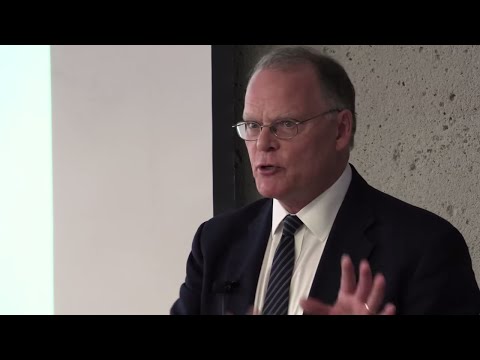
photograph was in the public domain when
the Obama book gave out the photographer
took a whole bunch of photos of me this
was one of my least favorites but I
guess maybe I’m looking toward democracy
they’re not a moment when they look
right now this book our democracy is a
900-page monster obviously I’m not gonna
be able to go through much of it but I
want to give you the bare bones of the
argument about what I think a democracy
requires it’s a book that starts in the
ancient world and carries forward into
the 20th century and drawing from that
the principles that a fully realized
democracy would show you get an outline
of where I think the United States has
been heading ever since the 1760s and I
then you get a sense of the reasons why
we have reason to worry that we’re now
moving away from democracy rather than
toward democracy so those
characteristics of a democracy are of
three kinds institutions principles and
what I think requires a little bit of
attention because it is too seldom
recognized as part of democracy the
underlying cultural predispositions are
the pillars on which democracy rests the
institutions are familiar to all
constitutional government with rule of
law elected officials free and fair
elections and just mentioning those few
characteristics those institutions
suggest to us good thrust of don’t Trump
of this candidate and as president it
was clear during the debates that he was
a man who did not understand the
Constitution perhaps had never read the
Constitution what I like to say in
advance of his election was he may not
understand the Constitution but the
Constitution understands him and the
independent judiciary the guarantees
that are provided by the separation of
powers in government all suggest that
even though he said he would only
respect the results of the election if
he won the Constitution actually ensures
that government official
are required to obey the law whether
they would like to or not the principles
are ideals toward which democracy points
I think are fairly familiar to us
popular sovereignty the idea that all
authority is vested in the people and
derives from the people the idea of
autonomy which I prefer to the idea of
Liberty because it’s not free to do
whatever the hell you feel like doing
it’s the freedom to obey the law freedom
to internalize the restraints that are
necessary in any government of laws and
finally equality of the United States
has grown very long road from the world
of white male supremacy to more
inclusive ideal and what we’ve seen
already in the first two weeks of the
trump presidency is that he would like
to see us move back in the direction of
a different kind of understanding of
equality that some people are more
people than others the underlying
predispositions that I think that
democracy requires are deliberating that
you reach conclusions as a result of
consider in different points of view
rather than simply declaring what the
truth is in an authoritarian manner
pluralism the understanding that
difference is not something to be
shunned but as Jason just said something
to be welcomed and finally what I call
the ethic of reciprocity which is not
only the willingness to accept the
consequences of an election even if your
worst enemy is elected but it’s a
willingness to see things from the other
person’s point of view and understand
that a democracy only functions is
people who disagree with each other are
able to come together and find a shared
resolution of their problems part what
is fascinating and troubling about the
election velcro to the presidency is the
extent to which he is mentally the
polar opposite of Barack Obama and park
was fascinating to me and the reason I
wrote the little book called reading
Obama was that he struck me as the first
president elected to the United States
who was actually a product of a
revolution in American history from
World War two until his election not
only was he the product of an African
father and white us-born mother who grew
up in Indonesia and Hawaii who went to
college in California and in New York
then law school here and became a
senator from Illinois not only did he
embodied all those different cultures he
was also educated at a time and in a
place where he was exposed to
revolutionary new ideas about how we
know this was a period when the American
Academy as all of you know was moving
away from a confidence that there is a
foundational unchanging universal truth
that lies beneath human knowledge and
moving instead to the realization that
all truths are partial they’re all
respectable they’re all historical and
they’re all particular two cultures he’s
the son of a social anthropologist so
the ideas of a cultural anthropologist
like Clifford Gertz are second nature to
Barack Obama he’s from two very
different families he’s lived in very
different parts of the world so the
notion of human difference differences
of religion
differences of culture our differences
he simply took for granted growing up he
also is educated here at the harvard law
school at a time when the law school is
written by confluence of all sorts
critical race theory feminist the
jurisprudence law economics critical
legal status the notion that there is an
unchanged meaning to the united states
constitution is an idea that is foreign
to everyone why like it encounters at
the harvard law school that’s foreign to
his way of thinking about the law he
describes the law as a nation arguing
with its conscience to think is a
wonderful phrase and it suggests his
understanding that our interpretations
of the united states constitution have
changed over time as our nation has
changed over time but for all those
reasons obama was a terrible threat to
Americans who believe that there are
unchanging principles that America is a
nation of white Christian Protestants
who do what the males in the family say
they should do so he embodied precisely
the challenges that so many Americans
found threatening and the fact that our
current president entered political life
with the birther controversy conjuring
up a controversy where none existed by
challenging legitimacy of this very
strange and foreign figure to be not
just
the United States Presidents but given
the United States citizen part what
fascinated me about Obama is not only
his first book which is a wonderful man
Warren if you’ve not read read and I
reckon recommended to you with
enthusiasm but his second book The
Audacity of Hope which includes a kind
of history of the United States as Obama
understands although he realized that
there were certain moments when
compromise was not possible the end of
slavery is perhaps the classic example
of that most of the time America has
made progress by finding ways to bring
together people who thought they had
nothing in common so he first enters the
national stage at the democratic
national convention in 2004 with that
memorable speech in which he says there
is no red America and blue America
there’s a United States of America and
his entire presidency was premise on the
possibility that these very Greek
Divine’s couldn’t bridge and that
Americans could be brought together
little did he know that he would be
elected at a time when the Republican
Congress declared that they would do no
business with him and that they would
find no compromises by if they were
proposed by him and his party what I’d
like to do for the rest of the time
today is trying to set this moment
Obama’s moments and Trump’s moments in a
loaner historical framework by talking
about four moments in American history
from the 1760s up to our own day I think
they suggest that there has been a kind
of dynamic movement back and forth
between moments when compromises
impossible and moments when it vanished
so the first of these moments would be
from the 1760s roughly to the 1830s the
superior founding when ideas from
religion from ethics from political
theory come together when you have civic
Republican ideas of the common good you
have notions of personal responsibility
and you have notions of ruts that Jason
mentioned all coming together in these
founding documents this is a moment that
endures to the 1830s and its caption
correction it’s classic form in Alexis
Couture feels democracy in america and
the argues that was distinctive about
american democracy is that individuals
learned what he calls dead tonight p.m.
on told you self-interest properly
understood by which he meant that your
own interest is not necessarily just
your personal interest Yuri under your
interest is caught up with the interest
of your culture and so people learn that
he argued by for spitting in barn
raisings but for spinning in town
meetings by being insurance we’re in a
jury you have to figure out what
everybody else thinks and come to a
shared understanding that sensibility
Tocqueville argued was what was
distinctive about American democracy and
what made it work able to hear her
Hamilton or seen Hamilton okay there are
lots of things that I don’t like about
that what music is slime but the
portrait of Washington at the moment
when he’s instructing Hamilton
right the address he’s going to say
farewell to the nation is actually very
good because it captures Washington’s
selflessness and it captures his
non-partisanship that was part of what
all the people in that generation prized
the thought partisanship was poison for
a democracy people had to see themselves
as part of a shared project it also
captures Washington’s sense that the
important thing to the United States do
globally was to maintain its neutrality
to remain open to other forces in the
world and that’s not a position that
endured through the 19th century the
second moment I want to talk about toes
into prominence with the election of
Andrew Jackson to the presidency Jackson
is a Indian fighting slave-owning
misogynist who not surprisingly has been
taken as a model by our current
president who has placed a statute of
Andruw Jones the Jackson and murder of
Andrew Jackson in the Oval Office to
remind himself how being a man of the
people can elevate him to a kind of
heroism this is the moment when
laissez-faire economics comes into
prominence in the United States when the
main chance the scramble for wealth
replaces that notion of selfless
devotion to the common good and
inaugurates a kind of dog eat dog
struggle in which my success is promised
on your failure rather than her share
success this is a woman who immigrants
pour into the United States but it’s
also a moment when enormous opposition
to immigration emergence and when the
first restrictions on immigration are
put in place this moment is in some ways
encapsulated best in a little book by
first sociologists in America man named
William grand sight of the title
was what do the classic what social
classes go to each other and they answer
Sumner offers is none this is a
Darwinian notion of struggle only the
fittest will survive and that
underwrites the scientific racism that
becomes so crucial in the decades
following the Civil War so this is a
period in which there is basically very
little government regulation of the sort
that Byron mentioned as a possibility in
our own day all overseeing and roll back
this comes under attack and is in a
certain sense repudiated by a new form
of liberalism or social democracy that
emerges in 1890s in the first decade of
the 20th century and transforms America
until the 1970s this is the democracy of
the Progressive Era and the New Deal in
free government regulation of the
economy it expands the inclusive
principle of America to include women
and through the civil rights movement to
include african-americans as well it’s
encapsulated best in franklin roosevelt
state of the union address in 1944 in
which he promised americans after world
war two a rain of social welfare
programs as generous as anything that
has been put in place in Europe after
World War two but in the United States
those benefits go only to geoff’s and
they are repudiated by the Congress
precisely because they would also have
been extended to people of color if they
were universe
and no southern congressmen were willing
to accept that possibility this
progressive or social democratic
dispensation leads to a shrinking of the
gap between the poorest of the
wealthiest Americans which continues
from the depression all the way through
to the middle of the 1970s but sometime
in the late 1970s over the 1980s we have
a repudiation of that era of American
politics and its replacement by the
arrow Ronald Reagan in which we live now
return to less a fair politics return to
notions of unchanging truths
foundational truths and original
understanding of the Constitution and
since the emergence of this sensibility
there’s been a bifurcation in American
politics on the one hand we had a return
to less a fair and a celebration of
free-market capitalism Reagan famously
said that government is not the solution
government is the problem the solution
as far as he was concerned and the
people who followed him was the free
market and so the celebration of
individual initiative and the
denigration of the possibility that
government can be a force for good the
end of Soviet Union and the end of the
Cold War brought an orgy of
self-congratulation in the United States
over the glories of untraveled
capitalism and a celebration of what we
now know as globalism now some people
have done very well as a result of that
globalism but most Americans for the
first time in united states history have
seen their income statement has been
almost no change in the
most Americans since the mid-1970s
exception are those ten percent at the
top salaries and have skyrocket so
on one hand the celebration of less a
fair the celebration of free-market
capitalism on the other hand we have the
rights revolution coming out of the
1960s affirmative action 400 represented
minorities reproductive rights for women
the notion that America should be in the
inclusive welcoming community with a
multitude of cultures represented in it
the LP g TQ resolution is a revolution
that along with formative action a
reproductive rights is a kind of symbol
to American conservatives of what has
gone wrong in the United States since
the 1960s and so what the election of
Donald Trump represents I think is a
kind of recognition of this bifurcation
in the policy politics between one hand
what’s called neoliberalism the return
to less a fair on the other hand the
rights revolution of the left and what
both of those accomplish is to feed the
resentment of white middle and lower
middle class Americans who feel that
both the return to globalist
neoliberalism on the one hand and the
rights revolution on the other have
robbed them of their nation now this is
a long-standing cultural
the roots of which go all the way back
to the 19th century and the first mass
emigration of people unlike these white
Protestant Christian Americans but
what’s added to is the economic
grievances that have come from the
genuine transformation of the economy
such that some people have been doing
tremendously well whereas they have been
doing not much better at all so that
combination of economic grievances and
cultural resentments has made a kind of
souring or poisoning of the American
political system and has ended us in the
position where we find ourselves am were
abandoned many of us considered as
utterly unqualified as practically
anyone in the United States could be
chosen as president of the nation
they’ll leave it at that point and open
the floor for questions [Applause]