
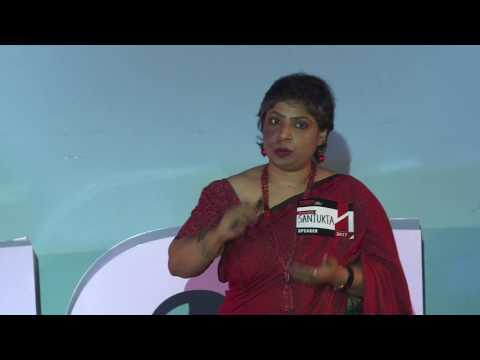
good evening everyone I have come here
today to talk about nationalism and
women we’re talking about bridges and
not boundaries and in that context
nationalism becomes a very important
topic to talk about before I start with
my identity so Who am I I am 40 year old
single woman born to a Bengali parent I
was born in Jalpaiguri West Bengal grew
up in Delhi
I mostly talk think in English but I
also studied Bengali literature I wrote
plenty of poetry and love letters to my
childhood crushes in Bengali and then I
grew up and I thought that oh you know
romance in pink Ali’s a stocky now I
have to do in English and and you know
like as a child in our childhood
children I don’t remember ever having
spent a Christmas without cutting a
Christmas cake we never spent a Eve
without having the biryani the mutton
biryani we would always have these John
much too many decorations we will have
the raviolis on petitioner shock we will
celebrate awards birth you know we will
sing Rabindra Sangeet and then we’ll be
glued to the TV to watch the award
seasons Grammys and you know Oscars so
what I’m trying to say is that I had
this very multilingual and multicultural
childhood and I believe that as a lot of
you also has also had and I believe that
it was only possible because I grew up
in a country like India imagine growing
up in a in a country which had only one
language to speak or only one religion
or only one particular culture to follow
so so that’s my identity and it is
precisely because of this this colorful
identity that I would want to be born
over and over again as an Indian
and I love my country and yet I stand
here today to speak to you to share with
you why as a self-respecting
independent woman I would never say
Bharat Mata ki jai why I find that
hugely problematic so as you see the
just to recap gender these are the
things that forms our identity and these
are also the the aspects that builds our
nationality we we have we have the
country as a nation we have language
nation we have religion nation and we
have caste nation we have many nation
within the umbrella nation so let’s talk
about nationalism everybody is you know
suddenly the whole world is is into the
Danish analysts sentiment across the
globe the British nationalism is so
inward and so narrow that they don’t
even want to be part of the Europe
anymore so and then then America is
talking about making America great again
but one really wants to wonder which
America is going to be made great by who
because you know they are saying we
don’t want the outsiders whereas mr.
Columbus was the first greatest invader
like he came from outside and was lost
at sea and then the Native Americans
discovered him that hey some guys here
in our country and then that became and
you know and we go say that this is
America
so one really needs to you know wonder
what is what does this laugh who does
the land belong to legitimately and who
is an outsider it’s a very tricky
question to answer and it is on this
notion that the whole concept of
nationalism is built the it is built
upon inclusivity and exclusivity like
this piece of land belongs to me and
everybody else is an outsider this is
the basic or basis of nationalism but
it’s very difficult to answer like if we
look at in an example the Vedic
civilization is what we were then Indian
nationalists consider as original
legitimate people and everybody who was
born in this part of the Indus Valley of
realization has been a Hindu was a Hindu
will always be a Hindu they have been
forcefully converted blah blah but they
were all so this is the narrative that
we have for ourselves but the question
is human civilization is like so many
years old why do we only go back 5,000
why not go to go all the way back to the
dinosaurs you know so it’s the question
is like where do we begin how do we
decide that this is where my story
started and this is where the story of
our land or the who who does the land
belong to start so so that’s how the
birth of nation is now let’s let’s talk
about who is this bharat mata that what
is bharat mata ki jai when we have this
thing so much in the public discourse
these days that we have to say Bharat
Mata ki jai what are we doing we are
expressing our patriotism our
nationalism so who is this bharat mata
in front of everybody in front of whom
everybody is supposed to bow down and
show respect think of the image of the
Bharat Mata if you have ever googled one
this is the most commonly found image
this is the picture on the right side is
by open Internet Tagore which kind of is
the original image of Bharat Mata and
then more people have you known as that
image but the most common image is of
this this fair looking fair-skinned
domesticated woman wearing a lot of gold
and she looks like a homely woman with
looks like goddess one of the Hindu
goddesses with the line and this is the
most common image as you can see it’s a
very narrow representation of the
identity so what happens when you when
you define the entire country’s identity
with just one human image you are making
it restrictive and making it restrictive
of all other kind of identities so why
can’t
Bharath matha be a jeans and t-shirt
wearing woman why does it have to be
fair skinned woman why does she need
we are so many goals she it seems she
belongs to a particular caste a
particular class a particular region
probably the northern region of India so
you know it becomes very restrictive so
that is that that begins there begins
the first problem with the image of
Bharat Mata coming to the strikingly
similar image of Britannia who
represents the great retail if you it
will be it will it strikingly odd that
the emails that of Bharat Mata which is
so close to us so patriotic so deeply
Vedic so Indian so partyer is strikingly
similar to something so you know to to
British representation she has the
Trident the threshold she has the lion
and she has the map of retain if you
google the image of Britannia you will
come across this image various versions
the other problem of women you know why
as a woman I have a problem with the
idea of Bharat Mata ki jai is because
women become the tool of exploitation of
in the hands of patriarchal nationalist
narratives how what is the role of women
in nationalism discourse this is the
role when when people say that Hindu
women should produce 10 babies so that
the national identity as I said before
the national identity is you know you
have the the identity has to be
reproduced and maintained for the nation
to stay relevant and it can only be done
when women will keep the woman’s womb
becomes the factory through which that
identity keeps producing and reproducing
not only that the woman’s sexuality has
to be controlled so that the purity of
the race is also controlled also
maintained and once again because
nationalism is a very European concept
you will see that the ideas of love
jihad is also very strike
similar to what mr. Hitler said in his
autobiography that the Jews men were you
know trying to persuade the the
pureblood German Aryan woman a German
woman and so so what happens is you
control women’s boom you tell her to
produce these many children her home is
not in her property it’s or the nation’s
property that’s where the nation’s
identities produce and reproduce
you control the woman’s sexuality so you
have used infantilizes the woman you
think that women cannot think for
ourselves so anybody if she’s falling in
love with somebody outside the community
it’s because somebody is you know miss
guiding her or whatever then comes the
other problem of representing the entire
country or the entire nation through a
woman’s body when her body becomes
coterminous with the map of India when
we when we when we when we look at the
objectification what happens is when we
when we look at a woman and only at her
certain body parts for sexual
gratification in let’s say in a item
number what we are doing is dehumanizing
the woman stripping her of her personal
identity and only looking at her as a
object of sexual pleasure similar thing
happens when we do it for the
gratification of patriotic feelings when
we represent a woman other country
through a woman’s body coterminous with
the map of India and you are gratifying
the patriotic and nationalist pleasure
because the woman again becomes the
representation and not a personal a
woman with her own personal identity and
desires
another problem with nationalism and
women is that nation is woman land the
piece of land is women it is something
to be acquired controlled or taken care
of but it is a it is not a human it is
it is a piece of land but the warrior
son or are the citizens so you will
always have these narrative where the
left the nation and the land is
described in feminine and that people H
caputre and all the citizens of the
country are the main so basically you
know women are not full citizens only
the men are full citizens women are
something to be exploited in the
nationalist discourse lastly this all
these things that Bharat Mata ki jai or
stand up for the national anthem or you
know these are rituals like we have cow
worship or we have yoga or we have Surya
Namaskar now these are rituals that we
have to continuously inculcate people’s
mind weights so that the national
identity that we have chosen for our
country which is not only near narrow
but also anti-constitution because in
our constitution doesn’t doesn’t
anywhere say we have a particular
religion to go for to follow as part of
our nationalist discourse but when we
restrict our identity to these rituals
what we do is not only is identity
constitutional where and also
restrictive but we are doing a
performance it is not natural
nationalism land is natural country the
political borders are sometimes by war
or other means
acquired becomes kind of natural but the
idea of nationalism is a is a perform
it’s something that you have to practice
with rituals and over and over again and
why as women time is now firm that women
more than anybody else have to stand up
against this narrative where so much of
violence and so much of divisive so much
in so much of walk talk of building
walls and not letting people come in we
will have stricter visa rules we will
not let other people come into our
country is going on women have to more
than more than anybody else stand up
against this narrative because women
it’s happening in the name of women in
the name of so-called Bharat Mata who is
not representative of everybody that
forms the part of the of the of the
country so you know the woman’s March in
Washington after the after the America
president was came into power was one of
the greatest the Civic civil movement
since the time of 1960s and 70s Vietnam
War and there were 5 million people
worldwide that came together and it was
a feminine force it was it happened
because women came with their rights
with human rights with black people
right with LGBT people rights with you
know with Disability Rights women came
forward representing the rights of every
kind of marginalized communities and
they say that you do not build walls in
the name of women in India we do not
build walls in the name of Bharat Mata
and that’s why just to you know close I
think it’s very very important that
every woman questions this this
narrative that we are being constantly
used our embodied our gendered bodies
are being constantly used in the
nationalist discourse to divide and you
know build more and more walls in our
community thank you very much [Applause]