
India after my training in cardiac
surgery that was 44 years ago I had a
very interesting and distressing
experience this was in a large Hospital
in Delhi suffers in hospital some of you
may know that we used to see lot of
patients with heart disease young people
in their 20s and 30s with valvular heart
disease this is a result of a rheumatic
fever very common in India even today
but the problem for me was these
patients were so much in disability from
shortness of breath they desperately
needed valve replacement because valve
is beyond repair so we had to replace
the valve for which I had been trained
but the tool to do this that was not
available the val was not available all
these had to be imported at prohibitive
costs and these patients couldn’t afford
hospital couldn’t supply this free so
here was a problem which I had not
encountered all my training was in the
United States there was I had never
faced this problem now all that we could
do was give them prescriptions you go
two swords charities and get funds prime
minister’s relief fund this was the
worst thing a surgeon could do when you
know the job you are denied the tools so
then was long the idea that why Cannot
we make this valve here this sounded
simple in theory many people agreed but
I could find little support for this
except long discussions on this how to
make it who could collaborate it went on
but there was no progress in this at all
but finally we decided the this kind of
theoretical discussion is gone going to
take us anywhere nothing happened
throughout my period in safdarjung
hospital except discussions a serious
beginning was made several years later
in a small in infant size institution in
trivandrum with just three people that
was later but despite all these we had
cast the die there was never any looking
back on this why you see if the hardware
development is so difficult so many
people were hesitant that is because the
heart wells are really one way check
valves they permit flow only in one
direction hardwell’s do the same there
are two in flow valves which permit flow
only in words there are two outflow
valves which only permit flow outputs
it’s very simple engineering has been
using one-way check valves for many many
years but what is special about the
heart valve is the environment in which
these valves function these valves are
located within the heart they are
constantly being based by blood
throughout the cardiac cycle now during
this these valve movements should not
damage the delicate elements of blood
that is one requirement secondly blood
this highly corrosive that should not
damage the value itself these are the
two conditions in the second the valve
must open and close or respond to tiny
changes in pressure within the cardiac
chambers instantly it should respond and
thirdly they have to open and close
100,000 times a day which means 36
billion times a year now in the
international standards organization
they set up the standards for making
half valves they stipulate that a valve
must have assured durability for ten
years before we can put it in a patient
now which means this we have to
demonstrate that 360 million times this
has to open and close by accelerated
testing without a mechanical failure so
you can imagine how tough this standard
sorry no wonder baxter museum that’s a
company making hot wells in the united
states they have a museum and there you
will find hundreds of models most of
them are examples of failed models those
which survived it and brought new life
to patients it’s a very tiny number
so we had a small group a surgeon an
engineer and directed a resurgent these
were the three people who finally got
together and decided to make this valve
and we had the first criterion was the
valve made in India must comply fully
with the international standards that
was one but the second criterion which
you do not find in Western institutions
that this must be affordable to the
low-income group patients not only in
India anywhere in india anywhere in the
world so the affordability was just as
important as the quality now this is how
we started the valve development program
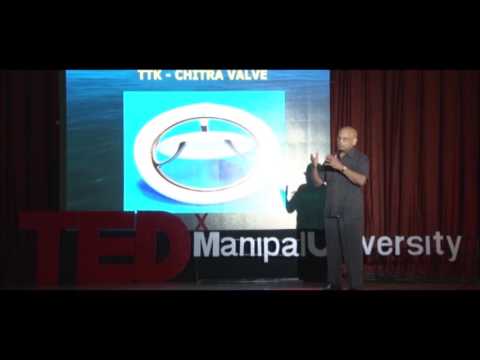
and you can see here this is a
successful model which was developed and
extensively used but the first we had
three failures during a period of seven
and a half years of development there
are three components in this valve
outside you see a sewing ring the
surgeon puts his stitches through that
then that metallic frame of the valve or
called housing and within which there is
a disc now this disc opens the closest
that is the occluder now anything could
go wrong in this the cage for example
there could be the welding that could
fail or there could be excessive erosion
of the metal or the fracture of the disc
many many complications could arise
during this stage of development because
the stages of development it goes
through the choice of materials choice
of a design fabrication function will
test durability tests animal tests it
goes on like this at any one stage you
could have a failure but if you have a
failure you have to analyze that failure
find out the cause of the failure
address that and make another model
minus that defect now this process
usually takes about a year and a half at
least in the Indian conditions so we
have three failures means we really
talking about 45 years of work that’s
what happens this was the force model I
won’t go into the failures except to
sale it is exacting and also a great
learning experience because some of
these failures in the international
literature
they never publish about their failures
they only talks about the success but
failures they are the biggest teachers
so here this is the force model which
was successful and it was implanted in a
patient for the first time on 6th of
December 1990 in a 35 year old teacher
who was severely disabled by ortak valve
disease this was the valve the model of
the valve which was used in him he went
back home worked full time as a teacher
retired now Lucy a retired life happily
in his hometown 26 years later this
valve has been used in the 100,000
patients up to date since a successful
valve throughout this process of
development of the valve two ideas Ted
is all about ideas to ideas used to come
to us again and again now developing a
life-saving device like this it is
really a game and in this game we are
the players but the adversary our
opponent is nature in the disguise of a
human body now the human body what is
the human body it is really a
compartment outside it is bounded by
skin inside it is bounded by mucous
membrane which starts at the mouth and
he said the rear end of the gut so
between this mucous membrane inside skin
outside there is a compartment this is a
mysterious dark component always in this
equilibrium with the external
environment only the dead body
equilibrates inside temperature is
different from outside language inside
pH is different from outside pH now this
is guarded that is the basis of life but
within this compartment any introduction
of an artificial material is fiercely
resisted by resisted by nature if you
put a piece of plastic it would degrade
if you put metal it will be corroded if
you put a foreign tissue it would be
rejected this is the fundamental how
nature gots this compartment but nature
it challenges us in developing
biomedical devices
challenges it vexes it makes things very
difficult for us ultimately begins to
commune with this after several years of
struggle and then the step society and
gives a little space for us to move
forward so it is not correct to say as
you know these implants have induced by
the millions bringing new life new
mobility to millions of patients so are
we can we really claim that we have
conquered nature in this battle that
would be very fallacious we haven’t
conquered nature because all these basic
processes protecting the integrity of
the body then thing has been changed but
nature has given as a little space to
move forward to bring relief to her own
children so this is an act of
beneficence it is a beneficence of
nature not conquest of nature this is an
important important idea because there
is a a tendency on the part of human
beings what is called heute spa our
arrogance there is no place for that
before nature because all these
biodegradation bio corrosion they all
exist again destroy everything a thing
has been changed you cannot reverse it
but we get a little space to move
forward so that sense of humility has to
be part of playing this game with nature
the second thing that we learned we had
before starting this valve when they
were in a small institution and
trivandrum we had attempted the
development of the Valor it allowed the
institutions put in a great deal of
effort with no success at all but
finally when we came to a small
institution with no furniture no
equipment those half there was something
in the air which told us that is a scent
of success there sooner a tailwind kick
from somewhere and things started
changing very rapidly the governance of
the institution changed overnight and
there was a sudden spurt of activity new
fund started coming whenever we did we
needed help in solving a particular
technical problem help began to pour in
from large technological positions like
ISRO all these began to happen and this
reminder sometimes he despite of
ourselves help would come this was our
experience and this is in some way it is
reminiscent of an airport where a we are
equation we’re very person is plodding
along and then suddenly he steps on a
moving walkway and he speeds towards his
gate it is he’s still walking but he’s
carried there in no time at all now this
happens in life and I am reminded of the
bards passage there is a tide in the
affairs of men taken at flood it leads
to success leads to flood and we are
convinced based on our experience in
this small experience spread over
several years at least 100,000 valves
implanted we are convinced that there is
a virtual law in human effects given a
fixed goal and untiring effort to get to
it every person is bound to have a bound
to be greeted by high tide I’ll stop there and thank you