
Translator: Maria Isabel Menendez-Leon
When I was 15 years old,
I used to make lists of things to be happy about
and hide them in public places for strangers to discover.
I hid them at restaurants and diners, in between salt and pepper shakers.
I hid them on people’s windshields.
And the last one I remember hiding at a snow-cone stand,
on a picnic table, in between two slots of wood;
and I imagined that somebody devouring a cherry snow cone,
with syrup just dripping down their face,
or maybe somebody down on their luck, who was getting a snow cone alone,
would look down, discover this note,
and be utterly delighted that somebody that they didn’t know
went out of their way to find a playful way to connect with them.
Now, these notes contained things like …
Actually, why don’t you just look underneath your seats?
(Laughter)
So, they contained things
like getting a handwritten letter in the mail from an old friend;
or how about finding five bucks in the back of an old book or a journal?
Or what about a double rainbow?
So intense, so beautiful.
This is one of the first memories I have of how I would go out of my way
to playfully connect with people I’d never met before.
Now, when I was in these teenage years,
[I watched] the way that people changed as they grew up.
So from childhood to adulthood,
I watched how adults just kind of stopped playing.
And from my vantage point,
it seemed like their well-being was suffering as a result.
It seemed like they were becoming less happy.
If we were to look at just one indicator of well-being, like stress,
we can see that it is in fact happening.
The American Psychological Association does an annual study
called “Stress in America,”
and this study has found that every year,
Americans are reporting that they are more and more stressed
and also that they are less capable of managing that stress.
Now, simultaneously,
play research,
the research done by Jack Pransky at Washington State University,
and he’s specifically studying the effects of play on children,
has found play is incredibly beneficial to our cognitive and social well-being.
Play helps to develop the prefrontal cortex,
which, in turn, helps to create more pro-social brains.
This research has also found
that play helps us get along better with people that are not like us,
and it helps us to become better problem solvers.
So, as I’m moving from childhood into adulthood,
watching how adults are not playing as much,
seem to be carrying a lot of the weight of the world without real relief,
and play seems to be very positive, I just decided to not stop playing.
I kept doing it.
So much that it led me to start a guerrilla performance collective
that brings these opportunities to play in public space,
in these really magical and unexpected ways.
Now, some people say, “Mallory, that’s just nonsense.”
And to that I say, “Yes, of course. It is nonsense.”
But, it’s important nonsense!
The point of play is there really is no point,
and how liberating is that!
In a world that’s product-obsessed, that’s end-oriented,
to be in a moment
and share an experience with the people around you is kind of a radical thing.
See, I think the power of play is that play has this incredible capacity
to disarm us, to tear down these barriers that we build up within ourselves
and the walls we build between each other,
and make those solid parts a little bit more liquid and permeable
so that we can really connect.
So, what am I talking about when I’m talking about play?
There’s a researcher named Peter Gray at Boston College,
who has helped to define what play means.
I’m going to use four of his points
to elucidate what I’m talking about when I’m talking about play,
and then also to share with you why I think it’s important.
First, Gray says that when we are in a state of play,
the means are more important than the ends.
This is a state of deep presence.
And when we are deeply present,
when the means are more important than the ends,
then that means there really isn’t a right or wrong way to play.
You just play.
You bring what you have into that moment, and you go from there.
And when it is the middle of January, and it is freezing cold outside,
and you’re riding the train without your pants,
you can be nothing but present.
I promise you.
You could be nothing but in that moment,
especially when the task at hand is to pretend as if it’s just a regular day.
So, you’re listening to your iPod, maybe you’re reading a magazine,
or you’re having a chat with the pants person next to you,
and you’re just acting like nothing is amiss.
A few years ago, I remember this gentleman who was shopping for groceries,
and he heard about the no-pants ride, quickly run and jumped on the train,
met us at our starting location, and then dropped down to his skivvies.
And he rode the entire way
with his grocery bags just swinging by his sides.
Now, if there is anyone in this audience that thinks
that they could be more in the moment than that man,
would you please stand up?
(Laughter)
OK.
Touché, ma’am, touché.
(Applause)
Didn’t think anyone could beat him.
So next, play.
When we’re playing, we’re in this highly imaginative state.
And when you are in an imaginative state,
the line between what’s real and surreal is blurred.
I would go so far to say
that the line between your mundane reality and the magical one dissolves.
Play dances in the middle there and it asks the question:
what is possible?
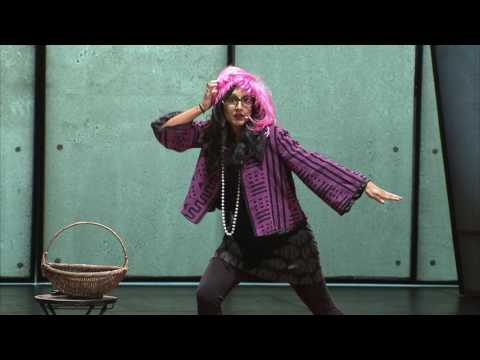
Round this time when I was 14, I used to go to the mall,
but not like most people went to the mall.
I would go and bring a bag of costume items with my friend,
and we would put on pearls,
we would put on weird glasses,
maybe a scarf if we had it, always a weird wig.
We would go into the front windows of a department store,
and we would become
mannequins.
(Laughter)
And people loved it.
They couldn’t tell if we were real, or we were fake, plastic, or human.
And, of course, always for good measure
we might break that fourth wall with a little wink.
Maybe, like any unprofessional mannequin,
if we had an itch, we would scratch it. (Laughter)
And we would do this as long as we could until, inevitably, we would get the boot.
I really don’t know what all the fuss was about
because it was essentially free marketing,
and honestly, I think it might have been
the beginning of guerrilla marketing as we know it,
started by two 14-year-olds in a Midwestern mall.
(Laughter)
So next, Gray helps us to understand play;
that third quality is a change in our mental or emotional state,
a change in our attitude.
The most important part of this element is the willingness to change,
that openness to the possibility of transformation.
Who here hates Valentine’s Day? February 14th.
A lot of people do.
It is why every year our collective makes handmade Valentine’s cards for strangers,
and we deliver them in public spaces.
One year, I remember we ran into a woman and we greeted her like we would anyone.
We were wearing fairy wings in pink and purple,
we gave her treats, we doused her with compliments,
we blew her kisses,
and at the end, we gave her this beautiful handmade and hilarious Valentine’s card.
Just for her.
And she started to sob.
She told us that she was having the hardest year of her life.
She’d just recently lost her job,
she was going through a really difficult divorce,
and her children were having a hard time with all of it.
But that running into strangers that she didn’t know,
who made a point on this day
when she thought she would feel the lowest of lows,
to go out of their way and find this playful way
to reach across that barrier and connect with her,
and remind her that there are hundreds of people
walking around her every day,
that are kind and that truly want to connect.
So, we all gathered around her and we gave her this big group hug.
And I remember thinking in that moment:
this is why we do what we do.
For those opportunities to break through the clutter,
through that mundane, rhythmic to-do list, through our fears and our doubts.
And remind people that we care about each other.
The last element of play is deep engagement,
direct participation.
You’re not sitting on the sidelines, you’re not watching,
you are actually involved in that moment.
And I can think of nothing else in my creative repertoire
that exemplifies this better than International Pillow Fight Day.
It is my favorite day of the year.
(Laughter)
Everyone gets dressed-up,
young and old, veteran pillow fighters, newbies.
Everyone’s got a pillow, battling it out.
Just like that.
But we do our Pillow Fight Day a little differently.
We invite in this imaginative quality that we love so much.
So, suddenly, you’re pillow fighting and then I might say:
Alright! Pillow fighting
(speaking slowly) slow ….
… motion.
Or pillow fight like you’re a ballerina.
(Laughter)
Few years ago, there were these two women that met at Pillow Fight Day,
and mere months later one officiated the other’s wedding.
They always attribute this rapid intimacy to their first of many pillow fights.
There’s also a mother who comes to Pillow Fight Day every year,
and last year she told me that this day is her favorite day of the year,
and it is the pinnacle of her parenting career.
(Laughter) She said this.
Because she loves to see her family so carefree and liberated,
and this is that moment when she can do that;
to see her husband and her children running around in costumes
unafraid of what people think,
and to see the community also participating and supportive.
It’s really a love battle more than a fight.
These are the qualities of play.
To be sure, you do not have to be this crazy, extroverted person
who runs around in underwear to be able to play.
That’s not really the point,
because play is not as much about the activity
as it is the state of being.
So it’s a way of engaging with the world.
Take, for example, if you’re at a meeting.
You can open up that meeting with a spirit of play,
maybe make it a creative icebreaker for people to leave their egos at the door
and engender that spirit of cooperation that really makes creative ideas thrive.
Or, if you’re more of a solitary person, you can play too.
If you are at a stoplight,
crank your music up and dance like nobody is watching.
Hint, they probably are, but that’s great, because dance and play are so contagious
that means you are going to inspire somebody nearby.
If it’s just a smile, or maybe they’ll start dancing too.
You see, I have found through play
that there’s so much more love in this world than we realize,
and there is far less fear.
But people just get stuck.
We get stuck in our routine, stuck in responsibility, in our worries.
And we need something to unstick us.
Play has that effervescent, catalytic quality that can do that.
It can do the unsticking.
It can tear down those walls and those barriers that we’ve put up.
And right now, more than ever,
we need to be tearing down walls, not building them.
We need to be reaching toward each other, rather than running away.
I think of play as an invitation
to embrace the unknown with a sense of joy.
Unknown or new places, ideas, people,
with a sense of joy and levity,
so that it’s not so scary, but it might actually be fun.
If play is an invitation, I invite you to come as you are:
young and old,
introverts, extroverts,
pink wig, blue wig,
cranky, happy.
All you need is a pillow.
(Applause)
Please follow and like us: