
Translator: Rhonda Jacobs Reviewer: Ellen Maloney
I’d like to ask you: How do we define wealth?
Is it money in the bank?
Material possessions?
The clothes we wear?
Perhaps it’s prestigious titles.
Maybe … freedom.
Maybe we determine wealth
by the number of shoes that we have in our closet.
And how about poverty?
So often we think only about the dollars in our pockets.
However that’s just one of the many variables
in the complexity of poverty.
I’d like you to meet Andrea, a girl I met in 2011.
Let’s just imagine for a moment what her life looks like.
She lives, together with her parents, four brothers and sisters,
and a family of chickens, in a small, 4 x 4 hut with a sand floor.
There’s no running water, no electricity.
Andrea owns one outfit that very seldom gets washed,
and she has no shoes.
But she’s a very happy young lady, very spunky and a little bit sassy.
Andrea lives on the island of Madagascar
where 95 percent of the local people are subsistence farmers,
meaning they only grow enough food to feed their families for the year.
They practice a type of agriculture called slash and burn,
where a portion of the forest is burnt down,
only so that they can plant crops,
mainly rice crops, as Malagasy people eat rice three times a day.
The island inhabits 23 million people with a three percent growth rate.
They often make less than a dollar a day, if they’re lucky enough to have a job,
and they also lack things like basic healthcare and hygiene,
with just 40 percent of all Malagasy students
staying in school past the fourth grade.
Due to this dependence and extreme poverty,
they depend on the forest for basic needs such as food, water and shelter.
However, on the other hand,
Madagascar is a place of incredible wealth,
a wealth of biodiversity.
It’s the world’s fourth largest island, located off the coast of Africa,
and known as a biodiversity hotspot.
That simply means the plants and animals found in Madagascar,
are not found anywhere else on Earth.
Eighty percent, or eight out of ten are found only there.
Now let’s give that some perspective.
Here in the United States, we have 50 states,
and within those 50 states,
we have approximately 80 different types, or different species of frogs.
If we compare that size to Madagascar,
the island is about comparable to one of our states,
the state of California.
And within that area, they have more than 800 different types,
or different species of frogs.
That’s 100 times greater just in frog biodiversity.
So if we think about the beginning of time,
before humans inhabited Madagascar just 2,000 years ago,
they had 100 percent forest.
And today, due to political instability,
that land degradation and extreme poverty, less than ten percent remains.
Less than ten percent.
Now we might think to ourselves, who cares?
Why should we care about what happens in Madagascar?
It’s clear on the other side of the world.
In fact, it’s a two day, 26-hour flight, just to reach the island.
Well, we should care, because what happens there
is felt right here in our own backyards.
These areas of high biodiversity
which make up just 11 percent of the earth’s land surface,
provide our entire planet with clean air, clean water,
and, in case you didn’t know,
more than 80 percent of all our medicines that we know about today,
come from these areas of high biodiversity.
Now let’s not forget about the lemurs.
These pre-monkeys, or prosimians,
are found only in the island of Madagascar.
There are currently 111 species of lemurs, ranging in size from a mouse lemur,
about the size of this clicker,
all the way up to the largest, the indri, which is the size of a kindergartner.
Now today, according to the IUCN red data list,
91 percent of all lemurs are threatened with extinction – 91 percent.
That makes lemurs the most threatened group of mammals on our planet,
which bring us to our first exploration of poverty and wealth –
the eastern rainforest of Kianjavato.
We originally journeyed here in 2010 in a fight to protect the wildlife
because of the greater bamboo lemur that you can see here.
It was once thought to be completely extinct,
but a small population was noted – it was rediscovered in the early ’70s –
and a small population was noted in Kianjavato.
Now sadly, because of that extreme poverty,
many of those lemurs were hunted, and a lot of the forest was cleared.
So when we arrived there, we really wanted to connect,
we saw that with two thirds of the Malagasy population
under the age of 20, there was a unique opportunity
to educate and influence the future generation of Malagasy leaders:
the children.
So we began connecting these children, their parents, their teachers,
government officials, to nature, and to the wildlife,
and they soon began to realize the tangible benefits
that the forest had for them.
They realized that lemurs are major seed dispersers.
They’re growing up that next generation of forest
that they use to stop erosion,
to clean their own air, clean their water, that they use on a daily basis
to build their homes, for fuel wood to cook and to plant medicinal plants.
We also had a chance to partner with the Omaha Zoo
and their award-winning reforestation program,
empowering local women and children to plant trees, to protect what they had,
and also increase what they had.
Today, we see success.
With multiple partners,
more than one million trees have been planted in the area.
Lemur hunting has decreased, education levels are on the rise,
and lemur populations are thriving in Kianjavato.
The wealth there is now measured in ownership.
These girls certainly aren’t going to want to burn down the forest
that they helped build.
Now I’d like to take you with me to the extreme south of the island.
It’s a three-day journey in the car,
past these incredible baobab trees,
and on a ferry across the Mozambique Channel,
to reach the dry, spiny forest in the small, remote village of Lavavolo.
Now when I first arrived in Lavavolo,
I thought for sure, this is the poorest region of the island.
However here, wealth is measured not by the money in your pocket,
but by the size of your zebu herd.
Now easily, the residents in Lavavolo could sell one cow
and send their child to school for an entire year,
or buy food.
However, the cattle are never eaten or sold,
they’re kept as a sign of wealth and prosperity,
and only consumed when an important member of the village tribe passes away,
as they find value in the afterlife, and build giant, elaborate tombs
that are decorated with the horns of the zebu.
Once again, we see the wealth of the biodiversity of the region.
Lavavolo is also home to the critically endangered radiated tortoises,
also on the brink of extinction.
That’s due to poaching from outside tribes
that are collecting the tortoises for meat.
They are often collected right before important holidays
like Easter and Christmas.
And also, poachers collect the tortoises
to sell in the illegal pet trade in the black market.
Again, we came to this community
in order to protect this endangered species,
and we really learned that conservation is all about community-based education.
By teaching these children the treasures their country possesses,
they will be more likely to protect them.
Let’s think again about poverty.
The kids in Lavavolo do not have access to basic education.
In fact, the closest school to them was 15 miles away, in the hot sand,
on foot, both ways.
Oftentimes we would see children
literally fighting to get into the classroom.
You can see this young boy here
climbing a tree to peer in on one of our conservation lessons at a nearby school.
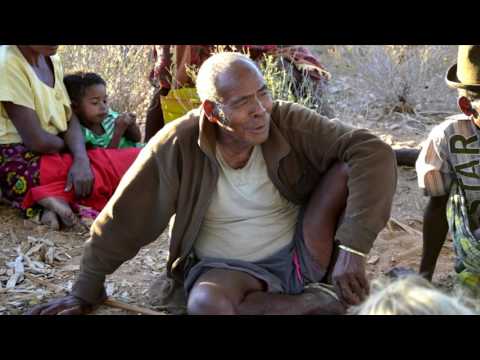
In 2011, I also had the pleasure of meeting this gentleman,
the Nauda, the village elder of Lavavolo.
And he shared with me that wisdom, leadership, empathy for your fellow man,
and a connection with nature can also equate wealth.
He shared with me that he had always felt that he was a very intelligent man
and had something to offer his country of Madagascar,
however, he never had the opportunity to do anything
because he simply could not read or write.
He shared with me that is was his dream
that his children and grandchildren be granted that opportunity.
In 2014, together with the local community,
we constructed the DREAM school.
Of course the school was built with money, with funding.
However, the richest part of this entire program
was the investment of the local community.
They gave of their sweat equity,
helping to carry sand for the foundation of the school,
painting the building and pitching in whenever they could.
With the DREAM school acting as a foundation
for conservation and education in the region,
we saw that our investment in that community was evident.
As these schoolchildren were able to help us to rescue
more than 600 radiated tortoises over a period of time,
because they alerted the local police, their teachers,
based upon a lesson that they learned in the DREAM school.
Now, the DREAM school also paved the way for global connections.
We don’t all have to purchase a ticket and fly halfway across the world
to be able to discover the wealth of our planet.
In fact, perhaps wealth comes to us in ways that money cannot buy,
in service to others.
Right here in Omaha,
hundreds of volunteers help to create these school uniforms,
made in the likeness of the radiated tortoises
in service for the children who attended the DREAM school.
And that gift of service was multiplied as the recipients,
those Malagasy children at the school,
were able to see that their peers thought they were so special,
and not only the treasures that they had in the tortoises,
but also the importance of education.
Now we have high truancy rates here in Omaha,
and I had an opportunity to work with a group of underprivileged students
right here in Omaha in a program that promoted education
and the importance of staying in school.
And when I was able to share with them the story of the children in Lavavolo
literally fighting each other to try to get a place in the classroom,
and yet we had to turn them away,
their definition of underprivileged shifted.
Together in service, we created these paper tortoises
that we hand out to the kids during our lesson,
the ones that walk from faraway villages, yet we still have to turn away.
And to us, it may look just like a little piece of paper,
but to them it’s something of true value
that they carry with them from year to year.
Now, our society often also adds wealth to our social status through selfies.
And in Lavavolo, maybe poverty is also the lack of something so simple
as access to basic healthcare and hygiene.
In fact, these children, and even the grownups in Lavavolo,
had never even seen soap before or hand-washing lessons in 2011.
Inspired by this, our UNO intern, Marin, saved her money for two years.
She could have easily bought herself the latest cellphone, even a new car,
but she chose to spend that money on a ticket to Madagascar
to hand out these hygiene kits to the children of Lavavolo.
She chose to invest in an experience in service to others.
The hygiene program continues today
with a hand-washing station at the DREAM school,
complete with mirrors.
For many of these children,
it’s the very first time that they have ever seen themselves.
Perhaps we can see what true wealth is when we reflect upon our own selves,
about the things that bring true value to our lives.
And let’s not forget about that spunky little Andrea
that we met at the very beginning, that sassy one.
Lavavolo is her village,
a place where education is often a luxury for the girls that live there.
The girls are the ones that fetch the water,
collect fuel wood for cooking,
and many of these girls are married off at a very, very young age.
Perhaps to them, poverty can mean a lack of freedom to choose,
a lack of choice.
So in the summer of 2015, together with the community,
we launched an empowerment club for these young girls.
And following our first meeting,
we decided that our club should have a name.
And so we asked the girls, and they came up with the name,
“The Girls with No Shoes Club.”
So perhaps that closet full of shoes
and all the material possessions that we crave,
are not really equating to true wealth.
Perhaps each of us can continue
to question our own definition of poverty and wealth.
Along my journey, I have come to find that the poorest people,
the ones with the least amount of money in their pockets,
have been the strongest, most resilient, most courageous people I have ever met.
As they must be as each day is a struggle for mere survival.
And as I look around me today,
I see an incredible amount of wealth right here –
a wealth of knowledge, inquisitiveness, inspiration,
an abundance of talent.
And along my journey, I have found that the more we give away,
the richer we become.
Thank you.
(Applause)
Please follow and like us: