
well you come to Brooklyn if you are
creative and no place in Brooklyn I
think is really more creative than Red
Hook my neighborhood we have to be more
isolated
we are the scruffy little hook-shaped
Peninsula in the middle of New York
Harbor without a subway 20 minutes by
kayak or bicycle to Wall Street my
neighbors all make things I make city
plans the day makes Wi-Fi networks
Dustin began with art now he has pioneer
works
Sinjin had a recipe for a cocktail now
he has Fort Defiance each one of these
people has found a place for their
talents in our neighborhood and their
talents have shaped our neighborhood our
neighborhood has character but don’t
confuse character with cute coffeeshops
character and a community like character
and people is revealed only when it is
tested and we were tested by Hurricane
sandy the biggest storm to hit New York
in its history I defied the evacuation
order to stay and watch maybe because it
I was chief urban designer at the time
and I had studied hurricanes and cities
and their interactions I wanted to see
it personally but I wasn’t prepared for
what I saw when you see your city under
water when you see everything devastated
you realize no matter how big how great
your city is the water is greater so I
learned a new word with hurricane sandy
resilience and I had to ask his Red Hook
resilient to find out I decided to study
resilience I wrote a book about it I
joined the faculty of the Stevens
Institute of Technology
we combine hydrodynamics urban design
complex computational modeling in order
to find out we made computer models of
cities and then we flooded them with
computer models of storms and we
developed an equation a graph to measure
resilience how much could your system
recover of its previous capacity in a
given amount of time
the more we studied this though the more
I felt that cities were in danger and
yet something didn’t seem right it
didn’t match historical fact something
was wrong with our equation about
physical resilience you see this
equation because you’re struggling
always to get back to where you were
before means that with repeated shocks
if you don’t get back to a hundred
percent eventually you go to zero and
cities have not gone to zero ninety nine
percent of the cities that we started in
history are still here today and they
have overcome things like earthquakes
like terrorists like disease the plague
you name it they have overcome these
challenges without super computers
without PhDs and they are better than
they were before so I had to ask is
there something inherent in cities that
is resilient now I have an idea but it’s
not my idea I had a mentor once a
politician who was also a great man when
the two things were not incompatible his
name was Daniel Patrick Moynihan the
senior senator from New York
he thought architecture important and he
wanted to have an architect on staff so
we would talk for hours about cities I
was officially the advisor but I was
getting the advice and he would tell me
how to combine politics and finance and
design in his experience how to make
things happen in cities and whenever I
would say something intelligent which
was not unfortunately very frequently
he would say spoken like a true Athenian
my mom is Greek so I thought this is
probably a nod to my heritage well no I
was wrong it had nothing to do with that
but I didn’t find that out until later
he was giving me a clue about cities but
I didn’t find out actually until he died
what he meant we had his memorial
service at his alma mater the Maxwell
school of public service and when I went
there waiting in the lobby I looked up
and I saw an inscription chiseled into
the wall that he would have passed every
day this was the oath of the Athenians
it had basically three parts it said one
Revere the gods to obey the laws and
three leave the city better than you
found it that’s it that’s the key to
cities thriving you see our graph was
wrong it’s not that you struggled to get
back to a hundred percent you get back
to 110 percent to two hundred percent we
had missed social systems in describing
physical systems because the Athenian
oath embodies the notion of civic virtue
and that notion implies a compact a
responsibility between a citizen and
their city a neighbor and their
neighborhood this is what’s called civic
virtue and classical learning and today
I would call it social resilience so in
studying these things studying urban
resilience you have to acknowledge that
urban resilience is a combination of
social resilience and physical
resilience let’s look at how that
applies to Red Hook well
after we were devastated the only thing
that saved us was the volunteers the
thousands of people who came and gave of
themselves to help us thank you to these
volunteers
they showed us that yes we as a
community as a neighborhood had social
resilience but physical resilience not
so much our entire peninsula was flooded
now we were promised a wall a flood wall
by the city to solve this two hundred
million dollars of which we learned
later that only a hundred million was
available and then we learned that out
of that hundred only fifty million was
actually in the budget so what are we
gonna do as a creative socially
resilient community of makers we decided
well maybe we can come up with a plan to
build part of this wall maybe we can do
it from the bottom up and here’s our
plan there’s an island in Red Hook
it’s called the long dock that you see
here and in the image it’s built in the
19th century out of cobble stones that
were brought over in ships from Europe
it was built to about four feet high and
served as a dock but it gives us an
inspiration for a sea wall it’s a Dutch
idea a sea wall built in the water is
called a polder what if we use sand and
rocks to build a new island but this
time we make it 20 feet high above the
water and a hundred feet out from the
island we have right now it can protect
us from the flooding that comes with
hurricanes what’s called the storm surge
let’s map a pattern of streets and
buildings and lots onto the land we can
put maritime industrial onto the port
side residential onto the seaside a
canal can go down the middle to catch
rainwater and protect us from flooding
from rainfall as well what would it look
like well if you’re standing on the
industrial side it would look like this
a working waterfront with new jobs if
you stood in the middle and looked along
the canal you’d see small workshops like
we have today in Red Hook on the right
and then
across the water new housing apartment
buildings low for New York but plenty
for Red Hook and finally if you stood on
the seaside
you would look at the sunset over the
Statue of Liberty from a park on top of
our seawall planted and open like the
most beautiful promenade but 20 feet
high so they would act as a barrier to
storm surge we’ve asked a lot from our
little island project it has to do many
things protect us from flood from sea
and from rain to create room for jobs
and houses and to provide a park that
helps us build our social cohesion and
we have to ask it to do one thing more
if we help to make it a reality we have
to ask it to pay for itself how it’s
gonna cost a hundred million dollars
well people are looking for places to
live and work in New York with our
little island project will create about
a million square feet of new building
rights what you see in green on the
diagram how much are builders in
Brooklyn today willing to pay for a
building right about $100 a square foot
so do the math 100 million 1 million
square feet times $100 per square foot
equals a hundred million dollars the
same amount it will cost to build our
new island the project can pay for
itself let’s do it what are the next
steps first let’s check the
hydrodynamics does it actually protect
us in the right way from the movement of
the waters check – let’s check all our
numbers every use on every floor of
every building has to be calculated
appraised and weighed against the cost
of the new island and 3 because remember
what Senator Moynihan taught me politics
finance and design the politics how
politically do you build an island in
New York Harbor who owns the land what’s
the law so we did some research on this
and we found something very interesting
it turns out that in 1923
the legislature of New York passed a law
and the governor of New York signed it
authorizing the creation and transfer to
the city of New York of the new island
in New York Harbor this Island Red Hook
Island it’s huge
we were just planning a little one up
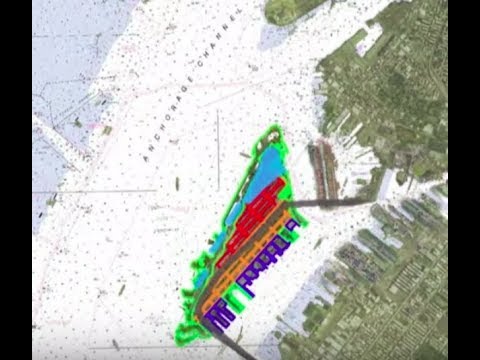
there by that little hook this is two
hundred and seventy-five acres a third
the size of Central Park but where is it
you can’t see it unless you look
underwater if you look at the bethey me
tree which is the underwater topography
map you will see a triangle there that
triangle is not natural in its shape it
is man-made we began to build this
island we built this island up to ten
feet below the level of the water so now
let’s apply the same thinking we applied
to our small island to this larger one
let’s give it the same requirements
protect us to 20 feet above sea level
provide reservoirs for rainfall increase
our maritime jobs increase our housing
increase our social cohesion and pay for
itself well we do that by mapping city
blocks on to it and there’s precedent
for this the Dutch have done it in
Rotterdam we can do it in Brooklyn we
just have to make more Brooklyn so what
if we built these new maritime
facilities and created our jobs on the
port side and on the water side we built
the most amazing new Waterfront Park and
nature habitat on the harbour bring back
diversity of nature that we haven’t had
in New York Harbor for 200 years and
rising high enough to protect us with
blocks and blocks of Brooklyn behind it
and what if just like our little island
we made it pay for itself so here are
the numbers it’s expensive yes about 3.5
billion dollars in infrastructure costs
but now we are creating 35 million
square feet of new building rights
remember the hundred dollars per square
foot multiply it by the 35 million what
do we have 3.5 billion dollars in
revenue it can pay for itself but what
do all these square feet mean in terms
of people in terms of community well it
means there’s enough room for 20,000 new
families almost 70,000 new people and
it’s room for 60,000 new jobs to support
those families and the schools and the
groceries and the libraries and the
parks on which we build our community
that’s the social resilience we can
build and the physical resilience it
provides a breakwater
for all of South West Brooklyn it makes
us safe from the next hurricane sandy so
let us finish the job that we started in
1923 and build this island but let’s do
it in a way that expresses civic virtue
let’s build it in a way that builds
social resilience as well as physical
resilience that grows character as well
as community discovering this island is
a gift New York City will grow by a
million people in the next thirty years
you may well be among those people who
come to New York and if the question is
where you will call home the answer may
well be more Brooklyn thank you [Applause]