
one of the most profound experiences of
my life it’s the day I meet Omar Omar is
11 years old and 5th grade and he’s
sitting in the second row in a stuffy
crowded classroom in a school for Syrian
refugees in a Turkish town called Rehan
Day which sits right on the Syrian
border and a few miles from where a war
has been raging on for many years now
I’m at the school giving a workshop
called mapping memory sorry and this
workshop is one that I’ve been giving to
Syrian refugee kids for a few years and
in it I teach kids how to draw the floor
plans of their home by drawing the floor
plans of my home in Aleppo and the kids
get to be architects for an hour and
draw the homes of their dreams the homes
of their future Omar catches my eye
right away his brown hair is perfectly
combed and his clothes are freshly
pressed and I imagine his mother had
prepared him carefully for school that
morning and I start to draw on the
whiteboard and I draw rooms
I draw furniture and I tell stories
about my home in Aleppo this is where I
used to sit and have lunch with my
mother and my father and my brothers
this is where I used to watch TV this is
where I used to read this is where I
used to the children get very excited
and begin to fill their drawings with
their dream homes
I see massive gardens towers of toys I
see happy complete families and a
bedroom for every sibling but Omar is
not drawing anything at all he’s sitting
there looking at a blank piece of paper
and I asked him Omar why are you not
drawing and he says I can’t draw my home
because my home now is not a real home
my real home is gone
and I can’t draw my home of the future
because I don’t have a future my heart
sinks and I asked him the question that
I’ve asked hundreds of Syrian refugee
kids over the years what do you want to
be when you grow up and he says I want
to grow up to be 18 as fast as possible
so I can die I’m devastated
and I don’t know what to say I think
about what has happened in his life that
he’s lost all hope
what has he witnessed and what has he
been traumatized by in his in his
movement from being at home in Syria to
becoming a refugee and I don’t know what
to say but I sit next to him on his
small bench and we watched the rest of
the children draw their futures at the
end of the week I leave Turkey back to
the United States with the rest of my
team at Kenan Foundation and our team of
amazing mentors who all come to do these
kinds of workshops with Syrian refugee
kids and we get to go back to our
comfortable privileged lives and we get
to watch war ravaged our country from
afar and I don’t think I’ll ever see
Omar again but one year later at the
same school I’m in the courtyard and I
hear us a boy behind me and it’s him
miss Lena miss Lena do you remember me
I’m the one who you taught how to draw
their home and I look at him and I say
of course I remember you even though I
know he had never drawn anything and I
tell him let’s do it again and so we sit
and he opens up his notebook and he
starts to draw the homes exactly the
same way that I had taught them one year
earlier he draws rooms
he draws furniture he draws a long
winding path to the front door he draws
a car and I asked him Omar what do you
want to be when you grow up and he says
I want to be a policeman and I asked him
why and he says because policemen defend
the people and he draws a swing in a
slide and he draws a boy with a
remote-control car
I asked him who is that and he says
that’s my son
Omar went from a child who could not
even imagine a future for himself beyond
the age of 18 to someone who had
invented a memory that helped him
imagine a concrete future for himself
with a family a home and a career and
that invented memory was a lifeline
there are over five million Syrian
refugees right now just like Omar with
no home to go to and no home to turn
back to home for Syrians is a fragile
dream home for so many Syrians has been
a plastic tent for years for others it’s
a storefront or an abandoned factory or
even a street corner home is a coveted
photograph or you’re smuggled housekeys
that you imagine one day being able to
use on your front door once more for
families like my own scattered across
the globe home is where the whatsapp is
I never imagined that I would have to
stand and talk about Syria and these
kinds of stories before today there are
over 11 million Syrians who no longer
live in their homes half the population
of the country that is the entire
population of the state of North
Carolina being uprooted imagine that if
you had told me six years ago that over
500,000 Syrians would be dead or that
one in four refugees would be Syrian or
that over 1 million Syrians kids would
no longer be attending school I would
have never believed you if you had told
me that Aleppo might my city my timeless
historic city one of the oldest cities
in the world would be left to become a
pile of rubble
just like scores of other cities and
villages and towns across Syria and that
Syria would become the most dangerous
place on earth and the site of the
largest humanitarian crisis of our
lifetime I would have never believed you
because six years
ago do you know how many Syrian refugees
existed 0-6 years ago this was my home
we never expected to live this kind of
endless nightmare of loss no Syrian did
Young University students brave men and
women didn’t expect to have to put their
studies aside and pick up their cell
phones and record atrocities that were
happening on their name in on their
neighborhoods in their neighborhoods in
their backyards record war crimes
sometimes recording their own deaths
with because snipers targeted them for
the very crime of recording truth of
what’s happening in their own country
doctors did not expect to have to
perform operations on field hospital
floors sometimes without equipment or
medicine or even electricity because the
barrel bombs that fall from the sky
target the most vulnerable parts of the
Syrian community they target schools and
hospitals and bread lines and markets
and they target them every single day
including today mothers did not expect
to become widows and children did not
expect to become orphans Syria the
country that had been accepting refugees
for centuries from different sects and
religions and ethnicities did not expect
to become the country of the displaced
of the dead of the drowned and the
detained none of us expected this what
would you do if your country was
disappearing in front of your eyes and
where would you find hope hope and and
two ways to act in meaningful ways to
help people even though the atrocities
don’t stop pause for even one day what
would you do our team at Kadim
foundation had an idea to create this
place where Syrian kids Syrian teenagers
boys and girls the most vulnerable parts
of the refugee community could find a
place to interact and to gain skills and
confidence and
and experience the kinds of workshops
that we did with kids like Omar for
years and we called this place a home in
the time of displacement a refuge in the
time of trauma
Karam house or the giving house and
Kadim house is a place where they have
access to cutting-edge technology art
science sports and math and most of all
it’s a place where teens can be teens
again where they can just be it’s a
place for for youth like Abdullah who
wants to become an architect or like
these young women who want to become
engineers and build their ideas and
projects or people are kids like
Mohammad who wants to be an animator
Kadim house is a place where kids get to
dream again and get to build new hopeful
memories for their future and it’s a
place where they get to build their
ideas but it’s also a place where they
become more than refugees more than
their trauma more than their memories
and more than their loss it’s a place
where they get to become people who
matter where they know that they’re not
invisible and most of all where they
know that they belong this fight to
belong and who gets allowed to belong is
really the struggle of our lifetime
there are over 60 million refugees and
migrants worldwide millions of
immigrants and so many marginalized
communities and our world leaders are
deaf and blind to the suffering of these
masses how did we get here how did we
allow this mass suffering to happen and
turn away when did it become acceptable
to turn away from genocide that’s not
only happening in places like Syria but
also other places around the world like
Yemen when did never again become once
again too meaningless words refugees
exists for one reason they exists
because of our indifference to evil
because of the worlds and difference to
evil
we decided to sit and watch was easier
than to act and now here we are Syria is
no longer just about Syria Syria is a
warning siren to our broken world it is
a symbol of our failed humanity and as
we know from history what has happened
in Syria what is happening in Syria can
happen anywhere when people decide to be
indifferent when people decide to turn
away from injustice none of us are
immune no one no country is immune
nothing separates you from being a
refugee you from having a home to being
homeless you from feeling safe to living
in fear you from belonging to being
unwanted but one thing holding the right
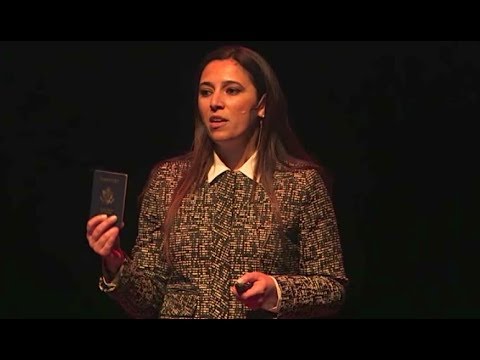
passport this is what separates me from
Omar this is what separates all of you
and us from the 16 million refugees and
migrants who are roaming the earth
longing to belong a passport cannot be
what decides who gets to cross safely
and who is left behind a passport cannot
be what decides who gets to live and who
is left to die this cannot define us and
you don’t have to live through war to
know this just look around the world
around us right now the choices are very
stark do you want to live in a world of
open possibilities and hope and ideas
fueled by our collective humanity or
will you let your silence allow fear
hatred and closed borders to dominate
I look at this picture every day at work
and I think about Omar and I think about
all of the kids I’ve entered acted with
over the years and the lessons they’ve
taught me about hope and resilience and
moving forward and being persistent and
determined no matter what is happening
around them in the world and being
focused on the future and I think about
the lesson that Omar taught me he taught
me that sometimes an invented memory is
what you need to begin to heal for them
from the trauma of losing home and
sometimes home itself has to become
where you’re headed to not where you’re
fleeing from the last six years I’ve
definitely seen the worst of humanity
but I’ve also seen the best of it that
winter day in 2013 I extended a lifeline
to Omar without even knowing it
just because I showed up and recently
we’ve seen thousands and thousands of
people showing up for others showing up
for refugees at for migrants and for
marginalized communities and they stand
shoulder to shoulder with the oppressed
telling them that they matter that they
are not invisible and those people are
my hope and my lifeline it’s so
important to show up and my hope is that
every refugee child in the world will
one day be able to have the opportunity
to become who they’re meant to be in
life and I hope one day that I’ll meet
amar again and I’ll see him and his
family at home and at peace wherever
that is in the world and I hope that
then he will not only be welcomed that he will truly belong thank you