
the seductive promise of virtual reality
is perhaps humanity’s oldest promise to
be like God to say let there be and
manifest a world completely catered to
your will and only limited by your
imagination now if you haven’t tried B R
it’s involving a head-mounted display
that as you look around the image goes
into your brain and tells you you really
are somewhere else because as you move
you’re seeing the world around you 3d
spatial audio helps amplify that sense
of presence and in the motor advanced
systems of today having a body or your
own hands and the ability to move really
tells every part of your sensory system
I am really somewhere else
that’s why basically every technology
company on the planet is spending
billions of dollars to bring this
technology to you the consumer following
the big spenders are my friends
thousands of guys doing little startups
each chasing their own vision of a
killer app and within all of that
collective enthusiasm storytelling has
occupied a peculiar corner of the
conversation now because me and my
co-founders were coming from Hollywood
backgrounds we found ourselves showing
VR for the first time to a lot of the
most iconic filmmakers and artists on
the planet and almost unanimously
masters of cinema reacted to VR with
pessimism and anxiety because they could
instinctively see that a lot of the
tools they use for storytelling we’re
not going to be readily available I’ll
call those I’ll call that reaction the
skeptic reaction the opposite reaction
is the the viewer revolutionaries who
say this is not just a new thing it’s
the final frontier of all human
interaction and it’s going to completely
change and reinvent the way stories are
told now I disagree with both camps to
all my revolutionary friends I say look
the ancient rhythms of story are not
changing with every new medium we invent
ways to service story and to the
skeptics I say look you are right that a
lot of the ways a lot of the techniques
a lot of the film
language we’ve developed over the last
hundred years does go away but that
doesn’t change hero’s journey that
doesn’t change character arcs and
conflicts internal and external changing
people in ways that inspire and move us
I thought that the best way to maybe
perhaps suggest a few of the first tools
maybe like the ABC of the entire
alphabet in the entire library of new
film language for VR is to just take you
through a short story sequence of one of
the projects I’m currently working on
put on everyone put on your VR headset
and now imagine when you put it on you
find yourself in this nice living room
you’re sitting with a very pleasant
professor somewhere nice there’s lots of
sunlight you can move around a little
bit you you sink into this living room
experience that you’re in now he’s got
up on his big fancy TV images of one of
the world’s most immersive least range
and alien trash site communities it’s in
Ethiopia it’s people who spend their
entire life surrounded by trash so much
so that the children who live there
don’t have any capacity to imagine
anything outside of trash Mountain other
than the truck drivers that’s what they
all dream to become so he’s taking you
through a really well rehearsed
presentation on the screen his slides
are changing he’s talking but then
something happens his presentation is
done and as he starts to tell you about
his first trip to trash Mountain he
starts to get emotional he starts to
choke up and he describes that feeling
when you get there even though you’ve
seen pictures even though you’ve seen
video when you’re really there there’s
this overwhelming shift that happens in
your soul and as he’s saying this the
walls disappear the TV disappears you’re
there you have suddenly been transported
you still got the rug the chair or the
couch you and him are the same but
you’ve suddenly landed in Ethiopia so
much so that you have to turn around and
look and see this whole world all around
you and then it cuts to black it’s all
black it’s not just a square rectangle
black screen you are deeply immersed
in darkness and a light comes on and
you’re face to face with daniel one of
the boys who lives in this site and he’s
excited he’s not tragic he’s not crying
he’s a pumped-up little kid today is the
favorite day of the week for him because
today’s the day the airport truck comes
and he’s telling you about it and you
don’t quite understand what he’s saying
but he reaches out as Annie says come
with me and he stands up and runs his
entire shelter just disappears and
suddenly you are following him and
you’re his size you’re going through a
crowd of adults there 15 20 feet high
because you’re scaled to Daniel sighs
and he’s weaseling his way through to
the front of this crowd and you’re going
along with him it’s in beautiful slow
motion so you have time to linger and
look and examine these statuesque adults
all around you and when you break
through the crowd you end up under the
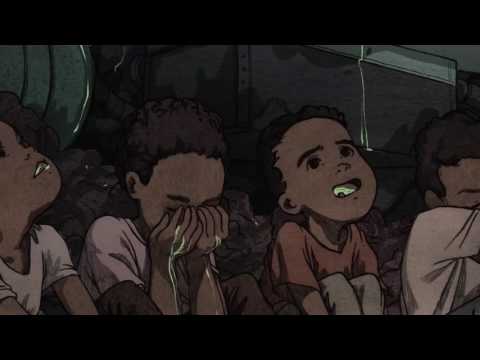
truck and you see other children coming
out of the crowd with you and they all
start reaching their heads up to catch
with their mouths liquids that are
dripping out of the truck and as you
look around all these kids are doing it
and they’re happy you hear the
professor’s voice and he starts telling
you that this is the largest shot of
calories they’re gonna get that week
because it’s a mixture of leftover
orange juice and water and motor oil and
whatever else is in that truck and now
your view suddenly starts moving away
from the kids and it starts to zoom away
from the crowd around the truck and it
zooms even further you start to see this
giant surreal red marker that stays with
you as you get all the way out to seeing
from space earth with hundreds of these
red markers marking all of the trash
sites around the world now from behind a
giant frame a big rectangle flies in and
suddenly reframes that world right back
onto the screen next to the professor
and he says one of his kind of big
moment one sentence thing he wants to
leave everyone with that you cannot
throw trash away you can only throw it
on someone so what is different about
this sequence in VR than if it was just
made by a great filmmaker as a
traditional movie the first thing I’d
like to suggest is region of interest
gets to be played with on a much wider
dynamic range
when you first start out in the room
you’re looking at him you’re looking at
the TV you’re looking at him
a traditional filmmaker would usually
cut between those two things during an
interview or occasionally some
traditional film shots really have a
pronounced multiple region of interest
however when he stops talking that one
of those regions goes away and if he
starts getting emotional all of your
attention starts to zero in on him it’s
almost as if everything else goes away
and you’re just looking at the well of
tears in his eyes now as the walls
disappear and that region of interest
gets even bigger you have to move cinema
could never do this no matter what
cinema did no matter how wide the shot
the screen was the box that everything
had to happen on now a lot of early
attempts at VR storytelling leave people
with an extremely wide region of
interest for far too long and that’s why
cutting to black I think is a very
powerful tool truly immersive black is
very powerful so region of interest
scale that moment when those people are
20 feet high scaling the world bigger or
scaling the world smaller from a fixed
human perspective is a powerful
storytelling technique but cinema
attempted but never could achieve the
way VR does and of course all black is
really deeply powerful and can be used
in a lot of ways and these different
early techniques are just the beginning
of the whole new film language will
develop and understand but I think it’s
so powerful that I’ve actually developed
a new hope for humanity to create a
connection between the stories we engage
with and the enjoyment and the benefits
of watching movies watching stories
engaging with media and what those
things actually do to us not
categorization of genres which is
important or the kind of aesthetic
critique of the quality of the story but
I’m talking about actually growing our
understanding of what stories do to us
now that might sound very academic or
esoteric or as my wife says the
the hopeful optimism of a dreamer but
the reason I have this hope is we
already do this with food if I say my
serious documentary is like a kale salad
or some new addictive zombie shooter
game is like a decadent dessert everyone
basically knows the difference between
what vegetables do to our body or what
sugar does to our body developing a
holistic healthy balanced media diet is
something that I think is going to be
even more important as virtual reality
and augmented reality and simulations
become so real now I don’t know what the
unexpected insights we’re gonna find are
or which consumption patterns are going
to take on the stigma of drug addiction
or even overconsumption and things like
that I would say we’ve already seen
early evidence of addictive patterns in
our relationship with our devices so I
think we can develop this understanding
of a media diet is gonna take a lot of
research and academics but it’s also on
those storytellers who are embracing VR
now to start being a bit more
intentional why am I telling this story
take the attitude of a chef saying what
am I making am I making a meal am I
making a snack am i making a drug and if
so what what do I feel about that and
what what is that offer on the menu
compared to everything else that’s being
made and as consumers I think it’s the
same exact question why am i drawn to
this story what is it about this movie
or this story or this series of this
this game that really attracts me and
really makes me want to consume it over
and over and over
I’d even suggest that we’re already
needing to ask that question about some
of our social media feeds but I think if
we can dove the sooner we can develop a
sense of a healthy media diet the sooner
we’ll all be able to collectively enjoy
and leverage the benefits of this new
technology a much more attractive
promise is a world where everyone is
engaged with virtual worlds that improve
us to then engage and improve the real
world
Thanks
[Applause]
is perhaps humanity’s oldest promise to
be like God to say let there be and
manifest a world completely catered to
your will and only limited by your
imagination now if you haven’t tried B R
it’s involving a head-mounted display
that as you look around the image goes
into your brain and tells you you really
are somewhere else because as you move
you’re seeing the world around you 3d
spatial audio helps amplify that sense
of presence and in the motor advanced
systems of today having a body or your
own hands and the ability to move really
tells every part of your sensory system
I am really somewhere else
that’s why basically every technology
company on the planet is spending
billions of dollars to bring this
technology to you the consumer following
the big spenders are my friends
thousands of guys doing little startups
each chasing their own vision of a
killer app and within all of that
collective enthusiasm storytelling has
occupied a peculiar corner of the
conversation now because me and my
co-founders were coming from Hollywood
backgrounds we found ourselves showing
VR for the first time to a lot of the
most iconic filmmakers and artists on
the planet and almost unanimously
masters of cinema reacted to VR with
pessimism and anxiety because they could
instinctively see that a lot of the
tools they use for storytelling we’re
not going to be readily available I’ll
call those I’ll call that reaction the
skeptic reaction the opposite reaction
is the the viewer revolutionaries who
say this is not just a new thing it’s
the final frontier of all human
interaction and it’s going to completely
change and reinvent the way stories are
told now I disagree with both camps to
all my revolutionary friends I say look
the ancient rhythms of story are not
changing with every new medium we invent
ways to service story and to the
skeptics I say look you are right that a
lot of the ways a lot of the techniques
a lot of the film
language we’ve developed over the last
hundred years does go away but that
doesn’t change hero’s journey that
doesn’t change character arcs and
conflicts internal and external changing
people in ways that inspire and move us
I thought that the best way to maybe
perhaps suggest a few of the first tools
maybe like the ABC of the entire
alphabet in the entire library of new
film language for VR is to just take you
through a short story sequence of one of
the projects I’m currently working on
put on everyone put on your VR headset
and now imagine when you put it on you
find yourself in this nice living room
you’re sitting with a very pleasant
professor somewhere nice there’s lots of
sunlight you can move around a little
bit you you sink into this living room
experience that you’re in now he’s got
up on his big fancy TV images of one of
the world’s most immersive least range
and alien trash site communities it’s in
Ethiopia it’s people who spend their
entire life surrounded by trash so much
so that the children who live there
don’t have any capacity to imagine
anything outside of trash Mountain other
than the truck drivers that’s what they
all dream to become so he’s taking you
through a really well rehearsed
presentation on the screen his slides
are changing he’s talking but then
something happens his presentation is
done and as he starts to tell you about
his first trip to trash Mountain he
starts to get emotional he starts to
choke up and he describes that feeling
when you get there even though you’ve
seen pictures even though you’ve seen
video when you’re really there there’s
this overwhelming shift that happens in
your soul and as he’s saying this the
walls disappear the TV disappears you’re
there you have suddenly been transported
you still got the rug the chair or the
couch you and him are the same but
you’ve suddenly landed in Ethiopia so
much so that you have to turn around and
look and see this whole world all around
you and then it cuts to black it’s all
black it’s not just a square rectangle
black screen you are deeply immersed
in darkness and a light comes on and
you’re face to face with daniel one of
the boys who lives in this site and he’s
excited he’s not tragic he’s not crying
he’s a pumped-up little kid today is the
favorite day of the week for him because
today’s the day the airport truck comes
and he’s telling you about it and you
don’t quite understand what he’s saying
but he reaches out as Annie says come
with me and he stands up and runs his
entire shelter just disappears and
suddenly you are following him and
you’re his size you’re going through a
crowd of adults there 15 20 feet high
because you’re scaled to Daniel sighs
and he’s weaseling his way through to
the front of this crowd and you’re going
along with him it’s in beautiful slow
motion so you have time to linger and
look and examine these statuesque adults
all around you and when you break
through the crowd you end up under the
truck and you see other children coming
out of the crowd with you and they all
start reaching their heads up to catch
with their mouths liquids that are
dripping out of the truck and as you
look around all these kids are doing it
and they’re happy you hear the
professor’s voice and he starts telling
you that this is the largest shot of
calories they’re gonna get that week
because it’s a mixture of leftover
orange juice and water and motor oil and
whatever else is in that truck and now
your view suddenly starts moving away
from the kids and it starts to zoom away
from the crowd around the truck and it
zooms even further you start to see this
giant surreal red marker that stays with
you as you get all the way out to seeing
from space earth with hundreds of these
red markers marking all of the trash
sites around the world now from behind a
giant frame a big rectangle flies in and
suddenly reframes that world right back
onto the screen next to the professor
and he says one of his kind of big
moment one sentence thing he wants to
leave everyone with that you cannot
throw trash away you can only throw it
on someone so what is different about
this sequence in VR than if it was just
made by a great filmmaker as a
traditional movie the first thing I’d
like to suggest is region of interest
gets to be played with on a much wider
dynamic range
when you first start out in the room
you’re looking at him you’re looking at
the TV you’re looking at him
a traditional filmmaker would usually
cut between those two things during an
interview or occasionally some
traditional film shots really have a
pronounced multiple region of interest
however when he stops talking that one
of those regions goes away and if he
starts getting emotional all of your
attention starts to zero in on him it’s
almost as if everything else goes away
and you’re just looking at the well of
tears in his eyes now as the walls
disappear and that region of interest
gets even bigger you have to move cinema
could never do this no matter what
cinema did no matter how wide the shot
the screen was the box that everything
had to happen on now a lot of early
attempts at VR storytelling leave people
with an extremely wide region of
interest for far too long and that’s why
cutting to black I think is a very
powerful tool truly immersive black is
very powerful so region of interest
scale that moment when those people are
20 feet high scaling the world bigger or
scaling the world smaller from a fixed
human perspective is a powerful
storytelling technique but cinema
attempted but never could achieve the
way VR does and of course all black is
really deeply powerful and can be used
in a lot of ways and these different
early techniques are just the beginning
of the whole new film language will
develop and understand but I think it’s
so powerful that I’ve actually developed
a new hope for humanity to create a
connection between the stories we engage
with and the enjoyment and the benefits
of watching movies watching stories
engaging with media and what those
things actually do to us not
categorization of genres which is
important or the kind of aesthetic
critique of the quality of the story but
I’m talking about actually growing our
understanding of what stories do to us
now that might sound very academic or
esoteric or as my wife says the
the hopeful optimism of a dreamer but
the reason I have this hope is we
already do this with food if I say my
serious documentary is like a kale salad
or some new addictive zombie shooter
game is like a decadent dessert everyone
basically knows the difference between
what vegetables do to our body or what
sugar does to our body developing a
holistic healthy balanced media diet is
something that I think is going to be
even more important as virtual reality
and augmented reality and simulations
become so real now I don’t know what the
unexpected insights we’re gonna find are
or which consumption patterns are going
to take on the stigma of drug addiction
or even overconsumption and things like
that I would say we’ve already seen
early evidence of addictive patterns in
our relationship with our devices so I
think we can develop this understanding
of a media diet is gonna take a lot of
research and academics but it’s also on
those storytellers who are embracing VR
now to start being a bit more
intentional why am I telling this story
take the attitude of a chef saying what
am I making am I making a meal am I
making a snack am i making a drug and if
so what what do I feel about that and
what what is that offer on the menu
compared to everything else that’s being
made and as consumers I think it’s the
same exact question why am i drawn to
this story what is it about this movie
or this story or this series of this
this game that really attracts me and
really makes me want to consume it over
and over and over
I’d even suggest that we’re already
needing to ask that question about some
of our social media feeds but I think if
we can dove the sooner we can develop a
sense of a healthy media diet the sooner
we’ll all be able to collectively enjoy
and leverage the benefits of this new
technology a much more attractive
promise is a world where everyone is
engaged with virtual worlds that improve
us to then engage and improve the real
world
Thanks
[Applause]
Please follow and like us: