
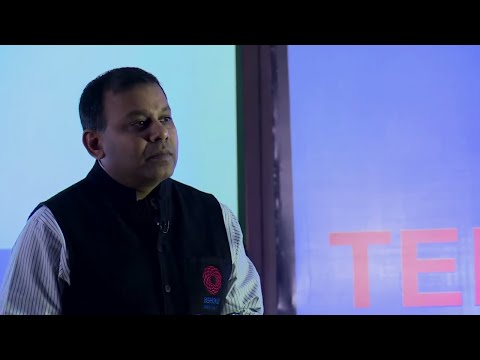
[Music]
good afternoon ladies and gentlemen I
hope the mic is working and you can all
hear me yes at the back I have been an
entrepreneur since 1991 but it was only
in 2005 that I had a new calling and
that was to help improve higher
education in India and this happened
totally by accident in one of the
businesses that I run jamberry we quote
students on the GMAT GRE and SAT so in
2005 I was sitting in my room when a
student worked in wanting help to
prepare on the GMAT I felt I had seen
this person before and when I asked him
he mentioned that he’d met me three
years ago in 2002 when he was preparing
for the SAT at that point in 2002 he had
been admitted to the University of
California and Berkeley he was the only
child of his parents and for family
reasons he eventually could not go his
94% in class 12 got him admission into a
mid-level delhi college and he spent the
next three years of his life doing
become honours in that college but i
think what struck me when I met him in
2005 was really that I was meeting a
different person the person I had met in
2002 was was very bright very chirpy and
this person whom I was meeting in 2005
seemed rather dull and actually quite
insipid so I started to wonder what’s
happened to him and on proving further
he mentioned that he felt that his
college experience of those three years
had been untruthful
he talked about
how he would go to college sometimes
classes wouldn’t happen and the few that
would happen were uninteresting and he
felt that largely his college experience
had been unfaithful I felt that the
three years of his college life had
changed him and not change him for the
good and somewhere I started to feel
that as a country we let him down as a
country we did not have enough
opportunities of quality higher
education for our students and this
experience inspired me to think that
what will it take to set up a high
quality University in India in the next
10 to 12 years I got involved with
building Ashoka University right from
2007 onwards and some of what I speak
today is largely based on that
experience India I believe has a crisis
in higher education we have a crisis of
access and we have a crisis of quality
India today has the largest higher
education infrastructure in the world
eight hundred universities 39,000
colleges we larger than us we larger
than China we’re also the second largest
in terms of number of students going to
college with the second highest we have
35 million students in our colleges and
universities only second to China but we
have 140 million in the college going
age group so in the age group of 18 to
23 which is a college-going population
we have 140 million 35 million of whom
go to college which is one out of every
four and they
means that our brass enrollment ratio
which is the number that the world
measures is about 25% one out of four go
to college how does this stack up
against the rest of the world the first
I believe that there is greater push for
autonomy and independence by the
government to really help improve
governance in a government universities
the Indian Institute of Management bill
which got passed last month is an
example the same this bill aims to make
the AIIMS more independent and
autonomous another example is really
this government’s proposal to set up 20
Institutes of excellence 20 institutions
which are going to be free from
regulatory control so these two pieces
of legislation as well as most signals
coming from the government point in the
direction that the government does want
to free up educational institutions they
do want to have better governance in
educational institution and this really
bodes well for a higher education but I
think time will die we’ve often had
these glimpses or rays of hope and time
will tell how far this autonomy goes
these are there’s a second trend and I
think I’m I’m I’m personally more
excited by the second trend and and also
more optimistic I think this one seems
more real and something that is here to
stay in the last 1012 years I feel there
is a new category of private
universities coming up in India private
universities which are genuinely
philanthropic and have a not-for-profit
intent India has had a strong tradition
of philanthropy in higher education the
Indian Institute of Science Tata
Institute of fundamental research BITS
Pilani I think they’re all examples of
outstanding private institutions that
got created on private philanthropy but
a lot of this happened before 1960 1965
then there was this period between 60 65
to 2005 when very few outstanding
private institutions got set up and this
was largely
cause it was extremely difficult to set
up a private university in India at that
point there was strong regulatory
controls you almost had to be a college
for ten years then you apply to become a
deemed university strong a series of
regulatory approval so it was really
tough I think we almost encouraged a
very different kind of private
universities that came up in this era
I believe 2004 five is when things
started to change and because education
is on the concurrent list of the Indian
Constitution both the central government
and the state governments can legislate
some state governments some state
governments actually came up with some
very innovative legislation to help set
up private universities in these states
Rajasthan Haryana – two examples and
these legislations made it easier for
private universities to be set up right
you could be a private university right
on day one and what’s more not only did
it make it easier for private
universities to come up most of this
legislation also gave a lot of autonomy
to universities right so it became
easier to set up a university also you
could set up universities which were far
more autonomous and then what happened
in in between the period of 2005 to now
we had scores of private universities
come up and we had universities of all
kinds but I think the good part is the
good part is that seven eight of these
universities are quite outstanding seven
eight of these universities have the
capacity to raise resources they have
not-for-profit intent and they are
pursuing excellence in absolutely the
right manner I believe these seven eight
over time could really become centers of
excellence but this number of seven
eight and I think this is where the ray
of hope for India is this number of
seven eight is going to become 20 in the
next five years and it will become one
hundred
in the next 15 to 20 years now this
number of hundred is not a pipe dream
but this number of 100 is quite doable
considering we are opening 50
universities in Europe so even if one
out of 10 universities that we open is
outstanding we will get to the number of
hundred and this does not take into
consideration scores of other existing
universities which are going to become
top class and I think this this group of
100 really can help transform Indian
higher education 100 is is enough of a
critical mass to really force others to
innovate and adapt and us again is er is
a prime example very early in 17th 18th
19th 19th century some outstanding
private research universities got set up
in the u.s. Harvard Yale Columbia
Princeton University of Chicago Stanford
they’re all examples which was set up
there is money through philanthropy
created large endowments and fund
education and research and over a period
of time they inspired not many other
educational institutions to come up in
the United States I believe India will
have a similar revolution so while these
two big trends of a push for greater
autonomy and a new category of private
universities coming up is going to
really help us tide over the four things
we talked of governance intent
excellence and funding India also has
some other distinct advantages that I
want to talk off briefly I think I think
the first really is cost if you look at
any of the top universities that are
named in the u.s. even at a price point
of $60,000 per annum tuition tuition
only accounts for thirty to forty
percent of the income of any top
university
right so these universities also have
large cost models the bulk of the budget
also getting funded from endowment and
research grants I think India we have an
opportunity to be far more efficient we
are building universities from ground up
our cost structures are lower so we have
an opportunity to deliver a quality of
education which is probably as good as
what is delivered outside but we can do
it at one-fifth or one-sixth the cost I
think there will be a time where in the
world when children from all across the
world will come to India to study we are
also doing much better on capital costs
and here I can give a example from the
University I was associated with so
shoka is going to cost one hundred and
ten million dollars or about 750 crores
to set up it will have two thousand five
hundred students fully residential
best-in-class infrastructure I am given
to understand that this is what to take
this is what it takes to build one
building on a u.s. campus so we have an
opportunity we have an opportunity to be
far more efficient and cost
I think the second the second advantage
we have is the high quality of human
capital that we have in this country and
this can really help us create a very
high quality faculty pool again a very
very important ingredient for excellence
in higher education a large percentage
of faculty in universities and
institutions in North America and some
other countries is of Indian origin we
can leverage this talent we’ve also seen
the impact and potential of a human
capital it has helped us to transform
our IT sector it has helped us to
transform our pharmaceutical sector and
I think it will now help us to transform
Indian higher education and the last
thing that I want to talk off is and
this is something that inspires me the
most we also have a very very hungry
student population we have outstanding
students in this country extremely
bright who are thirsting for
education we have 225 million students
in the age group of 10 to 19 all wanting
access to higher education the West has
the opposite problem they are dependent
on international students now to fill
their universities in US for example
higher education pretty much peaked at
21 million in 2011-12 and is now
declining 55 percent of the students in
science technology engineering math in
postgraduate courses and US universities
are international students we don’t have
that challenge we have enough of our own
and we have bright students bright
students with a hunger in their belly
and students who want to study so I
would like to conclude by saying that
higher education is an opportunity
higher education is an area where India
is on the cusp of revolution the ball
has already been set rolling the ball
has been set rolling by some very
innovative legislation that was brought
in by state governments to help create
private universities in India and Indian
philanthropy is responding to that
challenge in 15 years 20 years from time
from now we will have 100 outstanding
universities 100 universities that are
going to be autonomous innovative agile
and best-in-class and they will put
India on the road to becoming a higher
education center of excellence in the
world thank you
you
Please follow and like us: