
Translator: Leonardo Silva Reviewer: Custodio Marcelino
After all, what makes a real body beyond its physical existence?
Well, in my conception,
what validates this is precisely the medium, the way we interact with the world.
But what if you were still invisible anyway?
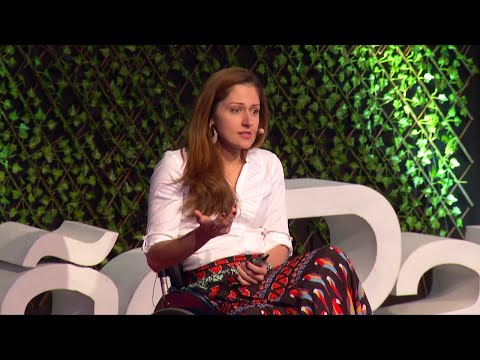
Well, in 2006, I had a car accident and I ended up becoming a wheelchair,
and I usually say I got a combo.
I won a wheelchair, I got a handicapped symbol
and a series of titles,
titles almost always accompanied by phrases such as:
“Wow, you’re so pretty, in the wheelchair …”
“Wow, you’re an example of overcoming …”,
and a series of other labels of coitadism, disability.
The fact is that in 2013 I decided that I would chase after my own titles,
and for this I need to understand what was or was not a limitation for me.
So, I chose to do this through an exchange,
because I needed to be in a place that would allow me to have accessibility
for me to have this interaction with the world again.
Now, you can imagine my fear.
After seven years, for the first time I was going to be alone
and, as a matter of fact, I still carried a project,
the “Wheelchair Traveler’s Guide” blog,
where I set out to share all the discoveries in that adventure.
I usually say “adventure” because to me it was a whole new universe.
For the first time, I could, after seven years,
walking on sidewalk because it had no gradient problem, was not afraid to fall;
took the bus, took the subway and there was no problem either.
I did not have to call places beforehand
to ask if it had accessibility.
In fact, at first I even did this,
but of so much to me with: “Why would not it?”,
or: “Sure, we do,” I finally gave up.
And the question of estrangement:
people did not look at me strangely on the street
because it was very common for me to meet many disabled people throughout the day.
That’s when I made the biggest discovery of all, for me.
The problem was not sitting in a wheelchair.
The problem was living in a poor place,
in a place that would not allow me to live and have the independence that I was having there.
What people need to understand is that, before being deficient,
we are people, as different as anyone.
The fact that I’m talking about it here
does not make me a spokesperson for the disabled
and does not even mean that they all agree with me.
But, returning to that question of invisibility in the world,
I believe that some concepts, some factors, reinforce this:
lack of accessibility, lack of representativeness …
You can now think of images about disability
that are not conveyed by the overcoming media,
with that claim, or that pianinho in the background,
with that sad image?
Good … and fear,
the fear that people have of talking about this subject,
especially those who are not disabled.
The fact is that, putting all this together, I began to understand
that if I wanted to make people look at me in a different way,
I should start to present my reality to them.
And I believe that the movement has to be the other way around.
I think we, as disabled,
we must begin to present our realities,
because most people do not live with the disabled,
so they have no idea what that universe is like,
a large majority; not all but a large part.
I decided to do this, then, through communication,
and the vehicle I used was the fashion.
For those who do not know, I’m a stylist,
and here comes the discovery of yet another title:
that the disabled are not seen as consumers.
It is very common for you to go to places that do not have accessibility
and come across an owner who says he has not adapted that place
because it simply does not receive disabled people.
Now, imagine carrying that same thought to fashion,
which works with a body pattern based on what is perfect.
You can imagine my difficulty.
What this same industry does not understand is the importance it exerts
in the lives of people with disabilities.
I’ll cite two examples.
The independence in dressing:
I remember the first time that, after a long time –
and it was not days –
I was able to dress for the first time on my own,
and the belonging and rapprochement with my body that it generated
were very gratifying.
And the representativeness, once again:
fashion is a vehicle of communication,
and representativeness breaks down stereotypes.
Within my research, I ended up making discoveries as well,
and one of them came from a visually impaired person who started telling me
how she consumed fashion.
Then she said, “Michele, I do not have access to a window.
I’ll get my clothes so I can buy some clothes.
So I never know what’s there.
When I go to a department store, they are gigantic.
I do not even know where to start.
Then a salesman arrives, who is totally in the way.
It is not very common to receive a visual impairment,
He does not know where to start.
and he ends up messing me up more than helping me. “
When I asked her the question of information, she said,
“Imagine, I do not have fashion information,
because most sites do not have audiodescription,
magazines do not work with it. “
So, that is, zero autonomy.
Now, how does an industry
which theoretically should attend to all bodies,
because, after all, everyone dresses,
ends up imposing limitations and excluding bodies,
without even understanding the needs of these bodies?
It was from this, then, that the project # meucorpoéreal was born.
The idea was to give active voice to consumers through actions,
and our first action was through a mini-document
where we gave voice to these consumers.
They put the way they related to fashion,
of what they liked, what needed to be improved,
all in a playful environment.
This documentary takes place behind the scenes of a photographic essay,
where I tried to work on this conceptual aesthetics,
which is so fashioned,
as a way to prove
that these bodies deserve to be worked through fashion,
and not about those old cliches that the media usually sell.
When we speak in the barriers that the unknown feeds,
I remember perfectly the first day
in which I started my postgraduate degree in communication and fashion culture
and I came across a class of curious glances.
After all, it was not so common to find a wheelchair stylist.
My initiative, then, was to take a wheelchair,
in the second week of school,
and invite these students to experience my universe.
So I took these people to bathrooms without adaptation,
to the streets, to public places,
with the sole condition that they acted just like a wheelchair.
So if there were physical barriers,
they could not get out of the chair, they would have to ask for help …
and the main thing: to look at how people related to them.
All this experience made me stop to think
that if I wanted one day to put these bodies in fashion,
I should narrow some relationships,
between consumers with disabilities, the marks
and the professionals of the future, who are the students.
That’s when “Inclusive Fashion Day” was born.
Inclusive Fashion Day is an event
that we perform in rehabilitation hospitals,
and these hospitals often receive people who are born disabled
or become disabled throughout life.
So we recruit students from the fashion industry
to map, through interviews, the real needs of these patients,
with the aim of bringing these students closer to the patients.
At the end of this event, we distribute kits
which are supported by companies.
So, we end this cycle.
I know that Inclusive Fashion Day has worked out so well
that we are in the third edition,
which will happen now, on December 7,
which excites me a lot,
because I understand that everything I learned in that exchange
today it is carried out in reverse.
Today I can demystify
the universe of almost 24% of the Brazilian population that has some deficiency
for these students.
So what I bring to you today is that you allow yourself to be real bodies,
that you understand that the different is not something negative,
because nobody is equal to nobody,
and my body is real.
(Applause) (Live)
Thanks.
(Applause) (Live)
After all, what makes a real body beyond its physical existence?
Well, in my conception,
what validates this is precisely the medium, the way we interact with the world.
But what if you were still invisible anyway?
Well, in 2006, I had a car accident and I ended up becoming a wheelchair,
and I usually say I got a combo.
I won a wheelchair, I got a handicapped symbol
and a series of titles,
titles almost always accompanied by phrases such as:
“Wow, you’re so pretty, in the wheelchair …”
“Wow, you’re an example of overcoming …”,
and a series of other labels of coitadism, disability.
The fact is that in 2013 I decided that I would chase after my own titles,
and for this I need to understand what was or was not a limitation for me.
So, I chose to do this through an exchange,
because I needed to be in a place that would allow me to have accessibility
for me to have this interaction with the world again.
Now, you can imagine my fear.
After seven years, for the first time I was going to be alone
and, as a matter of fact, I still carried a project,
the “Wheelchair Traveler’s Guide” blog,
where I set out to share all the discoveries in that adventure.
I usually say “adventure” because to me it was a whole new universe.
For the first time, I could, after seven years,
walking on sidewalk because it had no gradient problem, was not afraid to fall;
took the bus, took the subway and there was no problem either.
I did not have to call places beforehand
to ask if it had accessibility.
In fact, at first I even did this,
but of so much to me with: “Why would not it?”,
or: “Sure, we do,” I finally gave up.
And the question of estrangement:
people did not look at me strangely on the street
because it was very common for me to meet many disabled people throughout the day.
That’s when I made the biggest discovery of all, for me.
The problem was not sitting in a wheelchair.
The problem was living in a poor place,
in a place that would not allow me to live and have the independence that I was having there.
What people need to understand is that, before being deficient,
we are people, as different as anyone.
The fact that I’m talking about it here
does not make me a spokesperson for the disabled
and does not even mean that they all agree with me.
But, returning to that question of invisibility in the world,
I believe that some concepts, some factors, reinforce this:
lack of accessibility, lack of representativeness …
You can now think of images about disability
that are not conveyed by the overcoming media,
with that claim, or that pianinho in the background,
with that sad image?
Good … and fear,
the fear that people have of talking about this subject,
especially those who are not disabled.
The fact is that, putting all this together, I began to understand
that if I wanted to make people look at me in a different way,
I should start to present my reality to them.
And I believe that the movement has to be the other way around.
I think we, as disabled,
we must begin to present our realities,
because most people do not live with the disabled,
so they have no idea what that universe is like,
a large majority; not all but a large part.
I decided to do this, then, through communication,
and the vehicle I used was the fashion.
For those who do not know, I’m a stylist,
and here comes the discovery of yet another title:
that the disabled are not seen as consumers.
It is very common for you to go to places that do not have accessibility
and come across an owner who says he has not adapted that place
because it simply does not receive disabled people.
Now, imagine carrying that same thought to fashion,
which works with a body pattern based on what is perfect.
You can imagine my difficulty.
What this same industry does not understand is the importance it exerts
in the lives of people with disabilities.
I’ll cite two examples.
The independence in dressing:
I remember the first time that, after a long time –
and it was not days –
I was able to dress for the first time on my own,
and the belonging and rapprochement with my body that it generated
were very gratifying.
And the representativeness, once again:
fashion is a vehicle of communication,
and representativeness breaks down stereotypes.
Within my research, I ended up making discoveries as well,
and one of them came from a visually impaired person who started telling me
how she consumed fashion.
Then she said, “Michele, I do not have access to a window.
I’ll get my clothes so I can buy some clothes.
So I never know what’s there.
When I go to a department store, they are gigantic.
I do not even know where to start.
Then a salesman arrives, who is totally in the way.
It is not very common to receive a visual impairment,
He does not know where to start.
and he ends up messing me up more than helping me. “
When I asked her the question of information, she said,
“Imagine, I do not have fashion information,
because most sites do not have audiodescription,
magazines do not work with it. “
So, that is, zero autonomy.
Now, how does an industry
which theoretically should attend to all bodies,
because, after all, everyone dresses,
ends up imposing limitations and excluding bodies,
without even understanding the needs of these bodies?
It was from this, then, that the project # meucorpoéreal was born.
The idea was to give active voice to consumers through actions,
and our first action was through a mini-document
where we gave voice to these consumers.
They put the way they related to fashion,
of what they liked, what needed to be improved,
all in a playful environment.
This documentary takes place behind the scenes of a photographic essay,
where I tried to work on this conceptual aesthetics,
which is so fashioned,
as a way to prove
that these bodies deserve to be worked through fashion,
and not about those old cliches that the media usually sell.
When we speak in the barriers that the unknown feeds,
I remember perfectly the first day
in which I started my postgraduate degree in communication and fashion culture
and I came across a class of curious glances.
After all, it was not so common to find a wheelchair stylist.
My initiative, then, was to take a wheelchair,
in the second week of school,
and invite these students to experience my universe.
So I took these people to bathrooms without adaptation,
to the streets, to public places,
with the sole condition that they acted just like a wheelchair.
So if there were physical barriers,
they could not get out of the chair, they would have to ask for help …
and the main thing: to look at how people related to them.
All this experience made me stop to think
that if I wanted one day to put these bodies in fashion,
I should narrow some relationships,
between consumers with disabilities, the marks
and the professionals of the future, who are the students.
That’s when “Inclusive Fashion Day” was born.
Inclusive Fashion Day is an event
that we perform in rehabilitation hospitals,
and these hospitals often receive people who are born disabled
or become disabled throughout life.
So we recruit students from the fashion industry
to map, through interviews, the real needs of these patients,
with the aim of bringing these students closer to the patients.
At the end of this event, we distribute kits
which are supported by companies.
So, we end this cycle.
I know that Inclusive Fashion Day has worked out so well
that we are in the third edition,
which will happen now, on December 7,
which excites me a lot,
because I understand that everything I learned in that exchange
today it is carried out in reverse.
Today I can demystify
the universe of almost 24% of the Brazilian population that has some deficiency
for these students.
So what I bring to you today is that you allow yourself to be real bodies,
that you understand that the different is not something negative,
because nobody is equal to nobody,
and my body is real.
(Applause) (Live)
Thanks.
(Applause) (Live)
Please follow and like us: