
Translator: Vanessa Soneghet Reviewer: Claudia Sander
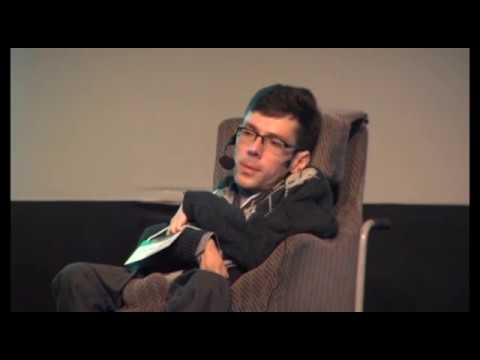
I’m Claudio,
but not only the Claudio you can see.
In fact, I’m the Claudio who carries the same thing each of you carries:
the human life potential.
And that’s what I’m going to show you.
Still as a child I was diagnosed with a rare condition,
a serious disease called infantile spinal muscular atrophy.
A condition that causes motor neurons destruction.
That is, the person gradually loses their movement
and vital capacities.
Even facing such difficulties,
my mother saw school as a possibility for me to make friends,
to play and to meet people.
But, even having full cognitive capacity,
as well as communication capacity,
I had difficulty with school inclusion.
But my mom didn’t give up.
She went to several schools until she found one that would accept me.
But I only began to interact with my colleagues on the third grade.
The teacher created a project called “day helper.”
Each day one kid would help me reach the materials,
and take me to the schoolyard, and help me with the games…
So, at our break, all games were adapted,
including jumping rope, hopscotch, run and catch.
But the play I liked most was run and catch,
because a colleague would take my chair and run after the others.
(Laughter)
Not few times did the chair get stuck at the uneven floor,
and I’d slam into the floor.
I stayed there, got hurt,
as any other kid, in an adventure, having fun.
Anyway, as the studies progressed and I got to high school.
Then, I could be accepted at a public school.
However, on my first day, the classroom was on the second floor
and there was no elevator.
And the principal said,
“Claudinho, we’ll have to call your mom to come pick you up,
because your room is on the second floor and there’s no access.”
But my colleagues didn’t allow it.
They did the moving themselves:
the students on the second floor came downstairs,
and the ones on the ground floor took the upstairs room.
Even on the ground floor, there was a small step,
and the principal said, “Claudinho, don’t worry,
I’ve already asked the Department of Education to put a ramp here.”
I graduated and the ramp hadn’t arrived.
(Laughter)
But plenty of colleagues helped me
to take part in all school activities including the extracurricular ones.
I graduated from school,
and at the end of high school,
I knew I could and I had conditions
to go to college.
When I told my family about my wish to go to college,
that sounded like a monster,
something too challenging,
something that scared and stopped them at first
from believing this was possible,
especially because of our poor financial conditions.
So, to avoid scaring people,
I decided to strip the monster into parts.
That means, I thought,
“What do I need to go to college?”
“To take the college entrance exam!”
“What do I need to take the exam?”
“To apply for it.”
So, the monster was not that big anymore.
Instead of saying, “Mom, I’ll go to college,”
I said, “Mom, I’ll apply for the exam.”
That wasn’t so scary.
But even the application was already challenging,
because my mom couldn’t help me financially,
not even with that.
So, I got some cosmetic catalogues,
and offered to my friends, neighbors, colleagues,
and with the profit I paid for my exam application.
I took the test.
When my name was on the list of approvals,
I was hugely happy,
especially as I was the only student from the public school where I studied
to pass the exam,
but at the same time I was really concerned
because I had only a few hours to enroll,
or the vacancy would go to a substitute.
Near the deadline,
a friend got to our house,
and said she had seen my name on the list of approvals
and offered me to pay for the enrollment fee,
My mom resisted accepting
because she couldn’t afford the monthly payments anyway.
Besides, our family had other priorities.
And I’d say, “Oh, mom, take it!”
(Laughter)
“One step at a time.”
She would poke me and say, “You shoud be ashamed, boy!”
But I insisted and she accepted it.
So I enrolled.
The day I enrolled, I wrote a letter to the city hall
requesting transportation,
as there were no accessible buses.
The public administration granted it,
they found more feasible some transport that would pick me up,
instead of adapting all buses in the city.
(Laughter)
So I had everything I wanted:
I was enrolled, I had transport,
so I just had to enjoy the opportunity.
At the end of the first term, the dean called us at home
and asked for a meeting with my mom.
My mother hangs up and says,
“See what you’ve done? Now I’m going to be blacklisted.”
(Laughter)
“We’ll have to pledge our house to pay this debt.”
When we got to college the conversation was totally different.
The dean said,
“Mrs. Elisa, when your son enrolled in our university,
we were very concerned
as to how we would be able to deal with a student with such limitations.
So, I requested the professors to demand the most from him,
so he would give up right at the beginning
or prove his competence and go till the end.
Because the job he’s chosen involves a lot of ethics,
it deals with human beings, and he had to show that competence.
So, to our surprise, Mrs. Elisa, the more we demanded from Claudio,
the more he corresponded.
The more we demanded, the more he corresponded.
Because of that and his overcoming all limits,
all challenges we imposed on him, we realized he has great potential.
And the university wishes to offer him a scholarship.
Do you accept it, Mrs. Elisa?”
(Laughter)
My mom obviously took it.
She was moved,
and so I kept studying.
In the middle of the course
I began to have difficulty to write.
My condition was getting worse, I felt the pen heavier,
I couldn’t move the notebook anymore,
I knew that in a short time
I would lose the ability to write as other people.
I had to anticipate things.
I had to find a way to keep writing.
So I looked for technologies that could to give me support.
But, at that time, for someone in my condition to write,
the only resource available was a stick attached to the forehead
or that you held with your mouth,
and with that stick you’d press the keys of a computer keyboard.
in order to write.
But that was too slow and hard for me.
Instead of thinking of what I couldn’t do,
I realized I could move the mouse,
a small one, on a laptop.
That way, I could use a computer with less effort.
But nobody writes with a mouse. How would I write with a mouse?
I needed to find a solution.
So, at class breaks, I’d go to the library,
I’d take information technology books,
and, using the computer I realized –
using the computer calculator,
what did I realize?
If there is a program, that I press or click with the mouse on a button,
and it shows a number,
why not a program that I click on a button and it shows letters?
There was the solution.
I had to create a program that I clicked and it showed letters.
So I began to study by myself how to make computer programs
and developed my first program called “Mousekey.”
This program has all the keys of a keyboard,
but to speed up my writing so I wouldn’t need click on each letter,
I put syllables around each letter.
So, for example, in order to write the word “button,”
if I was going to use the stick method,
I’d have to press “B,” “U,” “T,” “T,” “O” and “N.”
With this program I just click “But” and “ton.” Two clicks.
I put verb conjugation, that is, to write “Let’s go,”
I just click “L” and “G.”
I put punctuation,
special characters that I used,
pronouns.
Gradually, I improved Mousekey.
It didn’t stop there.
I kept studying to improve it,
and I developed a new Mousekey, with a new layout, with new resources,
which became my master’s degree dissertation theme.
With this program, people with conditions more serious than mine
are able to write using a computer;
with simple eye or finger movements,
the program enables people to write.
At first I wasn’t accepted in the labor market,
but to compete in the labor market,
I chose to take several volunteer and academic internships
to earn a wider résumé.
So, I took several volunteer and academic internships at different places.
I wanted to gather experience, to gather knowledge.
I wanted to make my own way into places, not letting myself be excluded.
Each challenge I had to face,
I found in technology resources that helped overcome it.
And in personal relationships I tried to show my potential.
I learned what overcoming means, and that it depends on me
and not on the size of the obstacles.
Sometimes I think that, if my mom hadn’t gone to several schools
to find one that would accept me,
if we hadn’t faced all the challenges,
or yet, if I hadn’t developed my own technology
to keep writing, maybe today, I wouldn’t have a degree in Psychology,
I wouldn’t be a specialist in Health Psychology,
nor in Neuropsychology and Inclusive Special Education.
I wouldn’t have acted professionally
in different hospitals and clinics as I did.
I wouldn’t be a columnist for different journals
in education.
Today, I am president of the Disabled People’s Rights Board.
I am a school assessor of Management Coordination of Basic Education,
at a City Education Department.
I am secretary at an International NGO
of IT and communication research
that seeks resources for people with special needs,
and I wouldn’t have been the first student from a federal university
to conclude a master’s degree in education with the highest grade.
So, I can tell you that I have already faced challenges,
I’ve won some steps,
I’ve overcome prejudice,
and all that makes me believe
that it’s our decisions, and not our conditions,
that determine where we can get to.
In the near future, I want to keep studying,
now for my doctoral degree,
and I want to be able to write the word “possible”
in history of the “likely impossibles.”
(Applause)
Please follow and like us: