
[Music]
thank you very much today I’m going to
tell you a story about cancer drug
discovery and about trying to build
molecules that target proteins that
drive the human cancer and the protein
that I’m going to talk about today is
called signal transducer an activator of
transcription 3 protein and it’s shown
here now I didn’t always do cancer
research in fact when I started I was a
synthetic organic chemist and I’ll just
give you a little bio and I started
making molecules really to make the
hardest molecule that I could and for me
that was interesting because I wanted to
do something that nobody else had done
before so I did this at the University
of Glasgow my PhD this is not to be
confused with Hogwarts because it does
look like Hogwarts interestingly my
undergraduates and my student
evaluations always say that I look like
Harry Potter but I
I really don’t think I do so I grew a
beard to try and stop these comparisons
and that didn’t work out too well moving
on I went to Yale University for my
postdoc and at Yale University I
discovered a new field of research
medicinal chemistry and the molecules
that I made had a purpose and that
purpose was to actually kill selectively
cancer cells over healthy cells and for
us and for me that was transformational
I really wanted to do this as part of my
future career it was hugely rewarding so
today I’m going to tell you about what
we did and what we did at Yale was
target stat 3 and this is the first time
that I was introduced to this protein
and I found this protein really
interesting because it was termed a
master regulator of the cancer cell that
drove the processes which made the
cancer cell behave the way that it does
to form tumors and for me this was
something that I wanted to do so I’m
going to tell you a little bit about
stat 3 as you can probably tell I’m
Scottish I’ve been here for 10 years but
my accent hasn’t changed very much and
I’m from a little island on the west
coast of Scotland called Butte and if
you look at the shape of Butte it looks
almost identical to stat3 so
so maybe me maybe it was fate that I was
meant to target this protein so I’m
going to tell your story about making
drugs today legal ones not like breaking
bad but what I can tell you is that if
you’ve T students decided to make crack
it could make it way better than
Heisenberg but of course they wouldn’t
do that now I’m going to tell you about
stat 3 so stat 3 master regulator of
cancer drives the cancer cell processes
and what’s most interesting about
there’s protein in the cancer cell is
that if we knock it out we find that the
cancer cell actually commits suicide so
drugs targeting this protein can make
the cancer cells commit suicide and die
so this seems like a really appealing
target so why do drugs work in the human
body well to answer this you have to
think of yourself at the highest – loans
of educated society you have to think of
yourself as a chemist an organic chemist
an organic chemist see the human body in
terms of a large reaction chamber we see
it as a collection of large and small
molecules that are undergoing chemical
reactions complex ation events to
mediate the processes the biological
processes that allow us to function as
human beings for example serotonin the
small neurotransmitter found in the
brain and then the GI tract binds to try
and get to receptors to give some of our
functions today are levels of anxiety or
levels of depression depend on this
interaction with receptors the key point
is that drugs interact with molecules
and we can do this positively or
negatively
to regulate biological processes until
sa biological responses in a human so
what is medicinal chemistry at its most
fundamental level it’s the design and
synthesis of molecules that bind to a
target receptor typically a protein with
exquisite selectivity and potency and
the result of this complex is a
biological response and in cancer
research that biological response has to
be death we want to see our drug binding
to your target and leading to the cancer
cell dying so why does it need to be
potent it has to be potent because we
want to use very little of it why does
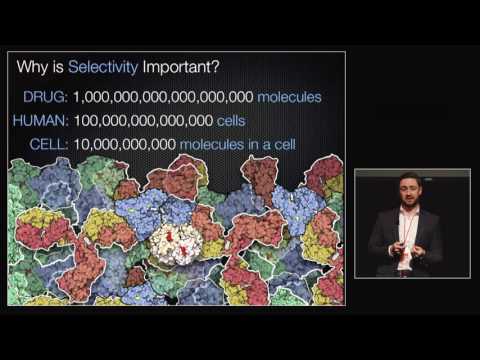
it need to be selective because our
target isn’t the only protein that is in
the cancer cell or the human body
there’s lots of different targets so to
give you a sense of the numbers and this
is pretty our filling when you think
about it the average drug dose gives the
human body 10 to the 18 molecules so
that’s a lot of zeros there is 10 to the
14 cells in the typical human being each
cell contains 10 to the 10 molecules so
if you do the math it’s a pretty amazing
number that for your drug to find its
target it is a one-in-a-million chance
so it tells you that when you get into
the cell you want to be binding to your
protein for long enough such that you’re
less at that biological response before
it disappears so where do we target so
our idea was the target stat 3 but the
active form of stat 3 is actually a
protein dimer and what we wanted to do
was to make molecules that could come in
and break open this dimer the dimer is
the active form of this protein so how
did we do this well we took inspiration
from me
and we use nature to guide us in our
drug discovery process and what you can
see here is in yellow you’ve got this
protein complex and this is actually DNA
bound in the middle you can see that
this dimer is mediated by interaction
with the yellow parts of the protein
which are shown to bind to the protein
and so our idea was can we take this
small sequence and use it to inspire the
design of small molecules which will
bind with higher potency and selectivity
than stat3 itself and disrupt this
active form so medicinal chemistry is a
little bit like a jigsaw puzzle we’re
trying to fit the molecular pieces into
the active site so that it binds
potently and selectively these are two
words that I’m going to be using a lot
in this talk so if we look at the active
site there’s three main pockets within
this protein so we want to make
molecules that bind to all three of
those pockets so this is a molecule that
came up through a computational screen
we’re going to call it compound one and
it’s got a nice e-50 of 90 micro molar
so what’s an at and I see 50 and I see
50 is the concentration of drug that’s
required to kill 50 percent of the cells
so micromolar suggests it’s very small
if you remember your organic chemistry
you’ll know that this is a very small
amount of material but in fact that’s
quite a lot when we consider what it
takes to be a drug to be a drug you need
to have a number closer to 0.5 200 times
more potent so you need two hundred
times less drug to kill the same amount
of cancer cells so what did we do well
we decided that to do this properly we
needed to find a piece that could fit in
that top pocket so that we’re tailoring
the molecule for that particular protein
so we built the molecule we added to our
structure so that we’re fitting in to
this top part of the pocket and you can
see that
kinda like a jigsaw puzzle so what do we
do what is the process for making
molecules that kill cancer cells how do
we rank them and assess them well first
of all we have to make them and we make
them with organic chemistry which is
everyone’s favorite subject at
university I know my students love me
and they love being taught organic
chemistry
biologists call as cooks they call as
coops because we mix things together and
something comes out at the end they
obviously have an inferiority complex
and this inferiority complex stems from
the fact that chemists are able to
manipulate material at the atomic level
we can do so many things with molecules
we can even time travel as then we can
make old mand excited we were looking
out for ourselves so so the first step
is to make molecules so here’s a typical
synthetic scheme we don’t just make one
molecule we make on average maybe 25 to
50 molecules in the first pass and we’re
just going to denis denote them as
little shapes here so what’s the next
step the next step is to test whether it
binds to the protein so we do this
outside of the cell because if it
doesn’t bind outside of the cell it’s
not going to bind inside the cell so the
idea is that we’re looking for a
molecule that sticks with high affinity
to this protein what’s the next stage
the next stage is to see whether it is
selective and we do this by screening
against different proteins that are both
similar and different and what we want
to see is that the molecule does not
bind to the protein it’s not a
promiscuous drug
so so then the next step is we put it
into cells so we put it into cancer
cells we dose the cancer cells and what
we’re looking for we’re looking to see
that the drug does what it’s supposed to
do which is to actually kill the cells
if it kills the cells the molecule moves
forward what’s the next stage
selectivity does it kill normal cells do
we see a selectivity of effect for
cancer relative to healthy cells and
ultimately we want to see as no effect
whatsoever so the next stage is we have
to do some cell biology we have to look
inside the cell and see whether we’re
knocking out a protein target so what we
want to see is with increasing
concentrations of drug that we see a
decreasing amount of our protein and you
can see it here then what do we do we
look at other targets inside the cancer
cell we want to see is it hitting
everything and the goal will be to see
that actually nothing happens to other
cells unless they’re related to our
protein we want to see no effect we want
to see an effect on our target so the
final stages looking in vivo so in
cancer research we engraft mice with
human tumors and we dose the mice with
our drug with two objectives the first
objective is to see whether or not the
drug is efficacious does it shrink the
tumor in the mouse and the other thing
is is it toxic we’re going into a living
system we want to see whether or not we
have serious side effects as a result of
this drug so what did we do so we
started off with this molecule compound
1 it’s got an IC 50 of 90 and remember
what we’re trying to do is to make that
number significantly smaller we want to
see this number dropping way down so
you’ve T we have a strict
your process so people like me have to
do well not just in one project but in
multiple projects or else we get fired
so bearing that in mind we made our
first change and our first change was to
get rid of this oxygen replace it with a
nitrogen and that turned out horribly so
at this point I was thinking of career
choices in Scotland cuz Canada was gonna
kick me out and so but remember the
policy that we had that we wanted to
access this upper pocket of the stat
protein so we put in a benzyl group 300
para cyano 260 Terra butyl 190 by phenol
115 cyclohexyl benzyl for micro molar so
this compound is now twenty times more
active than the first molecule so that
was really exciting we were very happy
but it wasn’t good enough we wanted to
be into the 0.5 region in terms of going
forward into animals so we meet some
more changes and I’ll summarize it very
briefly by saying that we discovered
this molecule bp1 102 so we changed this
part of the inhibitor and so this
molecule was way more potent it was 0.8
micro molar so we were getting more and
more potent we’re using less drug to
kill the same number of cancer cells so
what did it doing cells so in healthy
cells we found that had no stat3
we saw the no effect really on the metal
when we put them into cells that had
stat3 and more tumour cells we saw that
it killed the cells really really nicely
and so then we decided to move into cell
biology and we saw with increasing
concentrations of drug that our molecule
decreased the amount of stat3
so it showed us that we’re on target we
were selective for cancer cells over a
healthy cells so now what did it do in
an animal
so the first thing we do is we test in a
mouse so we inject it into the mouse and
we look to see how much drug is there
and for how long so the interesting
thing about animals and humans is that
they have a lever and a lever is
responsible for thrashing most drug
discovery dreams because they deliver is
full of enzymes that metabolize drugs so
think of the analogy of the jigsaw
puzzle and think about all the time that
my pure graduate students put in to
identifying this molecule and then they
inject it into mice and guess what
happens it completely changes the entire
structure is different and that sucks
because it doesn’t fit in the protein
anymore and we have to go back to the
drawing board to give you an idea of how
efficient their lever is this drug is
gone within 10 minutes in the animal
completely gone there’s nothing left so
what do we do like so many things we
rely on chemistry and we rely on
chemistry to stabilize these parts of
the molecule there are considered weak
to metabolic enzymes so to cut a long
story short we ended up making this
molecule which is a derivative of BP 1 1
or 2 and we saw that this molecule was
way more stable in fact it has a
half-life of over 4 hours so this was
really exciting and then we did some
more chemistry but it’s patent-protected
so we can show you the structure but
we’ll call it compound X 4 for my
venture capitalists
so we went into a multiple myeloma trial
so multiple myeloma is a hundred percent
lethal disease it’s a really toxic
cancer that claims everyone who
eventually who gets it so right now
there is no cure for it so I’m going to
show you the effect of our drug in
multiple myeloma and I’ve shown you a
series of images here which are really
cool and I’ll just state that again that
these are really cool images because
your idea of cool and mine might be
quite different so what you’re seeing
here in these mice is actually a tumor
but you’re also seeing stat 3 so stat 3
activity the is labeled so you see this
fluorescent dye is associated with stat
function so what we did was we treated
with compound X and what we showed in a
time-dependent manner over a two-hour
period was the air molecule shut down
stat 3 inside a human tumor inside a
mouse model which we thought was really
cool we then went into a major law
blastoma trial
medulloblastoma being one of the most
common brain cancers in children 70% of
the patients are treated with really a
horrible cocktail of drugs and radiation
survive they’re left with severe side
effects that they’ll take with them
their entire life the other 30 to 35%
are palliative
there is no cure option for them the
tumor spreads down the spinal column so
we wanted to see whether our stat 3 drug
would have an effect on this recurrent
medulloblastoma the medulloblastoma that
is completely untreatable right now and
what I’ll show you is two things here is
brains slices taken from mice they’ve
got these brain tumors and you can see
the tumors in purple and then we treat
with compound X and what we saw was
really stunning regression of an
untreatable tumor so this clearly got as
very
excited and just to show you that it
actually has a deference on the quality
of life of these mice that have human
tumors this is a we’ve video and what
you can see here is a mouse that has
been treated with compound X and a mouse
that has no drug and it just shows you
the most that is treated with our drug
is quite happy and behaving like a mouse
does energetic and inquisitive whereas
the most that is that no drug is clearly
more abundant so finally to summarize I
hope I’ve shown you in the course of
this talk the rational approach that
made chemists take to discover new
molecules and we’ve gone from a really
horrible compound to what we think is a
really good compound for treating
untreatable orphan diseases right now
compound X this compound has just
received Series A funding so we’re
hopeful that we’ll be in clinical trials
now within the next 24 months and I will
add the caveat that it is borrowing hair
cups medicinal chemistry and drug
discovery throws up hair cups all the
time and hopefully we don’t experience
any more and finally I’d just like to
acknowledge my research group these guys
do all the work they’re the ones that
are making the molecules testing them
and I just have the pleasure of telling
you about it and thank you for your
attention
[Music]
[Applause]
Please follow and like us: