
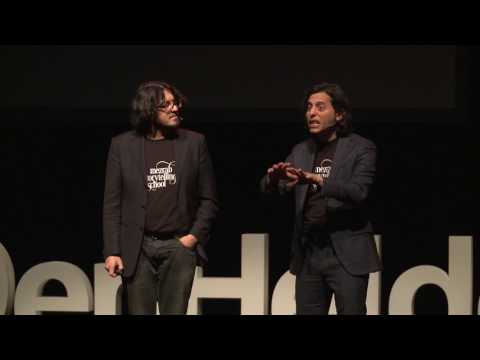
best friend we’ve been traveling to many
stages all over the world and we’ve been
sharing our stories we’ve performed in
museums and theatres often performing
for adults but not always yeah sometimes
we also perform to teenagers and we
always like to start in in in a playful
manner we tell them that one of us is
Israeli and the other was other one is
Iranian and we ask them who is who
but then we always add one thing we go
and we tell them you better guess it
right because if not we’re gonna blow
the place up it’s true even did it today
we went to some of the people that we
met outside and we asked them the same
question and about half the people we
asked got it completely wrong which
tells us quite a few things it tells us
first of all that even if there is all
these stories in the media that we
should be so different him the Israeli
me the Iranian if people can’t even tell
the difference is there even really a
difference and it’s true it’s true there
are a lot of similarities we are very
good friends we discovered over our
friendship that we have a lot of things
of things in common but we also have
some differences now I don’t know if you
guys know anything about Iranian culture
but I’ll tell you one thing these guys
they are incredibly incredibly polite
yeah that’s true yeah someone agrees in
the audience I’ll tell you I know him
for four years I still don’t know what
he thinks of me he loves me he hates me
yes no it’s all hiding underneath this
kind of mask of polite nice smile you
say it like it’s a bad thing
come on no politeness is important for
us if Iranians go into a theatre even if
there is people you don’t know the
people in the front they’re ashamed that
their back is facing someone so they
will apologize and then the person in
the back will say oh don’t worry a
flower doesn’t have a front or a back
how’s that for politeness er good right
huh okay let me let me add one thing not
just a polite smile poetic beautiful
as well yes yes as opposed to the
Israeli who very much like to open every
subject by kicking open the door
bursting and haha you know no not for us
we like to create some kind of stage for
communication friendliness kindness
friendliness yes you know what my
grandmother would say about this kind of
friendliness I’ll tell you a friend with
everyone is a friend with no one did you
hear that they agree with me
really yeah well you know what my
grandmother would say to them friendship
can have all directions its animosity
that has a very clear direction well you
know what my grandmother would say about
this true friends they stab you in the
front not in the back huh but my friends
a flower doesn’t have a front or a back
I let you win I let him win okay okay so
similarities and differences but if our
work would stop there with the stories
that we tell only on that surface level
level of identity it would be quite
superficial now we like to go deeper
with it we actually realized there is
there’s this question underneath that
that we want to ask ourselves and we
asked ourselves a very fundamental
question we asked herself when was the
first moment in our life that we became
aware of the fact that we belong to any
group because let’s be honest what does
a baby know about being Israeli or
Iranian right it starts at a certain
moment these layers of our identity that
we put on ourselves and gradually to the
point that we say we are this and we are
that and these layers how are they
created well many times by stories
stories of our ancestors of our heroes
of the failures of the people we loved
and like this gradually a certain skin
is placed on us and underneath it for us
is there is a there is a question that
it
who are we so this question who are we
but also this question of when was the
moment that you were claimed by your
group that you realized you were part of
one group and you were not part of
another group this we took to our
mothers he to his mother and me to my
mother yeah me to my mother with a
Jewish woman that grew up in Iran
actually and only later in her life she
came to Israel yeah and my mother who is
also from Iran but came from a Muslim
family now this is a story that my
mother told me she said that she was six
years old a six year old girl who simply
loved to sing more than anything in life
and at that age being with shy she would
always wait for her mother to go to the
market then she would have the house for
herself and she would practice and
practice the songs and in those days you
know pop songs didn’t have very cheaply
right no they were written by real poets
and these words like rubies diamonds
emeralds they would come out of her
mouth my mother told me that when she
was six years old back in Iran she was
waiting for the moment that her mother
will take her to the marketplace you
know what they called her cholera SIA it
means a Black Raven why because she
didn’t have the white skin of her sister
and the green eyes she was dark but my
mother has one really strong
characteristic she is very very stubborn
so she kept nagging my grandmother take
me to the marketplace take me to the
marketplace take me to the marketplace
until my grandmother said okay okay when
you’ll be seven I’ll take you okay
what do you think happened the day she
turned seven it was dark outside when my
mother was already up with my grandma
most beautiful hijab decorated with red
flowers standing next to my
grandmother’s bed shaking hair telling
her I’m seven are you going to take me
to the marketplace well a promise is a
promise and my mother told me how she
was amazed by this marketplace this is
not Albert Heijn you know
the smells of the spices the colors of
the fruits seeing the man picking up the
watermelon tapping them to see if they
were ripe and my mother she was so
excited she ran forward and she found
herself in front of a vegetable stall
and there in front of her eyes she saw
this big fat black aubergine and she
reached out to touch it and she will
never forget what her mother told her
then my mother will never forget what
her mother told her when she came back
from the market you remember the six
year old girl who loved to sing she’s
there she’s practicing and suddenly the
door of the house opens she hears the
footsteps of her mother in the hallway
she sees a mother stand in front of her
pointing a finger at her saying don’t
sing don’t touch that’s what my
grandmother said to my mother and then
my grandmother she pointed out the
vegetables without touching them and the
seller he placed them in a box and he
handed the box to my grandmother why
can’t I sing simple question from a
six-year-old girl to her mother why
can’t I sing and her mother explained
with a lot of patience you see my girl
if you sing and a man you’re not related
to hears your voice he will have bad
thoughts and then he will go to hell and
then because you gave him those thoughts
you will go to hell I have friends in
school they sing yeah very unfortunate
for your friends but we don’t sing we
are proper Muslims why couldn’t touch
touch the vegetables that’s what my
mother asked well you couldn’t have
touched the vegetables because if you
would have nobody else would why all the
other people were doing it yes but we
are not like all the other people you
well it is a narrative that was told a
long time ago and it’s a narrative that
[Music]
took these two girls who could have been
friends and separated them but you see
our generation us we work with these
narratives they’re our bread and butter
we look for them we ask them to be told
we dive into them we ask other people to
tell their stories so that we understand
who we are and who they are and what are
the layers that are put upon us and a
lot of this we do also in our school the
master of storytelling school so in a
way the narrative brings us together but
not just us also our mothers and this is
funny because I moved to Amsterdam and
my mother came to visit me a year ago
and when she came I told her hey I want
you to meet my best friend so we went to
visit this guy and he’s a little Iranian
flat in the west of Amsterdam and from
the first moment my mother entered that
house I saw a child the carpets
you know looking at the walls as if
she’s remembering a world she had
forgotten and I she was sitting on there
on the couch and then his mother came
and sat in front of her and at that
moment yes she took her hand and at that
moment my mother started speaking in
Farsi I didn’t understand the world but
it looked wonderful for hours you know
these two women went once stroking the
hand of the other by the way telling my
father bring some ice cream yalla Ali
come on come on I want to feed my best
friend and they were together like this
you know after all these years now I
don’t know maybe some of you would think
are these guys their storytellers
they’re exaggerating it was a sad story
they wanted to end it in a positive note
it’s not true well especially for you we
brought a proof
come on Irfan stand over here yes here
you see them the one time that they met
in our house my mother and his mother
ladies and gentlemen the power of story
[Applause] you