
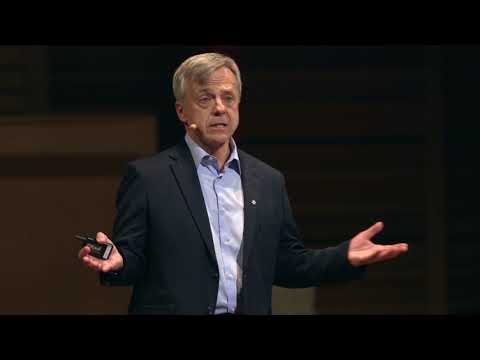
a couple years ago my wife and I have
were having dinner with some friends and
the conversation around the table got on
to spaceflight and medicine and so one
of our guests asked me knowing that I’d
been back on earth for a few years after
my last flight if I had returned to
normal and I said yes I’ve returned to
to normal well my wife interjected and
she said no no no no you have not
returned to normal
psychologically she said you were still
up there in space you’ve never returned
so we all laughed and what I meant when
I replied to our guests that I returned
to normal was from a physiological
perspective I had regained the aerobic
capacity I had regained the muscle
strength I had regained the bone mineral
density that I’d lost during flight and
my body more or less had returned to its
pre-flight State but my wife was correct
psychologically I was still up there in
space and a lot of my priorities a lot
of my perspectives had changed such that
what I considered signal versus noise in
the past had changed to post flight
state so let me explain what I meant by
that
the first way that space changed me was
an appreciation for the glorious beauty
of the planet that we live on
I remember our my first view of Earth
from space we had just launched to space
aboard the space shuttle Columbia about
ten minutes into the orbit and someone
tapped me on the shoulder and I looked
out the window and this is what I saw it
was the Atlantic Ocean and the Sun was
glinting off of the blue waters of the
ocean beyond the ocean was the curve of
the Earth’s horizon and then beyond the
horizon was nothing but empty black inky
space it was surreal it was totally
different than anything I’d experienced
in a simulator anything that I’d viewed
in a book or a film
the view sent a chill up my spine that I
never forgot and thereafter whenever I
had time on subsequent days my favorite
activity was just a float near a window
and looked down at this beautiful planet
down below so deserts come in a hundred
shades of brown 100 shades of yellow a
hundred shades of orange 100 shades of
red a thunderstorm is a powerful
phenomenon to observe from up above and
viewed from up above mountain ranges
erupting volcanoes ocean reefs are
mesmerizing ly majestic the other thing
I saw when I looked gazed out the window
I gained an appreciation for the myriad
of interconnections that exist in our
natural ecosystem down below so for
example forest fires in Siberia track
all the way halfway across the world and
impact the quality of air in North
America a small atmospheric depression
and the Atlantic Ocean develops into a
category 4 hurricane and wreaks havoc in
the lives of the citizens that live
along the Gulf Coast overnight the price
of gasoline goes up 30 cents per liter
in my hometown which is half a continent
away and what I began to appreciate is
that Earth’s natural ecosystem features
multifaceted interconnections between
the land and the ocean in the atmosphere
and the fresh water cycle and the flora
and the fauna and a small disturbance on
one part of the natural ecosystem can
have an effect on the other side of the
planet but ecosystems are elsewhere
they’re everywhere and they’re beyond
nature they permeate our society they
permeate our lives so for example think
about the human body the failure of the
beta cells in our pancreas can put
patients at significant risk for disease
involving the nerves the eyes the teeth
the heart the small blood vessels and
even the kidneys all because a tiny
tiny group of cells in the body no
longer produces insulin another
ecosystem is the financial world which
features complex relationships between
bankers consumers government’s
shareholders regulators and back in 2008
the collapse of the Lehman Brothers
kicked off a perfect storm of ensuing
events that rippled outward and almost
brought down our financial empire in the
in the earth on the west coast of
Vancouver Island there is an indigenous
nation and there the neutral news and
they believe in a holistic relationship
between the physical world and the
spiritual worlds and they have a saying
that they hold on to his shook ish so
walk which when you translated it means
everything is one we are all connected
everything is one we are all connected
in other words they perceive that the
universe is an intricate in an orderly
whole and things that happen in one part
of this whole impact and are connected
to many other systems throughout our
planet throughout society throughout our
our lives but looking down at the earth
with the passage of time and space when
days became weeks and weeks became
months I began to perceive some of the
small details down on the planetary
surface below and that really impressed
me with the fragility and the
vulnerability of our planet and it also
impressed me with the impact that human
activity is having on our planet as well
so for example off the east coast of
Africa there’s an island nation called
Madagascar and Madagascar is suffering
from catastrophic loss of topsoil so the
unregulated removal of forests native
forests from Madagascar over the last
fifty or hundred years for a pasture
land for cultivation purposes has
resulted in massive erosion so massive
loads of topsoil are coming off the
denuded mountain sides into the river
valleys below choking off the river and
then with the river outflow all of this
life-sustaining valuable topsoil is
leaving in vanish
from Madagascar for ever so you say well
Bob you know this is the 21st century
what happened fifty or a hundred years
ago is the past certainly we’re smarter
today we’re wiser we understand the
concept of sustainability this would
never happen again right wrong so this
is a photo that I took of the Brazilian
rainforest whenever we pass over the
Amazon I would see tens of brush fires
with their smoky Paul’s coming up into
the atmosphere and then being
transferred halfway across the Atlantic
Ocean towards Africa so the same
deforestation that happened 50 years ago
in Madagascar is happening today
in the Amazon one particular Brazilian
state known as Rondonia is particularly
bad hit and there is more area now of
clear-cut than or is of remaining
rainforest canopy and this is tragic not
just for the Brazilians but it’s tragic
for all of us because the Amazon
rainforest are the lungs they affect the
quality of the entire atmosphere of the
entire planet
so today was a clear day in Calgary and
I looked up and I saw clear blue Prairie
sky 360 degrees around me blue blue blue
blue blue and if you’re thinking that we
have one resource on earth that’s
plentiful it’s got to be our atmosphere
well viewed from space that’s not the
case all that we have that protects us
from the harsh environment of space is a
sheer veil of atmosphere that envelops
our planet so it protects us against
hard vacuum extremes of temperature
ultraviolet radiation ionizing radiation
all that we have that sustains life on
Earth is a sheer thin veil of atmosphere
one of the delights for me during my
first flight was recognizing that the
nighttime view of the planet is every
bit as awesome as the date-time view
took me by surprise and that’s because
of their aura and also because of city
lights as well city lights look like
diamonds that are scattered on on black
velvet and city lights are also helpful
because they the outline
the coastline of a country and they can
also give you them good impression of
the economic prosperity of a country or
of cities like like Rome and Naples
someone a long time ago said that from
space you can’t see national borders in
this statement is a nice sentiment and
it’s partially true in that you know
there’s no red line running along the
boundary between neighboring countries
that doesn’t exist but when you fly over
at night times regions of the world
you can certainly perceive which
countries are doing well and which ones
are not so this is a view of East Asia
at nighttime in the lower right corner
is the country of South Korea and the
big intensity of light that’s the
capital city Seoul and in the top left
that’s China you can appreciate some of
the big cities in China as well and what
you probably think is that in between
South Korea in China there’s a waterway
there joining the Yellow Sea to the Sea
of Japan it’s not it’s North Korea and
in North Korea it’s a desolate blotch of
darkness with no power no heating no
lighting for 25 million citizens and as
i overfly this country i realized that
the north korean political leaders are
misguided and they neglect the economic
plight of their country and they ignore
the standard of living of their citizens
the only spot of light there is the
capital city of pyongyang it’s it makes
me feel regret for those societies that
are repressed by harsh rule but don’t
get me wrong the experience of
spaceflight is overwhelmingly positive
it engenders hope and promise
collaboration everything that I’ve
achieved as an astronaut has been done
on the basis of collaboration
collaboration across cultures across
disciplines across international
boundaries
and even the view out the window helps
to set that mindset of
internationalization so at you know that
the International Space Station orbits
the earth once every 90 minutes and
every 90 minutes I see a new pranayama
of country so on one orbit I’ll pass
over Honduras then Cuba Ireland Britain
Central Europe the Middle East the
Persian Gulf then off we’ll go and visit
Australia and New Zealand and then the
new global panorama starts with the
start of the next orbit a new sequence
of countries a new palette of
topographies you know a lot of the
countries that prior to flight that I
wasn’t all that aware of suddenly
dominate my daily view of the of the
planet so I think about the countries I
think about the people that live there
Greece the home of ancient home of
civilization Sudan South Sudan with the
ongoing civil strife there and the
famine and then I think of the Middle
East the birthplace of Judaism
Christianity Islam on my first week in
space I eagerly sought out my hometown
and when I found it I called my
crewmates over and I pointed out my
hometown to them the second week I
became aware of my continent then the
third week and thereafter I was only
noticing one humanity
I felt predominantly a citizen of planet
Earth if you had asked me prior to my
first flight aboard the station what is
the best thing about the International
Space Station I would have said that it
is our unique research facility that
allows us to do research you cannot
possibly do on earth and if you asked me
that same question after I flew on the
ISS then my answer is a little bit
different I still proclaim that the
International Space Station is a R&D
facility of no earthly pier but I think
today best thing about the International
Space Station is its international it is
brought together
former adversarial Nations under a
common vision to extend
the capability of humans and a desire to
increase hope for Humanity and to
inspire the population to pursue
audacious dreams International Space
Station program has demonstrated that
the visions that unite us are more
important than the things that divide us
that we can overcome economic political
social cultural barriers to extend the
reach of humanity and that exploration
is important it’s critical that Earth is
no more than a cradle for Humanity and
that one day civilization will migrate
out to interstellar destinations I
believe that the legacy the enduring
legacy of the ISS is going to be the
international partnership the blue
marble is a photograph an iconic
photograph that was taken by the last
crew of the Apollo mission series as
they were venturing from earth to the
moon back in the 1970s its iconic
because it caused a consciousness shift
in society for the first time ever we
began to think about our planet as a
precious blue planet in the setting of
this Dark Void of of the universe well
the blue marble photo was also important
because it helped to create a term that
we call the overview effect the term the
overview effect is used by astronauts
and by others to describe the spiritual
feeling that comes over you when you
look down and you see the planet Earth
that we’re all connected and that we’re
all one and that three International
Cooperation we can do things that we
can’t do alone let me show you one more
photo that made a similar impact on me
earlier this summer we witnessed the end
of the scientific mission of the Cassini
space probe and over 13 years
Cassini took 450,000 images of Saturn of
its rings and of its moons as well but
my favorite Cassini photo is not of the
Rings it’s not of the moon my favorite
Cassini photo is of Earth
so three years ago when Cassini was on
the backside of the ring planet it
turned its cameras inward and image the
inner solar system earth is in this
field of view do you see it there we are
hidden in the rings of Saturn and as a
late astronomer Carl Sagan said Earth
viewed from afar
is a pale blue dot doesn’t this image
make you feel tiny doesn’t it make you
feel alone doesn’t it make you feel
vulnerable Earth is alone for hundreds
of billions of kilometers surrounded by
nothing but the void of space within our
solar system where the solitary oasis of
intelligent life and like dr. Sagan when
I look at this image I can contemplate
that all of human history everything
that humans have ever learned everything
that we’ve experienced everything that
we will know everyone whom I’ve ever
loved is on that isolated dot they are
and it makes me more diligent in trying
to preserve our existence you know I
think that a hundred years from now
humanity will still exist but a thousand
years from now on our current trajectory
in our present mindset I wouldn’t bet on
it some of the recent rhetoric and the
posturing between nations worries me
when you consider the snail-paced
progress of humanity over the last
millennia at great cost an effort
wouldn’t it be foolish
wouldn’t it be irresponsible wouldn’t be
the ultimate calamity if we ceased to
exist at our own hands you know I hope
that in the coming decades we will
discover life elsewhere you know in our
in our galaxy that would be mind-blowing
that’d be awesome that’d be exciting it
would be the news event of the 21st
century but it could be that we’re alone
it could be that we’re it the only
intelligent life in the universe
well anyways my wife was right of course
I never turned back from spaceflight and
my perspectives and my priorities have
certainly been influenced by what my
experience is what’s important to me
today is not illegal immigration it’s
not the travel expense claims of
Senators it’s not the affairs of the
Kardashian family what’s most important
to me today
after having flown in space and looking
down at the Earth from space is
overpopulation poverty inequality
environmental damage in other words
survival survival of humanity survival
of our of nature that’s what I call
signal much of the rest is noise you
know I don’t think I’m a better person
because I’ve flown in space but I think
I am different my wife in fact will
argue that I’m more difficult to live
with she says that with my head up there
beyond the clouds that it’s more
difficult to engage me in some of the
practical important affairs of our of
our household from the dawn of the Space
Age a half century ago filled me with
Wonder filled me with promise humanity
was gonna boldly go where we had never
gone before you know exploration is a
way of raising our thoughts from
parochial egocentric issues of the
big-picture long-term global goals it’s
ironic you know we go out into space we
venture out into space in order to learn
about what’s out there but much of what
we learn is about our home planet and
about ourselves I think every human
being every decision-maker
we benefit from this orbital perspective
thank you
[Applause]
Please follow and like us: