
and how do digital technology to perform
us another way to ask this question is
what are the physical and behavioral
symptoms of digital technologies present
within our everyday lives
to think about this I want to talk about
one thing which is your phone you’ve
heard it all night but ask yourself can
you count how many times you’ve checked
your phone since you’ve entered this
building right um during talks do you
feel the need to look at your phone even
if you don’t do it no and asking these
two simple questions
how has your physical and affective
state changed just by thinking about it
my name again is Jessica Rico and I’m a
professor in the school of film dance
and theatre my background is in dance
and somatic practices and given this you
may be wondering why I’m asking you
about your phone it’s real right but the
reason is is because I am very
interested in and concerned with how we
physically engage in our everyday world
I’m also really interested in our
conscious awareness of how we do that
physically I just so happened to take
those practices and put them into
thinking about the usage and making of
technologies now this gives you kind of
a picture of what I do but in like true
Ted fashion I gave myself a really
cheesy title just for this talk and so
here it is I am a compassionate
so downward from the bird passionate
other people’s distress feeling their
struggled as if they were my own in
other words I empathize with people
the other one is kinesthetic meaning
that I engage in physical f2 big
physical embodied bodily consciousness
connecting my consciousness to my
physical sense of self
the last one is dis ruptor hmm I aim to
interrupt your break apart
infrastructures and processes as I see
meeting radical change and it just so
happened that one of those faces that I
really see meeting radical change is our
relationship with our consumer digital
technologies why is this though it’s a
really great question and then to answer
that I brought on three people to
explain data that’s a really good
question right it’s a question I feel
like I should be able to answer I mean I
think about this stuff all the time for
example in the short relationship I had
with my fitness tracker I found in an
attempt to meet my daily goals that I
became a sort of data prisoner I would
pace around the house late at night in a
sad attempt to get to those 10,000 steps
and I only ever met that goal once I
have similar issues with my phone in
general I’ll pick it up at the first
hint of boredom throughout the day
according to this self tracking app I
have on my phone called moment I check
my phone 70 times a day that means on
average I’m spending about 2 hours and
43 minutes just staring at my phone now
I know I don’t need to check things like
Facebook that often but still I do and
this moment app is supposed to help me
take some conscious steps to limit my
digital interactions but mostly it makes
me feel super self-conscious so what’s
the point now I have another app to tell
me things I already know and still my
behavior hasn’t changed what is data
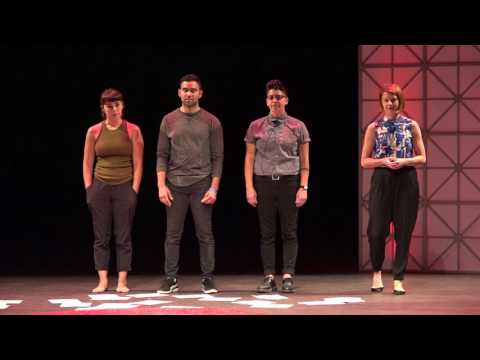
doing to me everybody this is at least
a cliff juan Rodriguez and Laci Garcia
three of the 14 artists I worked with on
an evening leg performance work titled
be my quantified self and I in this work
we explored the physical symptom in our
everyday life we told stories through
movement and words many of the stories
coming from the dancers themselves like
the one you just heard from ELISA and
you may hear some some things that are
familiar to you in this and I don’t know
if everyone got one but you may have
gotten a piece of paper that had a
phrase on it yeah that had a big blank
spot to put a word if you want to join
us in this next part I thought we could
do it together optional of course but
we’re going to do a demo version just so
you get a sense of how we’re going to do
this okay so you have a everybody has a
different phrase and we have three of
them in total spread throughout the
audience we’re going to demo what to do
with Netflix hmm yes i watch netflix
about one hour a day so as you heard us
come together you can do the same the
next one we’re going to do is go to
Facebook yeah on Facebook I spend about
40 minutes a day I see some in there
yeah just so you know the average user
according to Facebook spends a few
minutes a day on this on the site okay
this one look at a screen about six
hours a day all right according to the
2016 Nielsen Company audience report the
average adult US citizens spends about
10 hours and 39 minutes looking at a
screen consuming media each day yes and
it’s going up last one
I sit about five hours a day
any sitters in there yeah the average US
office worker spends about 10 hours a
we see these numbers and maybe we’re
surprised or maybe we’ve heard them
before but have you ever been asked to
write them down for yourself and look at
your own numbers hold them in your hand
so you can look at them and they can
look back at you right what do we want
from our digital technologies what do we
want from our quality of life with these
types of technologies many of us go
through lies we sit stand walk eat top
hang out with people without actually
being aware of our physical sensing body
through these processes and somatic
practices we call this somatic amnesia
what it means is we are so habituated
our own body that we can physically
engage in our world without being
consciously aware of how that feels
in our own body we are literally
practicing our bodies out of our way of
we are literally practicing our bodies
to make this more palpable I want you to
go ahead and close your eyes don’t do
anything but just close your eyes and
I’m just going to say some things to
take you through consciousness of your
own body connect first to your breathing
with your eyes closed where do you feel
it is it up towards the neck is it in
the ribs or down at the belly how deep
is it do you have to increase your
breath just to feel it inside yourself
this involuntary action we have to do
every day bringing your awareness to the
outside surface of your body I want you
to pay attention to how you’re sitting
in your seat take note of where you feel
pressure where it feels more or less
maybe where muscle is is a little less
maybe where bones are like those sits
bones we sit on is a little bit more you
might even know if you’re tilting side
to side one side to another just by the
pressure you feel in the back of your
legs maybe one leg isn’t even touching
because your legs are crossed
going back internally into the body feel
where you’re holding muscular tension
don’t change it
but just ask yourself recognizing your
own bodily intelligence if you did some
simple thing how could this position
feel better what could you do this act
you
[Music]
so this is a solo that Lacey Garcia and
I co-created as part of my quantified
self and I and in the practice of making
this work we were thinking about if we
listen to our bodies what would it say
to us when we’re working with
technologies we wrap our bodies in these
strange positions in order to stare at a
screen or our phones oftentimes twisting
ourselves in these strange places not
really even recognizing that our body is
seeking out into the world feeling and
sensing which it is always doing until
we maybe stand up and move again
maybe you would like a good stretch or a
sigh or even throwing our brow maybe
even a little hint of frustration by the
fact that our body just can’t quite
conform to the ongoing practice of
sitting still like I said we are
literally practicing our bodies out of
our way of being in the world or to go
back to one of my earlier questions we
could say yes that digital technologies
are performing us and in this
performance our bodies are really no
longer really needed I want to show you
an image this image comes from Donna
Sullivan and Tom igoe’s book on physical
computing and it was made to imagine how
computers would see us based on the way
we use them right one eye to ears in a
digit that is what we are to most of our
consumer devices so if this is how
computers see us they don’t see us as
human beings who can skip walk run or
dance they see this as an assemblage of
three body parts so what are we doing to
change this a lot of things that I’m
doing is considering this idea of play
right when we hear the word play we
think of children because they’re so
stinking good at it right really good
they are masters of like moving through
their world and being aware of what
they’re doing
right they are very aware of how their
bodies are moving in space and how
they’re learning from them it’s just so
happens that as we turn into adults
these sort of repertoire that is
acceptable has shrunk and it means that
learning is oftentimes denoted passively
and an active mind not if you’re a
dancer though I hate to tell you we have
all the fun as dancers we are just it
this is our lifeblood is movement we are
constantly in the ongoing sophisticated
practice of learning through our own
physical experience a lot of times we
call this movement improvisation but for
the sake of today let’s call it critical
play not frivolous play that’s just sort
of open-ended without any sort of
intention but free and open play that is
guided by the idea that we can learn
something from that this is what we do
and it’s something that as I went into
grad school has started to get into
human-computer interaction design spaces
I realize could be really really useful
in such spaces and this was really
reaffirmed for me when I read Phoebe
singers a chapter on an engineering of
experience and in this chapter she talks
about Frederick Taylor’s work during the
Industrial Revolution right making
movement efficient and engineering our
physical experience to cut out all the
excess stuff cut it out so that we can
do the work that we need to do in
factories but the interesting thing is
if you look at our contemporary
environment hasn’t changed much even
though we’re no longer working in
factories we are still using efficiency
with our devices and our engineered
experience and our engineered world as a
major metric that we use to define what
is good what she argues and I would I
would agree with is that maybe we should
forego efficiency for a little while and
think about things like fun play
movement physicality so how I’m doing
this is I started to look at things like
this is my lab this is a very large arts
festival family-friendly and what you’re
seeing in here are interactive
sculptures that we’ve made they resonate
or vibrate in real-time with people’s
personal data output meaning that when
people lay roll hang
out on these sculptures and they play on
their phones they can actually feel
their mobile phone device output in real
time we call it data ship so what does
it mean to think of this as our lab not
just our academic setting this is our
iterative process these is our
colleagues doing things like this and
this and this and this so asking other
people to participate in fun things is
not really that but what if we ask
designers to dance to play yeah as part
of their process is a requirement as
part of their process so one thing I did
is I made a rapid rote prototype
wearable technology band where you could
snap in a bunch of different sensors and
feedback modules meaning that when I
teach designers I asked them to move
first into play first before they ever
sit down and start to design those
technologies so they have to start
through action through play here’s some
other examples and here’s with people
who never danced where they started
thinking about the body different places
and we typically do right so this is
some of the work that I do just two
quick examples of my work as a
compassionate kinesthetic disrupter I’m
compassionate about the difficulty of
working with bodies it’s not easy as a
designer but I’m also compassionate
about the idea that we might want more
from our technologies than what we get
right now I’m kinesthetic I come at
things physically first tactic first I’m
a tangible human being I like tangible
things and I’m a disrupter because I
think we need radical change in these
spaces because if we want our
interactions with technology to look
like something more than this and we
want our bodies in relationship to
technology to look like more than this
then we need designers who are willing
to do this and we need to make sure
dancers are at the table when we’re
designing our technology
so that we can have experiences with
technology that look a little bit more
like this thank you [Applause]