
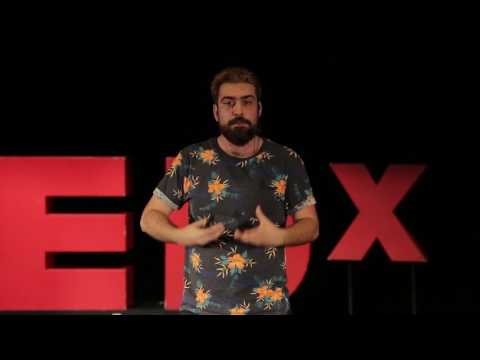
Translator: Getulio Marques Muniz Junior Reviewer: Maricene Crus
‘I don’t know if I’ll be strong.
I don’t know if I, myself, will be sufficient.
It’s something so small, that I should be greater than this “thing”.
“Thing”.
I can’t even say it out loud.
Sometimes I look at the window
and it looks like the light from the gap under the door,
in a dark morning, so inviting.
Before leaving the bedroom, it seems the day will be very good.
So, I don’t leave.
I lie down.
I get attached to this darkness.
I look at the window
and it looks like the light, in the gap under the door,
so inviting…’
Perhaps I’ll disappoint you here today,
because when we talk about HIV,
the expectation is for a very sad story, a story of abandonment
a horrible story, like in the movies.
And then I come in here walking.
Maybe you were expecting my entering in a wheelchair
with a drip, looking very pale, full of blemishes on my skin,
but then, comes in a nice-looking guy…
(Laughter)
My mum helped me to produce this talk, be aware…
(Laughter)
But let me explain to you why I’m here like this, healthy.
I was diagnosed with HIV in 2010.
At the time I was 18 years old. I was starting my life.
I had been accepted to university, had passed my driving test,
had met a guy, I was in a relationship.
He knew my family, my friends and we were going on a trip together.
But then, they called me from the clinic:
‘Gabriel,
you need to come in person to get your results’.
I was screwed, wasn’t I?
At the time, receiving a diagnose put me in a position
where perhaps many of you are still in:
I was sure that HIV would lead to AIDS
and AIDS would soon lead to death,
without any dignity along the way.
But reality was very different.
I got home crying, my mum put me on her lap,
and she went and booked a doctor’s appointment.
My mum, dad and my sister always supported me.
My sister has just been accepted
to work with The Global Fund to Fight AIDS, Tuberculosis and Malaria.
She has made a career out of it.
My boyfriend,
to whom I talked the same night I was very frightened,
he came to me and said: ‘It’s going to be OK’.
I can’t recall any friend cutting off contact with me because of this.
Some got worried,
because they didn’t understand I could live a healthy, fulfilling life.
But when someone doesn’t understand something we explain repeatedly,
some way or another they will get it.
So, I’m sorry to disappoint you,
but I had to come here because we are 800,000 people
living with HIV in Brazil,
and despite some being healthier than me,
some others are not so healthy.
The passage I told you at the start is in my play
which is based on real life,
about a guy who used to send me messages at 3 a.m.,
telling me he was thinking about jumping off the window,
and I used to wake up at 8 a.m. not knowing if he had jumped or not.
I had to come and represent this community.
But it’s difficult for me to talk about HIV,
because your expectation is for the presentation of many slides,
with some genital discharges… (Laughter)
And then, I would even show you some graphs with impressive stats,
but I wouldn’t get into much detail because it’d be just to scare you.
I would repeat: ‘Wear condoms! Wear condoms! Wear condoms!’
We aren’t going to talk about HIV because I don’t want to disappoint you.
I didn’t bring graphs, pictures and I don’t know how to use PowerPoint.
(Laughter)
And I didn’t get to know the horror and the fear of AIDS,
as the previous generation got to experience.
I can’t talk about this fear of AIDS with authority.
And I don’t want to do that.
That’s it, then. It’s finished, good luck.
(Laughter)
I think so –
because if I were to talk about HIV to fulfil your expectations
I would need to talk about my family kicking me out,
pointing at their gay son and saying:
‘I warned you it would end up like this. You went looking for it’.
Instead, I keep until now a note from mum,
from the night I spoke to my boyfriend and she was saying:
‘We will always be here for you’,
for me to know that in that house…
She’s wonderful!
(Vivas) (Applause)
They told me I could cry and I jokingly said:
‘Who’s going to cry on stage?’
(Laughter)
I’ve always known I’d be supported in that house, no matter what.
I could talk about the first blood tests,
which are quite frightening, because they are too many.
But the memory I have is of a very laid-back, funny doctor my mum found,
who would tell me jokes and explain:
‘Mate, we’re only going to do a checkup.
We need to know how your body is doing before treatment
to make a comparison afterwards. It doesn’t mean you’re at risk’.
I could talk about the side effects: dizziness, the hot flashes
that makes you want to punch someone; and some nightmares.
But during the first nights I took my meds, my boyfriend slept with me,
and this is a memory I have about him, being vigilant, ready to comfort me,
in case something happened to me, but nothing happened.
But then I became single, and you may think:
‘Oh, he’s found some suckers on his way. Now he’ll feel the burden of this thing.’
Yes, I have, but I would have found suckers with or without HIV.
And apart from this, I had a very interesting sexual rediscovery,
with partners who respected me a lot,
and I understood what it meant to have sexual relationships being HIV positive.
I also had some expectations about work, because I used to work with children,
but the principal told me: ‘If anything comes up, we have a meeting;
if they get offended, they should find another school’.
(Applause)
There are so many incredible people in my life.
(Applause)
Then I came out of the closet; the second closet.
I posted on Facebook telling people I was living with HIV,
and Facebook is no-one’s land.
So, probably, many mean comments were posted, right?
No.
What came from this is a project I lead about sexual health
through art, knowledge and care.
So, all I can do here is to list some privileges
that made me live well with HIV and work from it:
a loving family, a caring doctor,
respectful partners, concerned friends,
a loyal boss.
But wait…
This is not a privilege at all!
This is basic! It’s essential!
How have we got to this point where having a family that supports you is a privilege?
How have we got to this place
where the best of what a boyfriend or girlfriend can do is to respect you?
How can a caring doctor be different from the others?
This should be a prerequisite.
How can a group of people get together and say, ‘We are a family’,
if they’re not willing to care for a member
regardless of what could happen?
How do we establish a partnership without mutual respect?
How can a person spend years studying medicine, doing residency, studying a lot,
but at their office they open the door and only see a huddle of organs
and not a person?
None of this is a privilege.
We shouldn’t lose this perspective.
It’s all basic, it’s all essential:
respect is essential, affection is essential.
We can’t live without love.
None of this should be considered good fortune.
So, I’m not going to talk about the disease,
because I didn’t know AIDS, except from books, films, cases I’m told,
and I don’t want to know it.
Today we have technology to prevent everyone living with HIV from facing AIDS.
The problem is in health access, in the discrimination and fear.
So, I’m not going to talk about this, about the disease.
I want to talk about affection,
because to talk about HIV through fear is very easy.
The pictures, remember?
Some black and white photos with some thin folks dying in a hospital,
some genitals floating around:
‘Wear condoms! Wear condoms!’
But that’s not enough
and fear and sex are two things that have nothing to do with each other.
This fear of sex, of rejection, of not belonging to each others’ privacy,
brings silence, detachment.
Then we blame our sexual desire,
‘Well, it’s because, at that very moment, I was very horny…’
Hold on!
What’s this desire that makes you forget there’s a person in front of you?
It’s not about a few ‘holes’ which you can alternate.
How can you forget that this is a body affecting and being able to be affected?
It’s a body susceptible to the best and the worst we have in this world.
This objectification is exactly what stops prevention.
We need to talk about these things to promote respect.
This prevention by fear we used to see a lot around lasted very little,
and the specialists and the media love to avoid this reality.
In the 1980s and 1990s, OK, it was important.
It helped a lot of people who had never worn condoms start wearing them.
Because at that time, if you wore condoms,
it was because you’d been going out with careless people.
If you’re going out with a respectable lad, why are you wearing condoms?
Isn’t it a serious relationship? Aren’t you getting married?
And then comes a new generation,
that doesn’t know the fear of AIDS as the previous generation
and, thus, doesn’t relate to this process the same way.
What do we do then?
Do we wish for people to start dying of AIDS again?
Do we wait until they lose their dignity?
Do we exploit the sadness and abandonment faced by many of these people
to do massive national campaigns?
If someone here thinks this is correct,
come up here and hit me, this way I’ll get less offended.
You can actually come up here. I’ll wait for you up there to come down.
(Laughter)
Our treatment, the meds we take every day,
the stigma we’re subjected to, the loneliness many of us face;
none of that is sold to advertising agencies.
This is our process, our journey.
On the other hand, affection is the wealth of humanity.
Affection is something that everyone can take, share, replicate, multiply.
It belongs to everyone.
And the path of affection is different from the path of fear.
We need to make use of this absence of fear
and develop a new prevention strategy,
a strategy through affection, that relates much more
to the global era we live now,
that relates to respect and value to diversity,
regardless of any movement that may arise against it.
And affection demands a lot of work, but it’s well worth it,
because the change sparked by affection is a core change.
It’s founded on respect, because caring means connection
and to connect to you I need to remove all the barriers out of the way:
I need to remove stigma, prejudice; I need to end discrimination.
We’ll only have affection if we fight against disinformation.
A great example of this is:
the best way to fight HIV today is fighting sexism.
If we begin to discuss this heteronormativity of sex,
this phallocentrism in which the female is only the complement of the male sex –
and the male is the one deciding about prevention,
regardless of what his partner thinks.
I say ‘partner’ because the male in a gay relationship
also get into role models seen as feminine by the society.
So, from this comes homophobia.
All of it comes together and disturbs prevention, health care access,
all of this hostility.
This dialogue needs to happen,
because fear takes hold in the infertility of silence,
whilst affection comes with knowledge.
Both things can’t be separated:
if I understand you, I’ll love you
and if I love you, I’ll want to understand you even more.
Have you heard of empathy? This is empathy.
This spiral of affection is fed by knowledge,
whilst fear feeds silence and it doesn’t get any thanks in return.
We feel empty in ignorance.
Where affection takes hold,
we’ll truly break the silence,
the end of loneliness, no one will need to hide.
I’m not only talking about those who live with HIV,
but with any vulnerability.
Any stigmatising condition can be debated,
can be seen, noted.
We don’t need to know anyone with HIV to learn this:
Learn that those in HIV treatment don’t spread the virus;
learn that in case of an accident or even sexual violence,
you can do a 28-day treatment to prevent HIV infection;
learn that people can have kids like everyone else.
Kids who will grow up without blood tests, meds, without the virus.
We need to prepare ourselves and shout around, and I talk about it.
I talk about affection, empathy, about HIV.
But I don’t want to talk about AIDS,
because I understand HIV not just as a biomedical issue.
And this biomedical issue has developed quite well.
I want to talk about the social issue,
about an education that could build relationships,
not a biological and ‘hygienic’ sex,
a picture of two genitals that are even cut in half…
And then we don’t understand when teenagers have sex
and can’t find there anything they saw in the books.
‘I was expecting a 2D picture, cut in half, but t’s nothing like that!’
(Laughter)
I talk about relationships, all of them:
short-term, long-term, the serious and the casual ones.
It will never, ever be only about sex.
We’ll always have other implications rather than just pleasure.
I talk about well-being, not about disease.
The disease is what we want to cure, it’s what we want to end.
But the talk about well-being should be constant.
Treatment should be seen as a momentary measure.
Talking about these matters creates safe territories.
When we talk about HIV you can understand
I have a schedule to take my pills every day.
You don’t need to look at me with disdain.
You understand that if I miss my class or work
it’s because I have to see my doctor.
You’ll understand when I meet someone I’ll feel really anxious
because at some point I’ll want to tell them my situation
and it’s always quite complicated.
I want to be with someone as a whole
and you might say, ‘You don’t need to talk about it’,
but it’s my wish and my right to do it,
and give myself completely in a relationship.
And you feel nervous when you cut yourself
and see your own blood.
Even when you know it brings no danger.
Because it’s a witness of your infection.
And if you understand this, you break this silence.
My mum started bothering me, telling me to take my meds every day,
especially at the beginning of treatment, when I couldn’t think straight,
this was incredibly important;
the doctor who smiled at me when I was a bit down
and wanted to know how I was doing and he knew it wasn’t just about tests.
Someone who looks at you and says: ‘Everything is going to be OK’.
And the silence doesn’t just go away.
It’s not just a matter of me talking and you listening.
We don’t want isolated voices or painful howls,
because then the TEDx finishes with only a few echoes happening.
We want to walk together.
This is just the beginning.
I’ve made a commitment to always talk when someone is willing to listen.
And when someone wants to talk about it, I’ll always be there to listen.
It’s a commitment I take very seriously.
And you can do the same by sharing what you’ve learned from the talks today.
Making friends jealous about you being here while they weren’t.
(Laughter)
And then, when it goes online, you can share it.
We cannot allow silence to take over not even for a moment.
Let’s create safe spaces. Let’s talk about it.
Let’s do it together?
(Applause) (Cheers)
Oh my God, I’ll die…
Oh, I haven’t got my phone to do a snap of this…
Thank you very much folks! Good night.
I’ve got it… Come on, carry on with the cheering!
(Applause) (Cheers)
Hey, I don’t even know what’s that about.
I’m not sure how to video this. Let’s go folks! Carry on!
(Applause) (Laughter)
Guys, this is all a sham here; I’ve asked them all to scream.
Please follow and like us: