
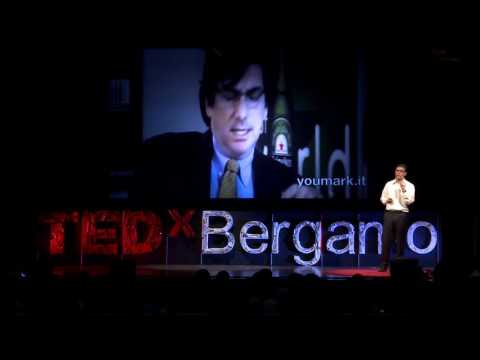
Translator: Maria Pia Lanfranchi Auditor: Alessandra Tadiotto
Which one of you is a teacher?
Which one of you is a parent?
Those of you, however, feels educator or mentor?
It is true: we are all educators! We are all mentors!
We all have a responsibility to the students,
towards children, towards employees.
What a challenge!
The challenge is to educate, by e-ducere, bringing out the best
by people who somehow life has given us.
And I, in my work as an educator,
I always tried to bring people to what could have been,
starting from the skills situations and initial skills.
He has always driven this Goethe’s phrase:
“You treat a human being for what it is,
and it will remain what it is.
Treat a human being for what can and should be,
and it becomes what they can and should be. “
And treat a person for what they can and should become,
is very important
because, in a labor market that is evolving rapidly,
we must ensure that they can thrive.
Because these scenarios from Gig Economy,
of which it has said very well before,
make us say that those born today
most likely they will do a job
that today has not yet been invented.
So, how can we create the right mindset?
I will try to answer this question:
It is innate, or you can learn?
But before we give an answer to these questions:
What are the essential skills
that within an organization are required?
I thank Seth Godin because he divided
in professional and personal skills abilities.
Professional skills are easy to identify.
As in this case: This website, created by Robby Leonardi,
clearly shows that Robby Leonardi is capable of programming
because it presents your CV as if it were a video game.
So, breeders, in the selection phase,
they easily identify the capabilities of this person.
Besides, professional skills are also easy to measure.
Those in this room are my age, are of my generation,
surely they remember the typists
which they were measured on the basis of beats per minute.
So how, I do not know if you remember,
those shady characters hanging around within the departments,
called “Function Timing and Methods”
and that, with the stopwatch in hand, measured the productivity of people.
Instead, personal skills, are a bit ‘more difficult to measure.
Think for example of the difficulty in measuring the liability,
in measuring the ability to take risks, to work in teams.
Yet, within an organization,
if a person, despite having good professional skills,
He is caught in while stealing from the till, it is immediately removed.
As a person, however, that it is defeatist,
rowing against the organization –
behold, this person is more difficult to move away.
So, think about it and see these new activities.
[Video]
Interviewer: What is your weakness?
I’m stubborn. Stubborn. Stubborn, I think.
INTERVIEWER: Give me a reason to hire you.
Sport is my passion.
Football is my passion.
I love football.
(The job interviews are identical)
(Same standard questions, same answers Standard)
(How to find the right talent for an internship between 1734 candidates?
(Test 3: The output)
Interviewer: Passionate or cold calculator?
I would say cold computer because …
Interviewer: Wrong answer.
Fire and passion …
She said that the others are stuck in the mind
Interviewer: Do you believe me to be now?
No.
(Alarm sound)
We have to go.
Simon, Mr. Ross, please.
Come on, we go out.
Can you help, please? You can help us?
Come on!
(Guy Lutchting’ve got the job)
Any reference to current events is purely coincidental, of course.
(Laughs)
Guy Lutching got the job because he has demonstrated personal skills.
The selectors are changing their approach
against this type of selection.
Now, let us understand further
such as professional skills can be taught.
It is easy to answer,
because no one is born with the skills to build bridges,
Or the skills to keep the accounts.
But personal skills, however, can be taught?
Or they are impossible to teach?
Let’s clear the field immediately: these soft skills,
so-called reading skills, so-called personal skills,
actually are real skills, are skills alive,
skills are present every day, concrete,
that only people that only true masters, competent teachers can teach.
[Only] deep teachers can teach.
They can teach these real skills,
that is, the ability to be receptive to the transfer of powers
that the organization decides to transfer,
so charismatic then transfer them to other employees
because they are results-oriented.
And they know how to motivate, as well as being motivated in turn,
so patient and able to listen.
One of the ways in which you can teach real skills,
it is the introduction of entrepreneurship in the school.
If this guy had been in a school
It had included in its business entrepreneurship,
definitely he would not have clipped the wings of his resourcefulness
and he would not even have taken this fine.
In my experience, 20% of my students
It exerts a business on their own.
Against a national average which is around 2-3%.
By creating value for the community, having created 800 jobs.
Because? Why do they instill in young people, in students
these qualities, these typical entrepreneur skills.
To be able to identify needs, to be able to respond to these needs
creating products and services,
their ability to work in teams,
to be able to have this approach, this mindset as an entrepreneur,
to identify strengths and weaknesses.
And the weak points then act,
as it is typically the entrepreneur,
the ability to find the knowledge to make decisions.
But the real professional abilities and skills are not enough.
To generate talent, I must further, I say,
valuing their first job, and the work of others.
Think how nice if, within the school,
the three main stakeholders, students, parents and teachers
They collaborate with each other and stimassero each other.
Think how grateful the students would watch the teachers
if they breathed at home trust
in the work that is being developed by the teachers.
And then,
we change the culture of failure, error, the mistake,
as if it was negative.
We need to see them in a positive way: we need to change that mindset.
Because?
Because the error, failure, the mistake,
They are of restart points
and strong experience of what has happened previously.
So much so that in the Anglo-Saxon world, particularly in the US,
are inserted in the CV, the CV,
and people are evaluated positively by recruiters.
Finally, all that we have said before:
mistake, failure, mistake, never define a person.
And this teaches it to Jesus Christ,
among other well-reported in this masterpiece of Caravaggio,
“The Calling of St. Matthew”
indicates where Matthew and summons,
regardless of the sin he committed.
And we must do the same thing
to all those that life has given us.
We must not judge them for the mistake, the mistake, for failure.
But we need to attract them to us.
Finally, let me say that “it’s time to”
is the time to let the people want,
to make people feel the nostalgia,
the lack of outer space, the lack of stars,
because only in this way we can create real people,
we value the person.
All, or at least nearly all, we defined early educators.
So I conclude by saying:
whatever the question, whatever the issue,
education is the solution.
Thank you.
(Applause)
Please follow and like us: