
as I’m apparently the last person wow I
can’t see you to speak can we give it up
for the wonderful students all backstage
who have put an enormous amount of work
[Applause]
so I’m going to talk to you about some
big questions if I may big questions
that were partly raised by a student of
mine in a class that I teach on the
history of capitalism and she asked this
very simple question to which i did not
have an answer which was how do we know
we’re on the right track how did we do
we’re doing well so how do we so when
you look around today wouldn’t be
particularly novel to say that we are
facing as Americans and as citizens of
the world enormous problems and
challenges they range from political
divisions to conflict to climate change
to inequality and so on and so forth so
what I’m going to do today is suggest to
you that all of these problems or at
least many of these problems have in
fact a common cause and a common origin
so that’s quite a claim so bear with me
and I want to try to clarify this at
first with a couple of questions so when
you look at this column of very
different things I would argue that they
all have something profound in common
what might that be what they have in
common is that according to the metrics
we use to measure success in our society
they all contribute to well-being now
let me put up another column
I again a number of very different
things and they too I believe have
something profound in common and you
might already into it an answer which is
of course that they actually contribute
to well-being but the more troubling
answer is that none of these things are
measured and the metrics we use in order
to define success in our society that is
the problem so since that is true i also
would argue that what informs policy
making politicians business leaders
economists in terms of making decisions
from the small to the large about our
society is essentially informed by the
column on the left and not by the column
on the right so what is the central
problem here the central problem is I
think that our metrics of success are
defined largely by growth and not by
well-being right we look at transactions
in the market not relations we look at
quantity not quality we look at output
but we don’t look at outcome that is a
big problem now how do we define growth
what is growth and interestingly enough
this is a question that really is asked
in politics we just know that it’s good
so how is it measured and of course many
of you have heard this and many of you
see it every day in the newspapers it is
measured by GDP which stands for gross
what does that mean it is a particular
kind of measure that is interesting in
part because it is a measure that is now
worldwide every single nation on earth
with the possible exception of Bhutan is
measuring its success with GDP it’s the
only ideology I know that is literally
universal independent of whether
countries are large or small rich or
poor developed or underdeveloped
authoritarian or democratic all follow
this metric why is this a problem this
is a problem I would argue because
number one it’s a terrible metric for
wellbeing it is not even a particularly
good economic metric why is that well I
give you some some some examples for
that first of all it doesn’t
differentiate between costs and benefits
it can’t tell you whether something is
good or bad that we’re doing in the
economy so it doesn’t tell you whether
you know buying a pack of cigarettes or
buying you know buying a bicycle whether
you build toys or whether you build
weapons it makes no difference all of it
is measured equally in GDP it also tells
us nothing about inequality so when you
read in the newspaper per capita GDP of
our country it doesn’t tell you anything
about how this is differentiated between
rich and poor in fact as in the United
States increasingly the top can be very
rich and the bottom makes no gains for a
long time and it still looks very good
so what GDP does one way to capture this
is to say that it measures the goods
life and not the good life it is what
Robert Kennedy in 1968 already said when
he said you know GDP in short measures
everything except that which makes life
worthwhile there’s another problem with
GDP which is that it doesn’t take into
account the future at all it says
absolutely nothing as in terms
what we’re leaving behind for future
generations a fairly famous entrepreneur
by the name of Paul Hawkins once said it
steals the future sales it in the
present and calls the GDP so what
everybody advocates here is not just
linear growth it is actually exponential
growth which is another problem with GDP
so I don’t want to go through all of
this but what this just says you know
when you start with a base year of 2000
which is the year that many of my
students were born when you go to the
year in which they will likely retire
something like that 2070 you would
already have to have an economy that is
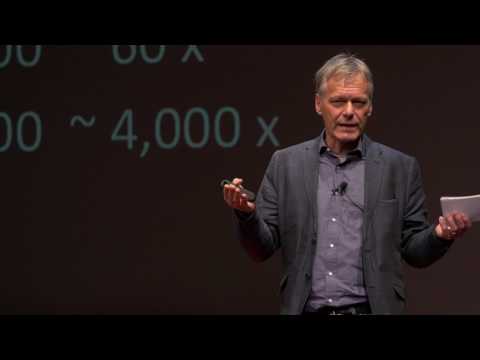
putting out 16 times as much if you took
what economy is considered to be a
healthy growth rate of four percent and
of course if you go all the way down the
line 200 years after my students were
born you would already need output that
is 4,000 times as much as we’re
currently producing in this economy now
if you consider this to be somewhat
insane you would be right the problem is
that this is precisely what informs top
decision-making among politicians
policymakers economist business leaders
around the world who tell you
essentially that what we need is this
kind of growth this will solve all of
our problems prosperity and progress
there’s one way to show what this
actually means this is a really powerful
set of graphs and I’m not going to have
it up very long but you should look at
it at some point and so what this
essentially says is on the left we have
exponentially increasing human activity
and on the right we have increasing Hugh
echo system destruction and what it
essentially says is that the two are
correlated right we can’t have one
without the other and so one of the
things that happens is of course that we
are undermining the very natural
economic growth is now pushing us to the
edge of the cliff when while it might
have been a good thing in the past it no
longer is it is an anachronistic thing
now this personally I personally think
that nothing in dangers the future
well-being of young people more than
this and I’m not even talking about the
planet the planet will be fine with or
without us and I’m not also talking
about the politics of it all and our
proclivity to elect people into power
who may not always be particularly
competent I am just simply talking about
the survival the our survival as a
species on this planet this keeps me up
at night I am I have four children I
love my students and yet we’re all
they’re all we’re all making them
passengers on the train racing towards
the cliff in fact we teach them and
educate them to be good passengers on
the cliff on the train we tell them that
their success will be measured by their
contribution to speeding up the Train
literally and very often we don’t tell
them about the cliff in fact we as
Americans today have the dubious
distinction to be gone
by the only major party in any developed
nation on earth that effectively denies
the very existence of the cliff so what
do we need to do we need to
fundamentally stop the train and we need
to lay new tracks we need to focus on
development rather than growth we need
to focus on better not more now this is
not to say to clarify that i am against
development in fact i am very much for
development rather than growth
development that takes into account the
satisfaction of human needs of actual
human needs and i also realize fully
that there are lots of people in this
world still who need growth who need
more opportunities more jobs more
education in fact one of the saddest
statements of this growth regime is that
we live in a world in which two billion
people are still living in dire poverty
which in absolute numbers may well be
more than ever before so for young
people in particular I think it is time
to retire whoops GDP as grandpa’s
definition of prosperity it is time to
let go of it and the reason is very
simple the reason is that it is our the
moral imperative for all of us to leave
behind a world that allows young people
to prosper not just us the analogy with
your bodies is by the way quite good
because obviously we all grow until
we’re about 20 but if somebody told you
at 20 that you needed to take hormones
and calories in order to continue to
grow in both size and height you would
probably think that person is a little
crazy but if you lived in a society in
which the entire health care system was
premised on the idea that you could only
be healthy if you kept growing you would
probably be right to think about moving
but that’s exactly where we are with our
economy that’s exactly what is happening
we are being told that we need to keep
growing even though we know we live in a
finite planet and even though we know
this is not going to change not not
possible the climate change of course is
just one of the many ways in which we
can see that we’re running out of time
but here’s my central argument this
regime of growth while it has created
unprecedented dangers also has created
unprecedented opportunities we can stop
that train and we can redirect it and we
can start focusing on actually
satisfying human needs now the great
thing is we already know a lot about how
to do this the great thing is also that
everybody can contribute because there
are more meaningful ways to engage in
economics and in public policy making
and in engineering and in biology in
order to create things like closed-loop
production or renewable energy centers
and so on and so forth so in the end I
would say that this there’s a lot of
good rewarding things good good
rewarding things that we can do and I
would suggest that it’s probably better
than just simply being a quiet passenger
on a train racing towards the cliff so
let’s just go do it thank [Applause]