
yeah for 25 years I’ve been working in
Ladakh in education reforms
experimenting with various things in the
textbooks and including the system of
education itself so I’ll share a little
bit of my learnings from those if you
look at this image education or
schooling as we do is perhaps the single
biggest pain that young adults go
through in our society today now can we
take analogies and learn from nature
that’s what I have been trying to do
while trying to bring reforms in the
education system are we doing things in
harmony with nature’s designs or are we
digressing away from it if you look at
the mouse and the horse if you could see
something that we can learn from you
would know at mice are obnoxious in that
they make holes everywhere in the walls
in the doors and I used to wonder why do
they do that who they really eat wood
no then I learnt that no there is a
design that Nature has for them a very
interesting design nature over millennia
as designed
or as evolved these creatures to have
teeth that will grow as it wears out
that they’ll be eating knowing at
various ruff foods and things and
therefore their teeth grow at a very
fast rate non-stop and if we
disrupt that design then we face the
consequences so away from that design as
these rodents nowadays have more and
more softer foods they have a problem
they have to keep grinding their teeth
so they nibble so they know at wood at
wires electric wires and everything they
otherwise what would happen is their
teeth grow at an alarming rate of
roughly 2 to 3 millimeters per week
which would mean over a year it would be
10 centimeters long this way and that
way and they would all die so imagine a
colony of mice struck a treasure of
butter they’re always looking for food
and they would think that would be the
best thing to happen butter butter
everywhere nothing but butter what could
be better than that but no over a year
they would all die with this kind of
phenomena similarly other animals like
horses are designed beautifully by
Nature who have shoes that are Auto
regenerating according to the rate of
where they regenerate and that’s why
they don’t have to buy shoes forever in
their lives so their own hooves keep
growing and growing but then in the rare
event when a horse is say physically
challenged or suppose a horse was
treated like a prince and never had to
walk or walk this is what would happen
their hooves would grow and grow with
nothing to wear them and grow this way
completely debilitating this is nature’s
design so my thought my hypothesis
looking at the education system and we
are young adults bee
have are known to behave you know young
humans are today integers and young
adults have become notorious world over
for being a problem for being rebellious
for causing you know problems more than
they solve could it be could it be that
this is again because of a grand design
of nature because our industrial
civilization which treats our young ones
like princes and princesses and cages
them in a classroom and lectures them
day in day out for 16 to 18 years in the
name of education is but only two
hundred years or so that we have out
sourced all our needs of energy and work
to ancient fuels fossil fuels and don’t
do anything anymore who are young adults
get it get everything on a platter the
parents who have now only one or two
children nuclear families dote on them
don’t let them do anything take care of
everything and what results is perhaps
because Nature had designed them to be
full of energy to endure and encounter
all kinds of challenges in nature
imagine 200 years of this easy life and
200 thousand years of evolution of the
human species
so nature has not designed us for these
200 years it has designed us over 200
thousand years at least if we even think
of the current form of human beings
could it be that our teenagers just like
the others are designed for facing
challenges taking on problems taking
responsibility and when all that
finishes with the current civilization
when everything is on a platter then
that energy comes out in the form of
destructive often violent
forms manifestations could it be that we
need to look relook at this system of
upbringing that we give our young ones
working in Ladakh I know that young
Ladakh is young adults teenagers who
come from very remote rural areas where
they have to go through all the
challenges that perhaps nature designed
us for I have never heard of even or
seen teenager problems they’re always
taking care of others taking
responsibility doing things and never
really a problem they are a partner in
running things
so I’ll just share some things from
Ladakh just to get to low Ladakh it’s in
the Himalayas or rather trance Himalayan
and at eleven to fourteen thousand feet
people live in a high Himalayan cold
desert which if you look from a distance
does not even look like no it would
support life but if you look closer than
there are os’s of greenery and
civilization has not only survived but
thrived over the years despite harsh
climate with temperatures going from
minus 35 to plus 35 yet as I said not
only have people survived but a
civilization thrived with its own
lifestyle no music farming and so on so
yes people here are a tiny microscopic
minority in a vast tropical country like
India so they do face a lot of problems
and the least or the most would be young
people going through the system of
education not only is it what it is to
all the big cities but add to that
that it is very alien to a climate and a
context which has very little
similarities with the plains and
therefore although I said young people
here are very enthusiastic to learn and
very responsible they used to fail and
mass in this system so when I was
finishing my own mechanical engineering
I had to teach students to earn the
expenses for my engineering study and
that’s when I came face to face with the
system perfectly bright students would
fail when it came to their examinations
of writing answers on paper even if they
had all the skills that their life would
require 95% of the students failed every
year consistently and we worked to
change that system and together with the
government we trained the teachers to be
more child-friendly and creative we
organized the villagers to take
ownership of the schools and then change
the curriculum textbooks and so on and
very soon the results changed yes over
the years it went up from 5% to 75% but
this also was not not a very good
situation 25% is still very bad even 1%
is bad if that 1% happens to be you so
therefore for those who still failed we
started a very special school which
would do things differently where we
could experiment with all these you know
ways of dealing and learning together
with young people it was also an
experiment in how human civilization
could advance in a way that brings us
comfort in life but does not cost the
earth in harmony with nature so it’s a
where everything is ecologically sound
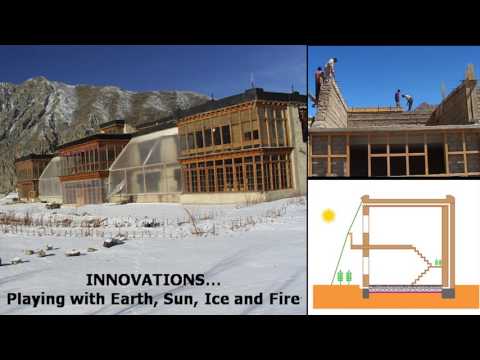
the whole campus is built with earth or
mud powered by sun solar energy with no
grid connection at all and the way the
students learn is very different here
it’s learning by doing and being there
actually the students run the school
themselves they come here and learn from
their seniors and they run the whole
school like a little country with a
little government that changes every 2
months and during the two months each
student is assigned a responsibility by
their elected leader they plan they
execute the report in the Parliament and
learn the life skills that way skills
that they would be needed they would be
need off when they go to the real world
similarly they take care of all things
that happen at the campus some would
take care of them cows and the milk
production solar cooking or organic food
power plants and greenhouses in the
winter innovations are a part of the
campus life and they are a part of those
innovations from scratch so the school
itself is in fact design and built by
the students the whole school
innovations run around the themes of
Earth Sun Ice and Fire
things that are contextual and needed
there so the whole campus as I said is
built of Earth and is heated by the Sun
very simple principles that you find in
high school science is applied just that
that warm air rises in the greenhouse
when the Sun heats it goes into the
building through the windows upstairs
and the cold air because it’s heavier
comes down and is pushed into the
greenhouse by the warm air coming in a
convection
and this cycle continues all day warms
up the walls of the building and in the
evening when the students responsible
for that closed the windows the heat is
trapped and the walls start radiating to
the rooms this is you know
thermodynamics of the simplest form heat
traveling through convection conduction
radiation and so on these are applied in
their buildings and they build the
buildings together with others and
that’s how in basic science in
application when it is contextual things
are hard to forget when it is out of
context they are hard to remember so
similarly the Sun is used for all other
needs
cooking greenhouses in the middle of
winter giving green vegetables lighting
in the building electricity water
pumping and even the cows on the campus
live in solar heated cow sheds so this
is how they learn contextual meaningful
things and apply them in life and of
course this becomes a part of their life
similarly ice can be a savior in the
mountains where due to climate change
fishers are melting away and causing
lots of problems so together with the
students three years ago we started with
a new innovation to freeze the water
that goes waste in the streams of Ladakh
and goes into the Indus and finally into
the Arabian Sea when nobody needs it in
winter but then in spring everybody all
plants need water and there is not
enough water in the stream so there is
conflict over water so we worked on
freezing up the water that goes in goes
waste in winter when it is so cold and
then the ice that would be made could
melt in spring when everybody needs
water it was a very simple idea just
with a pipe again simple high school
science or less a pipe
up stream that goes into the stream and
because it is going down the slope in
the mountains it builds pressure in the
pipe and then if you put a fountain at
the end of the pipe it gushes out
sprinkles and loses its heat latent heat
to the minus 20 air falls down and
freezes freezes and freezes and
naturally it forms the shape of a cone
which by the way is a shape with minimal
surface area to the volume of water it
contains now because of this shape while
all other ice on the ground would melt
by end of February this cone goes on and
on till June and July slowly releasing
it water its water just when farmers and
plants need water the most so it’s like
storing water in the sky vertically and
that’s possible only in a cold place
where water can have this solid phase
and just that fountain can make it you
don’t really have to make it is almost
like 3d printing of a large cone and a
cone that looks like a traditional
Ladakhi stupa therefore we called it an
ice stupa just to make it closer to
people so that there could be ownership
so it looks like a stupa in the
Himalayas we even put prayer flags but
they were really meant for me for
partial shading of the eyes and
windbreak although people take it with
some reverence like in stupa good then
the villagers got together to plant five
thousand trees as a pilot phase to prove
the concept and ice for young people can
be a lot of fun and young people as I
said have to be engaged in no
challenging things so ice
ports are very popular in Ladakh Ladakh
[Music]
could be called the capital of ice ports
in India but then until 10 years ago or
so it was limited restricted to only men
because I sports were played in ponds
and reservoirs which were not
conveniently located for women or girls
to go they never figured in this fort so
we said we should change that and we
innovated to make ice rinks anywhere
using some reflectors and shading we
were able to make ice rinks right
outside the girls hostel and over 10
years we created India’s national team
for ice hockey which yeah which in 2016
went and participated in the Asia
Challenge Cup in Taipei so basically
what we are saying is that education
doesn’t need to be only restricted to
reading writing and arithmetic the 3 R’s
which are all to do with alone our young
people are full of energy for more than
that perhaps they are too good to be
good for this system therefore it has to
involve skills of the hand and kindness
of the heart also and that’s how at this
school we have been experimenting by
giving them all the challenges that
perhaps we are designed for and so that
they can become a partner in the system
rather than a problem and some of the
results of this kind of experiment with
the school I’ll introduce you to some of
the say stars in Ladakh youngsters seven
rigs in learnt came to the school and
became a journalist and later became the
Education Minister of the Ladakh Hill
Council at 27 stanzin went on to become
an international
maker with many awards in France Canada
India and Sherrill is today a celebrated
entrepreneur written about in many
international journals one thing common
among them was that they had failed they
had failed not once but many times so
the question then is if failures can do
what toppers dream of then you can
imagine what everybody could do if the
system was more supportive
therefore we started working on a much
bigger program and in between luckily or
by design for us in 2016 the buildings
that the students and we built together
won the international terror award in
Lyon France and brought us a fair bit of
publicity the I stupa concept won the
Rolex Award for enterprise again it
brought us yeah visibility and a good
amount of money so roughly a crore
rupees as award money so what we have
done is to use that and go to the next
level of the school so now what we are
working on is to set up a university
that would take this concept further a
university where everything would be
practical a Dewar’s university a makers
university on a desert a huge desert of
which 200 acres were given by the
government for this university recently
using ice super artificial glaciers to
green this desert and then create a
university that would set a new trend
hopefully in higher education a vision
for University where the School of
Business will not be talking of business
or reading about them or studying just
case studies but actually doing business
or running businesses on campus
that actually have revenues and
dividends and so on the school of
tourism and hospitality would run
high-end hotels and simple home stays
and where the students can work and gain
experience and these enterprises would
raise the revenues for the university so
that the university doesn’t have to
charge students any fees that’s the idea
so the students don’t have to pay in
currency of rupees and dollars but they
pay in their creativity and their sweat
equity and participate in running an
thank you thank you similarly the school
of Environmental Sciences could be
engaged in taking further the artificial
glaciers and you know now with glacial
lakes outbursts problems and solve those
problems in real life and we have
started already with greening that
desert with ice stupas as I said five
thousand trees have been planted it’s no
longer just a dream and we wanted it to
be a people’s University which starts
with common people young people wanting
a change in the system and then goes on
to bigger supporters like corporates and
governments but starting with people and
therefore we launched recently a
crowdfunding campaign and I must share
you with you that when when you want
something really changed as they say the
whole nature conspires to support you so
recently a seventh grade student from
Delhi started raising funds becoming a
champion and seventh graders raised
thirty-five thousand rupees for a
university that he would like to see
before he grows up this is like a vote
of approval and a first need that we
really like to fear yes thank you very
much thank you you