
Translator: Roberto Minelli Reviewer: Michele Gianella
Good afternoon, everybody.
Today I’m going to bring you to my world.
I will speak about diversity in the blockchain sector,
but let’s first take a step back; what is the blockchain?
Blockchain is a new layer of the Internet
with some fundamental characteristics:
it is open, immutable, incorruptible, transparent, and decentralized.
And it is commonly called the Web 3.0.
If Web 1.0 was the era
where companies communicated directly with customers,
in a two-way fashion:
companies were promoting their products on the Internet;
and users bought them from an e-commerce platform.
The era of Web 2.0, instead,
was the era when users started to interact each other,
sharing information and data on blogs, social media, and so on.
The blockchain enables us to trade value without intermediaries.
We know that this technology will impact many industries,
not only finance,
and we know we need to be prepared for that.
We’re not sure when it will happen,
but we know that not only we need to be prepared
in terms of products
but also in terms of training the workforce
that will develop this technology.
In my company, for example,
we believe in the so-called “tokenization of everything”
In other words,
we think that every asset, every form of value,
one day –
be it houses, cars, precious metals,
luxury, artistic goods,
will be digitalized in a token
so that it can be traded
on this new blockchain technology.
Just to give you a few examples,
imagine the textile and food industries,
where blockchain could help track the supply chain,
for example against forgery.
Or imagine art freaks,
who cannot afford a whole masterpiece,
let’s say by Andy Warhol,
but can invest in a fraction of this:
and they can trade this token,
with other fractions of art items,
again, as an investment.
But if we know that blockchain technology will impact on everyone’s life,
through so many products,
the workforce behind it needs to reflect this openness,
must be able to speak to everyone.
Today I will talk to you about diversity,
the issue I most advocate for in this sector.
I have looked for a good definition of it,
I wanted to come here with a single, compelling one,
but I actually found so many different ones,
as diversity and inclusion can be declined to several contexts:
sexual orientation,
ethnicity, social-economic background.
In my opinion, the best definition of diversity in business
is the ability to build a workforce
where anyone feels accepted, no matter who they are,
feel like they are contributing to the future of the company.
We intuitively know that diversity matters,
but now we also have data-driven studies
showing that companies with the highest diversity
through all the management layer,
also have the highest financial returns.
This suggests
it’s not just about gender diversity,
but also all the other aforementioned types of diversity.
But, how come?
Why is diversity a driver for success in business?
Because companies with more diversity
develop higher sensibility
in understanding what the market needs, what customers want.
But where are we now?
It’s a time for diversity in tech, including, but not limited to blockchain.
At Circle, my company, we actually wanted to evaluate
the interest of women for blockchain
and more specifically for cryptos, our field of interest.
So we ran a survey in the US, one of our market,
on more than 3,000 people ranging from 24 to 74 years old.
Guess what?
Cryptocurrencies and blockchain appeal to millennial, white, men.
That’s the status quo.
And the results of this study,
compared with other studies and surveys,
proved to be robust;
there’s a five percent of women, think about it, only five percent,
who belong to the workforce of this field,
started blockchain companies,
invest in it, are passionate, engineers.
My bottom line today is:
to work in the blockchain sector,
there is no need to be a 20-year-old nerd,
who spend all day in front of a screen, have a degree in engineering,
and are passionate about finance and investments.
Think about me, for instance:
I want to briefly share my background with you,
because I don’t think it’s a coincidence
that I joined this new innovative sector.
I come from the sharing economy, a totally different world.
I have no STEM background:
BA, with specialization in marketing.
I traveled the world, for both school and business reasons.
and since I was a baby I’ve always been an early adopter,
I have always been the first to try something new,
eager to discover that innovation that would succeed later on.
And I’ve been lucky, because of my first example –
I grew up alone with my mother.
So my family was made of me, my mother, and my dog.
and she always – instead of tying me, keeping me,
she always pushed me to go and try.
And that’s what I did.
I grew up surrounded by the Piedmont’s fog
until I was 19 years old.
Then I moved to Milan to study.
After three years in Milan,
that was my dream ever since, it seemed unreachable to me,
and it was kind of over.
I felt it was time for me to move on.
So I lived in New York, London, Paris, both for study and business.
Think about it: when I approached business life for the first time,
the tech startup wave was just starting in Europe.
And I immediately realized, I wanted to belong there.
Even if it was much more risky
than working for established corporations,
I wanted to be there,
elaborating new business models
that would impact on millions of people’s lives
before they even knew.
And so I crossed the path of a then small California-based startup
who had started hiring to open the European market:
it was a 100 people company, at that moment.
I sent my resume,
after just two hours they replied,
and after a week they hired me.
So together with two other people, I launched Uber’s Italian market.
I worked in Uber for four years,
and I have to tell you, it was such a fascinating experience.
After four years in the Italian market, I said,
“It’s time for another challenge.
Move me to India.”
I want to experience an emerging market
on a completely different scale.
I want to see what happens there and how this technology can be adapted.
I lived in Mumbai for a few months
and I start hearing people talking about the blockchain,
a technology I sincerely wasn’t aware of before.
I get more and more interested.
And so I realized: okay, here we go again.
Now that the model of sharing economy was already successful and proven,
that is impacting in all the world’s areas,
I look for this innovation, this early-stage technology
no one still believes in.
So I start looking for companies
that are focused on blockchain –
until I stumble in my current one.
Initially, I had many doubts:
I’ll for sure be surrounded
by male tech geeks
who spend their days in front of a computer.
And I will not belong there.
I went through the recruiting process,
during which I fell in love
with my company and my colleagues.
First, I met my manager, which is a hero for me.
And then several inspiring women with leading roles,
from the European Director for Communication
to the Legal Director of Europe.
So these two factors: the recruitment process,
where I totally feel welcomed,
and I become sure a space was there for me,
and the innovation factor –
I wanted to be among the first ones to find and try that thing –
broke my last resistances to entering this world.
But let’s take a step back.
the world is composed of 50 percent of women
and 50 percent of men.
And what is technology for, at the end of the day?
Solving everyone’s everyday problems.
Therefore, in our companies,
even the workforce behind these products
should mirror this gender diversity.
I believe that companies – but not only them,
institutions also play a key role.
Let’s start from the institutions:
classes of computer science are held for children,
and later on MBAs, master courses,
contests in classic computer science.
The same should be true for blockchain and cryptocurrencies.
I want to tell you a funny anecdote, one that, guess what,
took place a few nights ago, while I was writing this speech,
so I said to myself: “I must share this.”
There was a TV show on the background,
“La TV delle ragazze” [Girls’ TV]
with Amalia Ercole Finzi.
Turned out,
she was the first Italian women graduated in aerospace engineering
and she told the audience a simple, interesting thing:
Young girls should be given both an Erector Set and a doll.
Not because all little girls will become engineers,
that won’t happen.
But, in case even just one of them wants to,
she should know she’s entitled to it.
To tell you about this episode, I was wondering
what is the female counterpart term for the word “engineer” in Italian.
And I discovered, some Italian words just have no female counterpart:
words like “surgeon”, for instance, or “engineer.”
The word “Major”!
That’s the role of the Institutions,
for example regarding education:
introduce dedicated classes and give little girls the chance
to discover this world, get in early touch with it.
And what about companies?
For sure, they should expose their female leadership:
let’s show these women,
let’s interview them, let’s expose them to the media.
Behind these thriving companies, the world should know,
are young women
who traveled all around the world, with a stellar resume.
On the other hand, of course, recruiting should be reconsidered.
There is a very interesting study done by Hewlett-Packard.
According to this study, women will only apply for a job
if they feel 100% qualified.
The men’s threshold to consider the same application
is just 60%.
Imagine the consequences of that in my field, FinTech –
we combine finance and technology,
historically two male sectors.
It’s so hard to attract valid female candidates,
women who could have a great career,
to be determinant in writing the white canvas for this technology.
And the approach to resume should also change.
A resume is no longer the foundation of the recruiting process:
A headhunter’s job is now to detect
what’s the talent, the appetite of this person,
looking at their soft skill rather than their hard skill.
Maybe their resume has nothing to do with blockchain or cryptocurrencies:
take me, I had nothing to do with them.
Or maybe, they already invest in cryptocurrencies, in their free time.
They already made their research, maybe, out of personal passion, interest.
So that’s what we, as companies,
should set our mind to.
And what about individuals? What’s our power today?
Well, I have taken you into my world,
sharing my gender-diverse reality.
I have had five bosses so far, in my career:
three women and two men, one of whom was black and gay.
They’re an endless source of inspiration for me:
I’d die to be like them.
What you can do, instead, from tomorrow on
is start getting informed:
not necessarily apply for a company,
but learning something more about this new technology.
Maybe you develop an interest
and start playing an active role in this revolution,
instead of just taking it passively
once it will impact on everyone’s lives.
Because it will have an impact, and it will be greater and deeper
than the Internet had over the last 20 years.
So I encourage you all –
should I give a suggestion to a fresh college graduate,
but also to you, it would be:
bring your backpack, put a T-shirt inside
and go to Asia, where this field is booming,
Go to meetups, cocktails, events,
start getting what it’s all about.
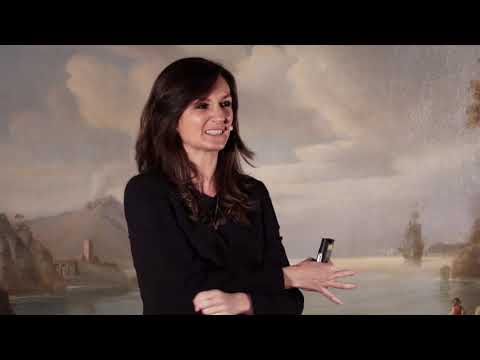
Do like this little girl behind me,
who is having mindless fun
trying this new mean she doesn’t fully know,
following her attitude,
and enjoying the ride.
I encourage all of you to do the same.
Do it, right now.
Thank you.
(Applause)
Please follow and like us: