
[Applause]
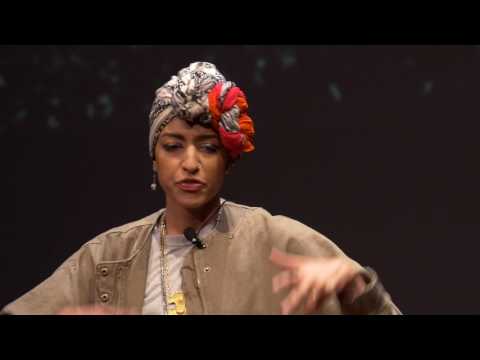
hi my name is sabotage and slightly
different than Saba but I’m an artist
and an activist and behind me you see a
series of paintings that I made in 2011
titled Technicolor muslimah it’s a
series of portraits of American Muslim
women and my aim with this work was to
humanize Muslim women to say it slightly
differently I as a Muslim woman felt it
was my responsibility as an artist to
make Muslims appear to be more human
that’s dark I was 15 when 9/11 happened
our mosque received bomb threats my
friends were assaulted and spit on at
school and we were afraid now 16 years
later it feels like not a lot has
changed Islamophobia is still as rampant
as ever and to humanize Muslims to make
Muslims appear to be more human is a
radical act in this climate is a
political statement Islamic phobia
operates through a systemic
dehumanization black folks Muslims trans
folks so many more are characterized as
others or not fully human
instead described as savage as criminal
or terrorist fetish in all threats to
public safety and morality and it is no
mistake that this notion of public
safety does not include those
individuals who are most vulnerable and
most at risk to systemic oppression to
state sanctioned violence to prejudice
into hate crimes this systemic
dehumanization
is communicated through the dominant
narrative this is a lens through which
reality is represented it’s a story of
truth that is curated by those in power
that centers the humanity and
perspectives of white heterosexual
assist men above and over all others
this capitalist cultural machine
operates in binary thinking that
categorizes us into a hierarchical
structure based on our closeness to or
our contrast to said white heterosexual
assist men it is reinforced through our
government our institutions and
individuals and by and large the public
both passively and actively consumes
upholds and replicates this narrative of
white supremacy and hetero patriarchy so
I grew up not really going to galleries
even as an artist now or museums but
consuming media and lots of it and I
still do TV media social media popular
music and magazines and while now I’m
incredibly aware of the shortcomings of
such things as a young person I bought
into this dominant narrative I saw these
things as truthful and was looking to
find myself within them and instead I
most of the time didn’t find myself and
when I did it was highly problematic
behind me you see National Geographic
and Indian vogue within the National
Geographic we see the fetishization and
other ring of black and brown people
their cultures and their suffering on
the other side vogue India which is full
of some beautiful stuff but also we see
this internalization of the dominant
narrative and things like bleach creams
and it is not subtle in that this
product is called white
effect and so in my newer work I
returned to these materials and this
time not as passive consumer but
critical creative agent and I ripped
them into pieces and made a big mess um
and this process of like severing arms
and gouging out eyes I mean like in
magazines is empowering it is cathartic
and it felt something like vengeance and
from these clippings I created new forms
and this is a kind of self determination
within the limits of the materials and
language of the dominant narrative I
made monsters black and brown femme
monsters in a story about destruction
and transformation and these are the
major players they are the warriors and
survivors who will inherit the earth
after an apocalypse after a revolution
who faced down white supremacy and win
their bodies bear scars a record of
oppression of a inherited trauma and
hybridity they both reflect and subvert
representations of beauty humanity and
violence this concept of hybridity is
really important to the work and
thinking about how life is valued upon
hierarchies to combine human and animal
or human and reptile or insect is
typically something that would be
disempowering and is kind of literally
dehumanizing but here it’s a reclamation
of the grotesque the way that we have
been characterized as people of color
and now it becomes a source of power
they embody the liminal the in-between
which for me was a reflection of my own
cultural hybridity growing up in a space
between Pakistani and American
in the question mark between the
systemically opposed queer and Muslim
and they assert that there is a
possibility for wholeness that exists
beyond binaries this metaphorical
destruction of the dominant narrative
and to create something entirely new
from its parts is much like the idea of
revolution and this story of destruction
and transformation of death and rebirth
of the end of one world and the
beginning of another has been told and
retold in so many traditions personally
I like to reference Islamic stories
sometimes very specifically and
sometimes more loosely behind me or to
details from a work called the return of
Hazrat ISA which is a story of the
return of Hazrat ISA or prophet Jesus
who comes back to defeat the Dajjal or
the Antichrist and if you can see here
in the this gold figure there’s
clippings of someone you might recognize
it’s not a drop and overall in this work
I articulate the enemy in a few
different kinds of ways well there’s
this consistency that it is weight
supremacy it’s depicted quite fluidly
and one of those forms is the evil eye
which some of you all might have seen
this symbol is it’s actually a belief
that’s upheld both regionally in South
Asia and Islamic Lee in the Quran and
it’s this idea that harm can be caused
from another’s gaze even if their
intentions are neutral that just they’re
witnessing of you can cause actual
physical harm and misfortune and one
mode of protecting yourself amongst many
it’s to wear a representation of the
evil eye and so this as a form this blue
eye as well as this idea of wearing the
thing that you want to protect yourself
from
was really compelling to me and so
utilize it throughout the work as this
to you know representation of the enemy
but its shape shifts at some times it
shows up in as an embodied form pretty
straightforward
at other times disembodied object here
just the eyeballs and also internalized
illness so in wearing this thing that we
want to protect ourselves from at what
point does it come inside of our bodies
become part of how we see the world and
finally is worn on the forehead of the
revolutionaries of this story as a at
this position of the third eye as a
symbol of wakefulness and awareness this
work operates as resistance through non
binary representations through
subversions of the dominant narrative
and its materials through a centering of
the subjectivity of queer Femmes of
color it takes a critical look at the
current state of things and radically
imagines liberation it is empowering and
healing to make this kind of thing and
it’s something that keeps me going I
have the opportunity to share this work
in galleries and spaces like this which
is amazing and that’s all really great
except for the fact that art is also a
pretty messed up institution and it
really reflects the biases of the
dominant narrative they have serious
issues with representation and it is not
a neutral space and not one that is
accessible to the the public at large it
is one that the people who are included
in it are the ones who have been
afforded a certain level of access based
on race class and education and there is
so much art that
this outside of these spaces that isn’t
named art with a capital A it’s yet
another way that marginalized
individuals are systemically
disempowered because their art will most
certainly not be named art unless they
can make it to the top of the access
ladder first this is art Greenpeace
International activists five days after
inauguration put up this banner right by
the White House this is a public
expression and it is resistance because
it’s an expression of non-compliance
with the presidency with the current
administration and it is a call to
action
it is widely accessible in the way it’s
presented it’s something that we can
literally read and understand this is
art this is performance performing
non-compliance with corrupt and
oppressive norms protest is considerate
of its participants its audience its
messaging and its context sometimes it
can even be choreographed protests
references strategies especially in
particular black lives matter protest
represents references strategies of the
civil rights movement there is clear-cut
accessible yet deeply layered messaging
like black lives matter people gather in
public space and they are highly visible
and highly vulnerable and they disrupt
business as usual but it’s constantly
diminished graffiti and protests are
deemed criminal or frivolous vandalism
riots when in fact they are often
thoughtful artistic expressions of
dissent police confrontations sometimes
results and this serves to further
illustrate the conflict between the
dignity of people of color and black
folks in particular in this country and
a police state that has been the violent
and races
arm of mass incarceration and so to move
forward what do we do one thing is to
consistently personally with our friends
push back against the dominant narrative
see it name it also to redefine identify
and support art and artists outside of
the dominant narrative and one way that
we can do this is to support and create
alternative spaces one such space exists
here in Durham Durham
artists movement is a group of artists
activists who connect art and activism
with a local focus we Center the
leadership voices and membership of
queer people of color and we’re cute and
we understand that our creative actions
as marginalized people is an act of
resistance in a system that seeks to
silence us we recognize the connections
between art and healing between
resistance and resilience and strive to
expand arts access and with active
inclusivity and a shared anti-racist
art is activism is any and all
expressions of non-compliance with
corrupt and oppressive norms it is a
conversation with the dominant narrative
and it is our responsibility as artists
as innovators as people who care to join
that conversation activism has always
been a willingness to imagine and create
alternatives to what has always been to
what is right now and so I know one
thing for certain the resistance will be
creative thank you
[Applause] [Music]