
Translator: Ivana Krivokuća Reviewer: Mile Živković
I’m going to talk to you a little bit today
about a particular speech by a president 65 years ago
that has some very crucial implications for the present.
That’s me, you can find me on Twitter.
That’s my handle, I’m the director of Grassroots Advocacy at EFF.
We’re going to be talking about surveillance versus democracy in America
and the particular warning that was issued to us 65 years ago, this January.
Just a show of hands – “Ike,” does the word mean anything to anybody?
A few can place it? Okay. Dwight D. Eisenhower.
He was the Supreme Allied Commander in World War II,
as responsible as any other single person, quite frankly, for defeating Nazi Germany.
He was a two-term president.
He, in that capacity in particular,
continued some of the work he’d done as a military chief
in establishing something that he would warn us about.
Ha was voted Gallup’s most admired man 12 times,
he built the national interstate highway system, he established NASA,
and he had a particular speech on January 17th, 1961,
from which I’ll read you an excerpt soon,
in which he issued a warning
the likes of which we’ve not really seen in America since,
with the possible exception of a particular speech
by senator Dianne Feinstein last year,
in the context of a situation we’ll talk about in just a little bit.
The Snowden revelations. Let’s go to 2013.
Before we get there, I want to just read you a little bit
of Ike’s last address as the American president.
There’s a particular line in here, I want you to hear it.
He speaks about the combination of a large military industry,
which he felt compelled to help support and create
in order to defeat Nazi Germany,
and he talks about the combination of it
with the profit motive that underlies industry.
And he speaks of a military industrial complex
that he forecasts will come to threaten democracy in America.
He says, “In the councils of government,
we must guard against the acquisition of unwarranted influence,
whether sought or unsought, by the military industrial complex.
The potential for the disastrous rise of misplaced power
exists and will persist.
We must never let the weight of this combination
endanger our liberties or our democratic processes.
We should take nothing for granted.”
So, what we’re going to talk about over the next few minutes
are some ways in which his predictions, unfortunately, came true.
In 2013, Edward Snowden revealed, among other things,
that the sworn testimony of multiple senior officials
before Congress was not true,
and these were questions, for instance, as straightforward as:
“Does the NSA monitor millions of Americans?”
Congress had been assured, under oath, by the Director of National Intelligence
just three months before the Snowden leaks that it does not.
I want to talk a bit about a couple different sets of institutions
that have buried their heads in the sand since.
Courts exist, of course, to enforce constitutional rights.
In the federalist papers, the independence of the judiciary
is described as the crux on which liberty rests.
If you think about the courts
in the context of judicial supremacy and the system,
the constitutional separation of powers and checks and balances between them,
the courts are our constitutional guardians, and when, for instance,
hiding behind either the constitutional standing doctrine –
which I’m welcome to take questions about later –
or the state’s secrets privilege – also we could talk about that later –
these are judicial doctrines that have essentially enabled
judicial abdication.
Similarly, Congress, despite having been informed from the press
about what the NSA and the FBI as well, and the DEA for that matter,
or your local police department are doing around the country
with respect to surveillance,
has never actually actively investigated to find the facts.
Still, even after having discovered
that executive officials have lied under oath,
Congress has deferred to those officials.
Not once has ever invited any of the whistle-blowers to testify.
Just to share a quick timeline here,
it was three years ago that Snowden revealed mass surveillance.
Just last year, Congress adopted in the USA Freedom Act,
an initial set of reforms to marginally increase transparency,
particularly at the secret federal court responsible for surveillance.
Part of the hook for my talk, what I want to focus you on,
is the end of next year, there is a key statute
in the Foreign Intelligence Surveillance Act
that underlies the NSA’s dragnet spying.
It is already set to expire.
So in the next year, Congress will examine mass surveillance.
The question is: will it do anything about it?
We’re going to move now to another area, a little bit of history here.
Another show of hands for who –
Does COINTELPRO mean anything for folks in the audience?
Not a single one of you?
Fascinating! I’m so glad I’m here.
COINTELPRO stands for the Counterintelligence Programs,
and this is a set of programs, particularly one out of the FBI,
that the Congress investigated very actively in the 1970s.
This was a two year investigation
that compiled tens of thousands of pages of documents,
and the US Senate, in 1976, described COINTELPRO
as a sophisticated vigilante operation aimed squarely at suppressing
the legitimate use of First Amendment rights of speech and association.
I want just to make sure you understand
who some of the targets of COINTELPRO included.
This was a 40 year campaign to, in the FBI’s word,
“neutralize domestic social movements.”
They included the main line civil rights movement,
as well as the militant black power movement.
They included the Puerto Rican independence movement.
They included the movements for equal rights for women
and the movement to end the war in Vietnam.
This multi-pronged assault
on not just particular social movements,
but through them democracy in America is what I want you to focus on.
I want you to place that in the context of Eisenhower’s warning.
Any guesses as to COINTELPRO’s most famous target?
Yes, you got it. There he is.
The letter from Birmingham Jail
remains a piece of very crucial modern American literature
I’d invite you to read if you haven’t before.
Its implications are especially vital to consider
in a time when state violence has emerged not only fully fanged
as it has been for 400 years,
but for the first time perhaps in the American history
with transparency to the public.
The letter from Birmingham Jail particularly relates to
what solidarity looks like and what does to come to win the justice mean
at a time when justice somewhere is threatened.
I want to talk briefly about the civil rights movement
in the context of Dr. King and the assault on his character and his life by the FBI.
The civil rights movement is typically depicted as victorious, right?
A shining moment in our nation’s history.
I just visited DC last week and had a chance to attend
a new African American history museum, where of course, appropriately,
Dr. King and his colleagues were lauded.
There was one plaque acknowledging COINTELPRO
and the FBI’s vicious witch hunt against that movement,
but while the assassinations of civil rights leaders,
of course, loom large in our history
and the continuing legacy of state violence,
we still occasionally think of the civil rights movement
as victorious.
I want to basically examine here its policy experiences,
the extent to which it actually did win what it was looking for.
We won voting rights, the right to pass the ballot,
for what that counts.
Essentially you could – if you were to be critical of that,
say it’s a right to choose between the opportunities or the choices
constructed for us by the two percent of the American public
that actually donates to political campaigns.
There was another policy victory.
We’ll get to that in a minute, but notice some of the losses here.
Among the things that the civil rights movement won
in addition to voting rights was desegregation. Right?
Think about the ground of the Brown v. Board decision.
It recognized the distinction between de jure, which was to say,
enforced housing discrimination and educational discrimination,
and de facto, which was to say, market driven discrimination.
The awareness of de jure versus de facto discrimination
has eroded and faded from the federal judiciary entirely.
In fact, the 14th amendment,
if you compare it to the Brown vs. Board era,
has basically been flipped on its head.
Which is to say,
the policy victories of the civil rights movement
not only failed to crest over the movement’s aims,
which included a right to eat, a right to housing,
a right to education, a right to healthcare,
but even the core victories of the civil rights movement,
in particular voting rights –
There is a key section of The Voting Rights Act, section five,
which, until it was overturned by the Supreme Court,
having been extended by Congress,
forced Southern states with a history of discrimination
to preclear changes in their voting laws with the Justice Department.
Overturning of section five of The Voting Rights Act
essentially returns us to, in some respects,
even a pre-civil rights movement era,
even with respect to voting while all of the movement’s aims,
of course, its deeper, underlying aims remain unsecured.
I want to talk about some of the contemporary social movements
that have continued to be targeted by surveillance.
We talked before about mass surveillance,
now we’re talking about targeted surveillance.
One example is the environmental movement.
If you go to the federal prisons around the country,
the communications management units they’re called,
where people convicted of terror offences are held,
you might be surprised to find substantial minority
on the order of 30 to 40 percent
were young, and are now middle-aged white men,
particularly from Oregon and Washington state,
whose worst crimes could be characterized as environmentally motivated vandalism,
or in the very worst case, as arson.
They are serving terror sentences,
decades and in some cases 35-year sentences for terror offences,
having taken great pains to avoid any threat to life.
The peace movement.
I mentioned before that the movement to stop the war in Iraq
was particularly infiltrated and impacted, neutralized, you might say, by the FBI.
Its contemporary equivalent,
working to stop the conflicts in which our country is currently engaged,
has also been very thoroughly targeted for not just surveillance
in the sense of monitoring, but suppression as well.
The Occupy movement –
its experience at the hands of militarized police
is very well documented.
I’m going to read you a quick quote, where you can see it for yourself.
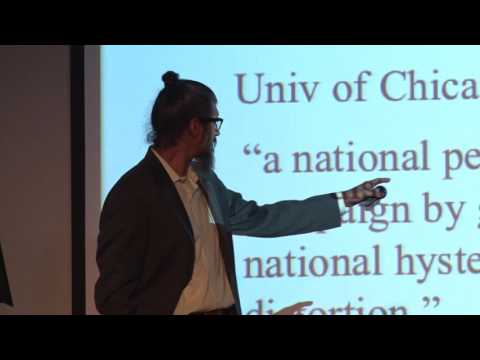
Geoffrey Stone from the University of Chicago, my undergrad alma mater,
describes “a national perception of peril and a concerted campaign by government
to promote a sense of national hysteria by exaggeration,
manipulation and distortion.”
You might say that fearmongering is inducing us to accept constraints
on the liberties and democratic processes.
The president Eisenhower warned us would be at risk
by the combination of a profit motive and an impulse toward public safety,
especially in the context of this national hysteria
prompted by exaggeration, manipulation and distortion.
We’ve talked about mass surveillance,
we talked a little bit about politically motivated targeted surveillance.
I now want to shift the lens to what we might describe
as “street level surveillance.”
These are programs and tools, technologies often developed
from military application originally,
that are deployed increasingly around the country
by local police departments.
The most conspicuous example –
you’ll see them in some US cities increasingly –
armored vehicles.
There was one very controversially stopped in Berkley
after local activists discovered it, the plans, that is, to procure it.
They are unfortunately becoming increasingly common in US cities.
There’s a fascinating story here to be told about.
I believe it was the Marines in particular
who were receptive to a push from military families
in the middle of the Iraq war,
to buy more mine resistant armor plated vehicles.
These, I guess, were Humvees that had a particular design
in the undercarriage to deflect explosive blasts,
and in some respects – there was a whistle-blower, for instance,
who revealed the need to buy more of these,
and essentially the military’s abdication
of its responsibility to protect our troops –
and while in some respects you might describe it as a victory
that then, I believe, thousands, if not hundreds of these MRAPs
were bought, built, deployed.
They now need somewhere to go,
and the weapons manufacturers and the military agencies
that develop and deploy these weapons want to send them somewhere;
local police departments become them.
Machine guns are another that are deployed around the country,
and I want to focus particularly on surveillance equipment,
on a few different kinds.
Drones you hear about particularly in the context
of CIA assassinations and strikes abroad.
Let’s just pause here for a very brief digression.
People sometimes forget that victims of US, particularly CIA, drone strikes
include US citizens targeted for their speech.
A particular one who was never accused of raising a gun but,
as a propagandist essentially,
was declared persona non grata and an enemy of the state,
even while his family sought to vindicate his right to due process in federal court.
Another victim of drone strikes included that person’s 16-year-old son
who was never accused of anything, including even mere propaganda.
But the point that I want to,
zooming back from those particular individuals
and the constitutional rights at stake,
focus on – well, maybe two.
Let’s look first at the empirical data with respect to our drone strikes
before we get back to surveillance by local police.
Defensible.
The director of the CIA, John Brennan, has claimed before Congress
that the civilian collateral casualties owned to drone strikes are infinitesimal,
that essentially every dead body is a militant.
The only independent study today,
conducted by human rights clinics at NYU and Stanford,
established that over 90 percent of the deaths from drone strikes
are collateral civilian deaths.
Essentially, the same way that we talked about Snowden,
showing that executive officials testifying under oath
about the limits of mass surveillance were lying,
so has the CIA about the collateral deaths related to drone strikes.
There is a further piece I could share here.
There’s a symposium article from a symposium at Loyola Law School,
I’m happy to share with people to the extent it interests you,
that I gave a speech the week after the Attorney General,
at the time Eric Holder, had announced to the symposium criteria
limiting drone strikes.
You could describe them as remote, robotic assassinations.
The particular point I want to draw here is while the Obama administration
has very thoughtfully attempted to articulate limiting principles,
there is no transparent or neutral form in which those principles are contested,
and among them are, for instance, imminence.
There has to be an imminent threat.
There is no form in which to contest imminence,
and when imminence includes killing US citizen propagandists,
it starts to stretch the definition of the word
in ways that render the principles themselves suspect.
We talked about CIA drone strikes, I want to just draw the parallel.
Drones were developed for military and quasi‐military application abroad.
They’re now being deployed by police departments
across the United States to monitor essentially law abiding
civilian populations en masse.
Police body cameras are sometimes presented
as a police accountability tool.
I want to just invite you to think about a few other ways
in which body cameras not only might fail to achieve their intended purpose,
but also expand on and exacerbate
the threat of surveillance that we’ve been talking about.
A couple of points to consider here.
The first is, of course, police body cameras don’t face police;
they face you.
They don’t actually capture what a police officer might do,
and in cases where a police officer might,
as they’re often documented of having done,
planning weapons or contraband on a suspect.
A body camera won’t necessarily capture that.
There is also the frequent phenomenon of body cameras being turned off
in opportune or for police opportune times.
The biggest hole in the bucket
is a public right of access to the footage,
the raw footage captured by police body cameras.
A police body camera – a program, the deployment across the police force –
without a robust public right of access to the raw, unedited footage,
is worse then useless,
particularly because it becomes another factor for mass surveillance.
They’re only useful as police accountability tools
if the public can get the footage,
and if police don’t have a right to edit it first.
There is a further problem here, which is to say, even with video
of police murdering someone in broad daylight –
I’m talking about the Eric Garner case in New York – are people familiar with it?
“I can’t breathe,” right?
Eric Garner was murdered by police officers on tape
viewed by tens, if not hundreds of millions of people,
and the only person who went to jail associated with that incident
was the person who captured the incident on video.
Say what you will about it, but the point is:
transparency doesn’t equal accountability; there is a hole in the law.
I’ll name very specifically what it is.
It’s the qualified immunity doctrine, and it basically says that
as long as police act in what the courts will construe as good faith
and acknowledging well-established rights,
they can get away with violating rights in particular instances
if a reasonable person in the same situation
might have done the same thing.
When you couple this with the erosion of the 14th amendment,
equal protection doctrine, what it basically means
is that if you want to establish a claim of racial profiling by a police officer,
you basically need video of them beating someone
while screaming racial obscenities.
Anything short of that is insufficient to establish a claim.
That is, of course, not what the founders envisioned
when they wrote the constitution,
and wrote poems about how we would be a land of the free
and the home of the brave.
Is anybody familiar with the secure communities initiative?
It’s very well known in immigrant communities
because it was a program launched
at the very end of the Bush administration
enabling and setting up, essentially, the Obama administration to become the one
under which our nation would deport historic numbers of undocumented workers.
The secure communities initiative was presented as a way
to streamline the removal of criminal aliens from the United States.
What the FBI built on its back, out of public view,
was the next generation initiative.
This is a biometric data collection scheme,
applicable not just to immigrants, but to all Americans,
and it demonstrates a continuation of a long established pattern,
which is to say the justification of novel powers or programs or equipment
for particular ends,
and then their expansion well beyond the mission creep.
The mission creep behind biometrics.
When I talk about biometrics, we’re talking about fingerprints,
your iris patterns, even the sound of your voice, the way you walk.
Gate detection algorithms are increasingly being applied to video feeds,
facial algorithms or just the shape of your face
and the contours of the shadows on it.
All of these are biometrics that are increasingly being tracked
in government databases,
and I want to talk briefly about a particular tool
that you might have heard described as a “stingray,”
that is used to monitor cell phone networks.
These are also increasingly deployed by local police.
There are a couple of things I want to say about it.
The first generation of stingrays
were capable of monitoring cell phone traffic and network traffic,
but they weren’t capable, for instance, of hacking a phone,
or planting malware, or denying service,
all of which the later versions of the device are able to do,
and we’ve had many reports of these devices being used
in the context of suppressing – not just monitoring, but suppressing –
peaceful demonstrations.
For instance, demonstrations by the Movement for black lives.
There is certainly a strong sense that they were being used
against the Occupy movement, though no one knew at the time,
because stingrays weren’t public yet.
The first known deployment of a stingray happened on a protest
in which I participated in 2003 in Miami,
resisting the free-trade area of the Americas.
It was the precursor to the TPP, the Trans-Pacific Partnership,
that you might have heard about since.
After that, in Baltimore alone – Baltimore, Maryland –
the police department used stingrays thousands of times
without any judicial warrants over the course of the mid 2000s.
The only was we even know they exist is because a jailhouse defendant,
someone representing themselves against a fraud charge,
who admitted his guilt, as far as I know,
was curious how he got caught,
and in exploring his court documents caught an accidental government refference
to a stingray – it was the trade name of the first generation of the devices,
which were sold and licensed to police departments around the country
under FBI mandated contracts
which required the devices to remain secret.
Not just from you and me, and not just from The New York Times,
or the papers of record of the cities in which they were deployed,
but also kept secret from policy makers, and particularly judges.
When the FBI contracts with a weapons manufacturer
to then sell surveillance equipment to local police departments
on the condition that judges not find out,
there is something wrong.
Since then – it’s interesting,
I think we’ll get to this actually at a different point –
but I’m going to talk a little bit about what’s happening to curtail stingrays,
because it suggests one vector that the movements
to resist mass surveillance might take.
We just talk a little bit about this.
Stingrays were used before any policy makers or judges knew about them,
thousands of times without warrants, also in Baltimore,
and the only reason we know so much about Baltimore
is because it’s a city very close to D.C. which is not a federal district,
so it happens to be a place that reporters and investigative journalists
have explored and dug into, particularly.
There is no reason to think that any of the things
we’re talking about in Baltimore
had not happened in other cities around the country.
The most recent revelation from Baltimore –
this came from Bloomberg, if I remember correctly –
was persistent aerial surveillance of the sort that we thought
only drones could enable, only they use manned flights to do it.
Legally it’s indistinguishable from persistent drone surveillance.
Incidentally I should know in the midst of all this,
in the later 2000s the Supreme Court ruled in US v. Jones
that persistent location tracking using GPS devices
is constitutionally offensive,
so there is some interesting crosscurrents here to think about.
This is the part I want to focus here for you all,
as young people stepping into the society that’s already made these decisions.
What might you do to recover your rights?
States are individually legislating to impose checks and balances,
to impose transparency that Congress and the courts have abdicated.
There are some great examples of this here in California,
the California Electronic Communications Privacy Act, CalECPA, is an example.
It essentially requires police in California
who might want to examine your, for instance, emails stored in a cloud,
like your Gmail or your Yahoo, if you still use it, email,
to get a warrant first.
It’s worth just briefly digressing about warrants.
A warrant stands for the principle that some neutral arbitrator
has to say it’s okay for police to do what they’re doing.
It’s not a functional constraint on police activity.
It’s a functional constraint on police abuses,
because it’s the first and the only point in most investigative chains
where the police have to answer to someone who is not within the department.
When you have these sorts of searches absent of judicial warrants –
warrants exist and they’re required in the constitution
under the 4th amendment for a reason,
and it’s because the state doesn’t always get it right.
In fact, the state often gets it wrong.
But without a warrant requirement, we never know.
The state of Illinois just a few weeks ago, maybe two months ago,
adopted a new law.
As far as I know, it’s the strongest around the country
with respect to the stingrays, the IMSI-catchers,
the cell phone spying devices that we talked about just a minute ago.
Not only does the Illinois law require a warrant to use them,
but unlike the half dozen other states that have similar requirements,
Illinois uniquely allows criminal defendants
who are accused of crimes based on evidence collected from stingrays,
to exclude that evidence from criminal trial.
It also, particularly the Illinois law, prohibits even with the judicial order,
the use of the later versions of the devices to hack a phone
or plant malware or deny service,
and that’s a big deal because if you’re in a demonstration,
or even if you’re not in a demonstration,
let’s say you’re just walking down the street
and you see police beating someone
or perhaps, God forbid, shooting someone, right?
You know how important cell phone video and transmission in social media has been
to enabling a public discourse.
When police have tools to deny service to phones,
or hack them to prevent that kind of video from being captured in the first place,
it’s a hole in the bucket of what little transparency we do have
into these kinds of abuses, and that leads me right here,
to Silicon Valley – we’re in Santa Clara County.
This summer, perhaps fall, I guess it was August, I think,
when the ordinance took effect,
Supervisor Joe Simitian on the Board of Supervisors
sponsored and the Board of Supervisors ultimately adopted an ordinance,
the first of its kind in the country –
which the ACLU has now launched a campaign to replicate
in two dozen other cities around the country –
a requirement that when police want to buy surveillance gear,
they have to ask your local elected policy makers first.
That should not be rocket science, that shouldn’t be revolutionary,
that’s exactly what you would expect in a free society,
but it takes active local intervention to make it happen.
I want to just sketch a quick historical narrative for you.
1945: Eisenhower wins the Second World War.
The crucial legal result of it you might describe
as the Nuremberg principles, right? The trial, strict liability for torture.
If you commit torture, doesn’t matter who told you to do it,
doesn’t matter if there was a national security emergency,
it is a crime, full stop, period.
That’s what World War II supposedly stood for.
In the 50s through 70s, the CIA staged a series of coups across the Global South,
particularly in Latin America.
I think the number of countries ultimately impacted bordered on a dozen.
In the 1990s, here in San Jose – do people know the name Gary Webb?
Fascinating! Okay, I’m even doubly glad I’m here.
If there is any one thing I would invite you to do after my talk,
it’s google Gary Webb.
He has a book called “Dark conspiracy,” I think it’s the name of the book;
it’s a tome.
He was an investigative reporter from the San Jose Mercury News
who revealed a story that would have been the biggest story of the 1990s,
had not the corporate media silenced it,
with the complicity of the national security agencies.
This is not a conspiracy theory,
this was admitted by the CIA in the late 90s,
five years after Gary Webb’s career was ruined.
He was vilified, lost his job,
ultimately died of a suicide entailing two gunshots to the head.
That’s Gary Webb.
Fast forward –
What he established was that the CIA was running drugs
into Los Angeles and Miami,
that the narco-traffickers who were killing cops
on the streets of Miami and Los Angeles
were trained, funded and equipped by the CIA.
This is all part of the Iran-contra scandal
and the effort of the Reagan Administration
to basically run a rogue foreign policy in Latin America.
But the point of that
is that when cops were dying in Miami and LA,
what happened as a result?
Police militarized.
That’s when used military equipment started finding its way into the streets
of otherwise peaceful US cities.
Fast forward the tape another 10 years,
the CIA gets caught torturing people, they destroy the evidence,
particularly in the forms of video tapes.
Fast forward a few more years,
the CIA develops a whole new form of human rights abuse
while lying to the public again.
2013, to hide its criminal trail, the CIA conducts an espionage operation,
targeting the US Senate.
This triggered the speech by Dianne Feinstein
that I described as maybe the only other one like Ike’s
in our nation’s history, where she describes –
this was only three years ago –
a constitutional crisis in a speech on the Senate floor,
which has not been resolved.
We go from police militarization, responding to the drug war,
to Ferguson in 2014 and the continuing movement
to establish that black lives in fact matter.
I want to ask you: do you actually live in a land that you might describe as free?
Slavery remains legal under the terms of the 13th amendment
as long as it’s in prison,
and there are more black men in prison today
than there were enslaved at the height of the institution.
Do you think that slavery ended or did it shift?
CIA torture in the face of the gains of the Second World War.
We not only committed violations of the principles
that we fought a world war to establish, but we have since said it’s okay to do it.
Host: Okay, with that thought, I am so sorry, but I have to cut you off,
because we’re running short on time…
Please follow and like us: