
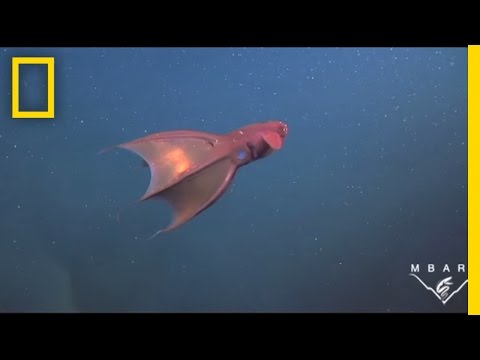
this menacing-looking squid is just one
of many species out of sight and out of
mind that could be threatened by human
activities far away from the part of the
ocean in which they live the Monterey
Bay Aquarium Research Institute has
released this video of the vampire squid
to emphasize a report that raises a red
flag about the Earth’s oceans vampire
tooth this infernalis is a type of
living fossil meaning that it has seen
very little change since it first
appeared before dinosaurs about 300
million years ago the Monterey Bay
Aquarium Research Institute’s dr. Bruce
Robeson who authored the report
published in conservation biology
narrates the institute’s video
Vampyroteuthis has very large eyes
because it lives about half a mile deep
in the ocean where the light is very dim
we took these pictures from a deep
diving robotic submarine and you can see
the reflection of our lights in that
beautiful blue eye the vampire squid has
eight long arms and a long curly strand
that serves as a sensory filament it has
a unique ability to react when it is
startled it can curl its web and arms
around the rest of its body turning sort
of inside out this change in appearance
may help it avoid being attacked by
predators these cephalopods they’re
technically not squids live in the deep
ocean with millions of other species
some of which are little known and on
which little study has been done Robeson
says human activities threaten all of
these they are threatened by ocean
warming decreasing oxygen pollution
overfishing industrialization and dozens
of other changes taking place in the
deep we have a responsibility to learn
all we can about these amazing animals
and to protect them from the greatest
danger to life in the deep the human
species
Robeson’s focus is on the oceans deep
pelagic zone which extend down from
about 330 feet below the surface to just
above the deep sea floor up to 6 miles
below the surface while the sea floors
had significant study he points out
little exploration has been done on this
water above the deep floor this zone is
home to species eaten by fish that
humans eat such as tuna and salmon mini
whales
turtles and giant squid also rely on the
zone for their food even though all of
this is out of sight any upset in the
balance here can ultimately have a
devastating effect on what humans have
come to expect from the oceans a place
that provides food for millions of
people
you
Please follow and like us: