
[Music]
this time on testing testing
motorbike helmets this is a specialist
testing laboratory in Hoover Larkin
Holland first up the weather test this
helmet has to enjoy six hours of driving
rain and six hours in 50 degree heat
twelve hours of punishment later it’s a
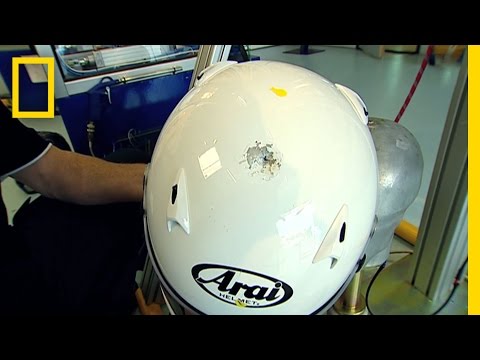
pass to test the outer shells resistance
to sharp objects a three kilogram weight
is dropped onto the helmet from a height
of three meters
there’s no room for maneuver even
momentary contact with the head form
means a fail when this shop point hits
the head you hear a beep only the
smallest touch will already give a beep
[Applause]
the helmets dented but the buzzer
doesn’t sound it’s a pass it must also
be tested for penetration of the visor
imagine if you are happily riding along
and a load of sand blew in your face
well the visor has to be scratch
resistant to a section of the visor is
taken out three kilos of sand should do
the trick
and after it cleans the visibility still
has to be 75% the inner shell is made of
polystyrene with three kinds of
densities the reason is because of the
fact that the human skull is on the top
it’s quite thin and on the front side
it’s quite hard actually so you can have
a different impact on the front side of
the helmet or on top of the helmet the
inner shell acts like a cushion to
absorb impact energy polystyrene beads
are compressed
one by one extending the time of impact
and providing a stopping distance for
the person inside much like body panels
being crushed in a car accident and how
to test it you drop it headfirst sensors
in the 5 kilo head form measure its
acceleration when it strikes the inner
shell is there to slow the impact so the
lower the acceleration the better the
shock absorption of the helmets and the
test doesn’t even damage the surface
this time on testing testing
motorbike helmets this is a specialist
testing laboratory in Hoover Larkin
Holland first up the weather test this
helmet has to enjoy six hours of driving
rain and six hours in 50 degree heat
twelve hours of punishment later it’s a
pass to test the outer shells resistance
to sharp objects a three kilogram weight
is dropped onto the helmet from a height
of three meters
there’s no room for maneuver even
momentary contact with the head form
means a fail when this shop point hits
the head you hear a beep only the
smallest touch will already give a beep
[Applause]
the helmets dented but the buzzer
doesn’t sound it’s a pass it must also
be tested for penetration of the visor
imagine if you are happily riding along
and a load of sand blew in your face
well the visor has to be scratch
resistant to a section of the visor is
taken out three kilos of sand should do
the trick
and after it cleans the visibility still
has to be 75% the inner shell is made of
polystyrene with three kinds of
densities the reason is because of the
fact that the human skull is on the top
it’s quite thin and on the front side
it’s quite hard actually so you can have
a different impact on the front side of
the helmet or on top of the helmet the
inner shell acts like a cushion to
absorb impact energy polystyrene beads
are compressed
one by one extending the time of impact
and providing a stopping distance for
the person inside much like body panels
being crushed in a car accident and how
to test it you drop it headfirst sensors
in the 5 kilo head form measure its
acceleration when it strikes the inner
shell is there to slow the impact so the
lower the acceleration the better the
shock absorption of the helmets and the
test doesn’t even damage the surface
Please follow and like us: