
[Music]
hello everyone welcome to a beer in
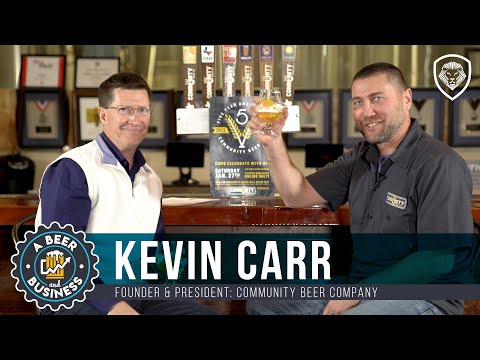
business this week we are with Kevin
Carr the founder and president of the
community beer company but first what
have you got there I’ve got a beer
specifically our Texas lagers is a light
type of lager really well-rounded
everyday sessionable kind of beer and I
selected your wit beer because there’s
nothing I don’t like about unfiltered
wheats and this is phenomenal first of
all you’ve done this this walk over the
thin ice of entrepreneurship a couple
times where did it start I think the
passion kind of started early as a kid
you know kind of hustling and trying to
make money and stuff like that but yeah
my first business was kind of mid-90s it
was actually in the financial world then
started business doing digital marketing
a lot of websites then into legal
software and then today beer all of that
will make you want to drink absolutely
you know what’s really interesting is
you talk about these they all seemed
like they were doing something slightly
new was that a theme
maybe I mean before I went into the
financial services business I was in the
financial services so that was a natural
progression but it was definitely new
once I got into technology that I was
always into technology computer science
minor when I sold my last business which
was a software business I did it so that
I could go provide beer to people so it
was beer and underlying passion so I’ve
always been into beer in college first
to use a college I didn’t drink at all
so a lot of my friends that know me now
I think it’s bizarre that I own a
brewery so I homebrew for about 15 years
before I opened a brewery and because of
that experience and that passion for
when I was looking to do something
different make a change you know that
was kind of top of the list I was you
know kind of already interested in it
so you didn’t just dive in so what was
that path when you say you know what
when I sell the software company this is
what I think I’m going to take it take
us through that research in that
decision process because I would imagine
along that path you you know research
may take you the place you know maybe
this isn’t a good idea maybe this isn’t
a good market but you went all the way
through and then you said yes at the
software company we had we had offices
in New York DC Chicago did a lot of
business in Denver and Portland which
are very craft-beer century cities
completely yeah and so as you know I was
visiting those those markets and seeing
this this great beer scene that that
existed out there I’d come home to
Dallas and there was really nothing
there’s windows of opportunities with
with any business any industry you see
it every day the window of opportunity
for me was in my hometown in Dallas
Texas there was a couple of craft brews
that were open but I just saw like
literally a wide open untapped market
pun completely intended and so you know
instead of just jumping right into it
and shifting gears which is a very risky
thing to do it’s risky enough to open a
business but once you grow it to a
certain scale and you have your
lifestyle you have all the moving parts
that depend on you and your business
you can’t just hard shift that way so
what I did is I started to just
investigate what it would what it would
take to open a birdie right and so a lot
of that was demographic research
understanding alcohol sales in this
market specifically the big hurdle for
me was I I had never been in the beer
business or the alcohol business you
know it spent the last at this point 20
years of my career in the technology
business you can do a bunch of research
but for me you got to go talk to people
when I went to these markets I would
find time to you know extend my trip and
seek out these business owners and seek
out these Brewers and ask them for their
time to talk to me and tell me you know
the ins and outs of the business what
they have done successfully what they
would do different if they could start
over and so this whole process really
what I was doing is I was almost looking
for a reason not to do it and at the end
of the exercise I didn’t find a reason
not to do it so you know I did it you
know what’s great about that is you just
described the process it’s not just
having a passion and being impulsive and
opening up next Tuesday it’s almost
finding the reasons not to do it and
then re talking you’re reselling
yourself on the dream to do it how did
you find like employee number one number
two and the key players because there’s
a lot of chemistry in beer there’s it’s
as a food product so there’s things you
have to you know comply with there and
then you have to finance it so what was
when you said okay let’s do it
what was the
have to find those first two three key
people and then the financing did you
bootstrap because I’ve been
self-employed for a while I had enough
experience under my belt maybe made a
lot of decisions wrong that you know
would have done differently but you’ll
learn from those experiences I made a
lot of right decisions obviously so I
had a good idea of finance and
accounting and operations and HR and
legal and a lot of those moving parts
that go into marketing and sales that go
into business as we talked about I
home-brewed but the one thing that I
recognize is just because I could
homebrew doesn’t mean you can do it
commercially and a lot of people do that
they make that mistake and there’s a
there’s a host of issues that can come
from that so right out of the gate I
knew that I had to align with the head
brewer or a master brewer brew master
but I was fortunate enough to come
across Jamie Fulton who is still our
brew master and a business partner with
me here’s a guy who lives in Fort Worth
who had a brew pub had won a ton of
awards through that brew pub kind of in
between gigs he was traveling the world
installing brewery equipment at other
breweries was looking to get back on the
brew deck and so sometimes in business
timing is key to you know next steps
forward and success and so I was I was
fortunate off to be able to find Jamie
and together we’ve built this this
incredible brewery it is a true
statement that every entrepreneur has
got like three or four core competencies
that are underneath when did you know
that community beer had like crossed an
inflection point and how long did that
take you said you know what we’re gonna
make it how long did that take when did
you know I’m not gonna lie you know
those first couple of years are really
rough before when you’re in technology
my biggest cost center were programmers
with staff right in this business it’s
very capital intensive I mean you look
at these tanks back here that brew house
was you know several hundred thousand
dollars each of those tanks ranged
between forty to sixty thousand dollars
obviously we laid out a budget and of
course we were way over budget
I had a running joke of you know if we
need a broom is that gonna cost twelve
thousand dollars because everything
seemed to start at twelve thousand
dollars there’s probably a $12,000 broom
out
some probably so the first year honestly
as much business experience as I had I’d
never done this business before and I
was relying on a lot of metrics from
someone else really took every bit of my
experience and you know kind of working
through the valleys of Revenue and
expenses and timing things out to kind
of get some sure footing under us and
thankfully for us you know when we
opened up along with some others the
craft beer business in North Texas was
starting to explode pretty quickly I
mean it was it was almost straight up
and the more you could produce the more
you can sell it was you know it was that
it was really one of those situations so
that helped us a lot
year two we strengthened still kind of
really watching her pennies we’re always
watching her pennies but to answer your
question I think was about year three
the industry was starting to mature a
little bit our business was starting to
mature a little bit we really kind of
got set into our expenses and our
capacity and we were able to sign on
with a really good distributor which
could help you know kind of take our
sales to the next level and that was
really the point where I was like all
right things are going well folks are
enjoying our products the year four we
were very profitable and we’re about to
celebrate year five next couple of weeks
so people are here in Dallas on the
Saturday the 27th that’s your five year
anniversary that’s right you know I
think it’s really interesting about what
you said is is how disciplined and
faithful you have to be to a process and
a plan you don’t know what tomorrow’s
gonna bring and in the Army they talked
about that the battle plan usually
doesn’t survive the first day of combat
but if you’ve spent these hours and hour
hundreds and hundreds of hours planning
then you’re ready for all the
alternatives because all that thinking
was into your planning stage did you get
to a point where you felt like man I
just don’t know where we’re going or did
you really just kind of lean back on
your career as an entrepreneur and all
the other businesses and saying okay
this is a bum day this is a trough this
is a low revenue moment but you know
what I feel there’s light out there
we’re gonna get through it yeah I mean
there definitely some
annulments that keep you up at night and
as an entrepreneur you know I mean it’s
it’s that’s pretty much a constant
really I mean if you’re so invested
every part of your life in your business
I mean every every moving part of that
business can affect your life the longer
you’re in business the more you see and
I felt that I had seen enough to where I
could navigate peaks and valleys in my
mind the way I process information and
process those situations it doesn’t
fluster me I think because of my
experience I know there’s a path there’s
often several paths to get to where you
need to go you just got to see all the
moving parts and pick the right path
that is either the most productive the
most cost-effective the most whatever
your goal is I mean there’s a point
where we were down to two thousand
dollars in the bank that’s not a lot of
money and that stressed me out but you
know you know where your receivables are
and you know you know what your
production is and you know and we do a
lot of events and tours you know you can
expect a certain amount of revenue this
week and so you can kind of see this
path to get out of that Valley and and
right the ship and also you know if it’s
not gonna be all right always have
contingencies on what you’re gonna do if
it’s not all right you know that’s a big
part of giving at least yourself some
relief is like well worst case this is
the path we’re gonna take if path number
one doesn’t work out it’s almost just
always moving chess pieces and if you’re
you know if you’ve got the experience
you can you can pull that off pretty
effectively regardless of whether it’s
community or one of your early
businesses what is the time where you
made just a righteous error and you had
to learn from it later cuz it didn’t
turn out well well the error that didn’t
turn out well gosh I mean how long do
you have you know I mean that’s part of
it right I can write a book on them I’m
right right I mean that’s kind of the
entrepreneurial path is like you you
know often make more mistakes and write
ones but when you write they better be
really right to keep you going to answer
that question there’s a business
opportunity that I kind of half-assed
into and it could have been something
bigger every day there’s windows of
opportunity you don’t just start a
business and go down the path and
everything works out swimmingly the way
you think it is it’s you know once you
start a business here come all the
moving parts and situational things that
change every single day literally and
there’s always windows of opportunity to
help you grow your brand grow your
product you know
whatever it is so when I had the digital
marketing company we’re doing a lot of
websites and things like that
and what I’d like to do is is I would
try to find a window of opportunity to
build this an application that I could
go on and sell and oftentimes I would
create its own branding I wouldn’t I
wouldn’t confuse it with the branding of
the marketing company I’d let it kind of
get up on its own on its own startup and
once it gets got some legs I would spin
it off into its own product
well I found an opportunity with at the
time web statistics you know measuring
people who come to your website and
things like that
today it’s ubiquitous but this was again
this was back in the the mid nineties
and if you wanted that kind of business
intelligence those analytics you had to
spend a lot of money so I saw a big
opportunity to create a web statistics
or a reporting platform that you could
plug into your website so I got my
developers we built it worked well it
worked just like the big boys but 20
bucks a month I mean who’s gonna say no
to that versus thousands a month and it
immediately sold to my clients they’re
using it created its own little online
marketing and started to get leads from
all over the world started doing
implementations the thing is though I
didn’t nurture it I didn’t take care of
it I didn’t I didn’t focus on growing it
you know I had some momentum I didn’t
capitalize on it so we grew at a very
kind of slow burn with that and it’s
easy to say you know we’re growing so
it’s good all the while I knew we could
do more we I could put more resources
into it but more my time into it I could
do more marketing into it but I’ll get
to it I’ll get to it I’ll get to it
we’re doing we’re doing good enough
right and you have the full-time agency
over here right yeah we’re in many hats
you know so it’s it’s an honest mistake
right but I was really excited about
this product well fast forward you know
three four months six months nine months
a year later well here come four or five
other companies that’s doing the exact
same thing there was one in particular I
think they basically stole all of our
platform all of our ideas and and went
out and did this that company went on to
sell that platform two years later to
one of the big guys from
many millions of dollars and I’ve never
I’ve never forgotten that lesson it’s
one thing to to not jump at the window
of opportunity when it opens and if you
don’t it’s gonna close but if you jump
at it if you’re gonna put in the time do
it all the way if you’re gonna do it
half-ass
don’t even bother don’t even try to do
it because you’re you’re only gonna lose
the opportunity my dad had a saying he
is to say Tom you have to commit the
things you can’t wear a raincoat in the
shower that’s not the purpose of the
shower the purpose of shower is you’re
gonna get wet and there’s a purpose to
that and so you try to wear a raincoat
and shower to say well I was in the
shower I took a shower but I wanted to
save time yeah it’s just like there’s
all the metaphors that come with that
and what he was saying was the same
thing if you did whether it’s a project
or a company you got to commit and go
all-in not foolishly but you have to
commit to the plan to nurture it where
did you find your set of principles that
lead to whatever management or mentoring
style where did that come from I’ve
learned that you know for me anyway that
if you bring motivated hard-working
people around you as part of your team
and you let them run with parts of the
business they’ll thrive and the business
will thrive along with it when I first
started in business for myself for me
you know I felt like I had to be a
micromanager I had to be in every part
of every decision and over over time you
start to learn especially the bigger you
get that that doesn’t work that doesn’t
work for everybody or most people
firstly because if you’re micromanaging
you’re spending more time doing things
day-to-day that take away from other
things you can be doing right the view
of the world and businesses units of
work versus units of revenue or result
ideally you want to put in the fewest
units of work to get the highest units
of results or revenue right that’s the
perfect balance and this is how I feel
others may disagree but when you
micromanage you spend more units of work
to get maybe arguably the same units of
result maybe less and you’re doing the
same for the person you’re micromanaging
if you trust someone enough to be a part
of your team and pay them
and invest in their career then there’s
something about them that you felt that
they could do the job so let them do the
job so you’ve done so many things all
these different companies and stuff here
it feels like you’re learning every day
yeah that’s true
you never stop learning as much
experience or knowledge or anything that
you’re good at that you bring to the
business if you’re not prepared to
continue to learn then you’re gonna
handcuff yourself when you want to start
a business you have to learn the basic
principles there’s a lot of folks who
don’t know what you know the difference
between a P&L and a balance sheet that’s
pretty important especially if you’re
gonna grow and especially you’re gonna
go to a bank or an investor to ask for
some money whatever you’re good at you
know bone up on what you’re not good at
what you don’t know
don’t ever stop learning because you
know when you when you get complacent
when you think you got it all figured
out that’s that’s when something’s going
to shift and you’re not gonna be ready
absolutely so right now you’re in Texas
what is the next milestone for you in
terms of distribution and getting beyond
Texas in this business I think you know
a lot of breweries and business owners
will become enamored with the idea of
going out of state I mean how cool is it
to go to Colorado and see your stuff on
the shelf for us though I mean there’s a
lot more room to grow inside of our own
state you know once you start going out
of state you start to lose some margin
the laws are different per state so you
got to deal with that you have to as a
business owner again not be complacent
like just look at the metrics look at
what everyone else is doing and look at
what you’re doing and realize that
there’s more room to grow it’s the same
activity you’re already doing you can
just do more of it so therefore you can
keep a higher margin and make more money
while doing it the last report that came
out this summer we were ranked the 10th
largest brewery in the state which is
actually shocking to me because there’s
almost 300 breweries now in the state
but when I look at our footprint in
other markets I mean in Houston in San
Antonio and out west in the Panhandle I
mean there’s so much room to grow still
for us how do we leverage that and take
it to the next level how do we add more
people in different markets how do we
leverage off-premise versus on-premise
and so our plans right now we have no
illusions of going out of state that
brings to mind some things because there
are people that will lead
comments on case studies or other things
that are on the bag attainment channel
and it’s like oh I’m in Australia and I
can’t wait to selling United States I’m
in Brazil I can’t wait to come to the US
but what you just brought up is a really
important thing it’s get it right get it
right at home maximize what you have at
home and then from that foundation
maybe there’s a path to go there but
that’s almost like an original
entrepreneurial decision because now the
cost the difficulty the team and all the
things you’re gonna have to do are
different so it’s almost like going back
and making okay I’m a national company
but now to be an international company
it’s almost like a different
entrepreneurial thought you got to put
into there on how to fund it how to pull
it off and how to get there successfully
otherwise you could find yourself hey we
did all this work now this Australian
product we’re selling it United States
and I’m not making a lot and I got
headaches and I’m up half the night
because the time zones and why I wish I
thought this over well and a lot of
times you know as a business owner it’s
important to say no something sounds
like a good idea well maybe it sounds
like a good idea but let’s let’s put pen
to paper make sure it’s a good idea and
if it’s not a good idea for whatever
reason you say no to it then you walk
away from it and you focus on what
you’re already doing well why add more
to the mix if you’re already doing
something well well thank you so much
for that and I am glad that you said yes
to talking to us because this has been
great this has been informative and I
think a lot of people are gonna get a
lot out of that whether they’re running
a t-shirt company in Perth Australia or
they’re running a brewery following a
passion here in Dallas Texas and I just
I so appreciate that and so do they if
you want to support an entrepreneur here
in Dallas and support a wonderful
brewery and all the people that have
worked at it and the jobs they’ve
created and everything they’ve done in
the wrist they’ve taken to make great
beer for us it’s on January 27th tickets
are on online you got to go online right
yes and what time does it start and
where can I go to get the ticket you can
go to our website there’ll be a link
community beer calm
it starts at noon but there’s three
different sessions there’s a premier
access there’s a early entry access and
there’s a general admission access there
will be plenty of beer for everybody to
go around it just depends if you want to
get some of that rare stuff
before it’s gone and you should come
earlier so come here at noon to get some
of those 50 beers and some of those that
you aged special for the event that’s
right yep that’s it
come down support community beers you’re
making jobs and entrepreneur here in
Dallas this is great to meet you thank you so much appreciate it
Please follow and like us: