
Rob: Welcome to 6 Minute English, the programme
where we explore an interesting topic
and bring you some useful items vocabulary. I’m Rob.
Neil: And I’m Neil.
Rob: Now Neil, I know you’re a keen swimmer.
Neil: I am. I try to get to the pool once a week
and do a few lengths, yes.
Rob: That’s good to hear because swimming
is one of the best sports for keeping fit.
It’s an aerobic exercise – aerobic means a very
active type of exercise that makes your
heart and lungs stronger.
The opposite of this is anaerobic – and for my question
today Neil, I wonder if you know which of these activities
is an example of anaerobic
exercise? a) weightlifting, b) kickboxing or c) dancing
Neil: I don’t have a clue but I’ll pick
my favourite sport – a) weightlifting.
Rob: Is that really your favourite sport?!
Anyway, we’ll find out the answer at the end
of the programme.
Neil: So what about you Rob
do you visit the swimming pool very often?
Rob: Only to use the cafe! I don’t like anything
aquatic – I mean connected to water.
I just don’t like getting wet – and swimming up and down
a pool is just boring!
Neil: Well there are alternatives to plain swimming.
There’s synchronised swimming…
Rob: Synchronised – that’s moving together at the same
time or speed as someone else.
Like dancing in water I suppose?
Hmm, I’m not a good dancer either.
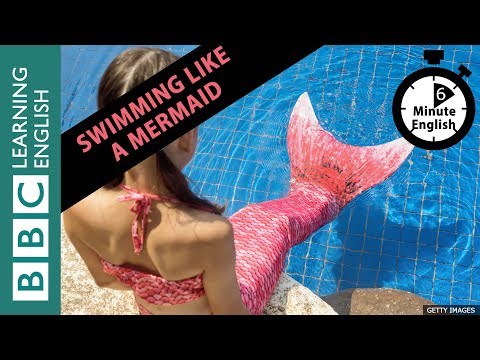
Neil: How about the new craze of ‘mermaiding’
which is making a splash at the moment –
in other words becoming very popular.
The idea originated in America but is now popular in
the UK and Europe.
Rob: OK. Tell me more!
Neil: Let’s hear from an expert – Emma Longden,
who’s founder of Fin2Fit – which runs classes,
teaching the skills of swimming safely like a mermaid…
Emma Longden: Mermaiding is putting a monofin on
your feet. Putting a beautiful tail on
and getting in the water and swimming like a mermaid.
Rob: OK, so I would need to wear a monofin
– the prefix ‘mono’ means ‘only one or single’
– so a single fin -that’s like a mermaid’s tail
– then I just get in the water and swim around
like a mermaid – I’m not so sure about that Neil
– I don’t really know how mermaids swim!
Neil: There’s more to it than that Rob.
It’s actually good for your fitness as
Emma can explain…
Emma Longden: It gives children’s confidence in water
a boost, it improves their water strength,
it gives you an entire body workout.
It works your cardiovascular system,
it works your legs, your core – it improves the children’s
swimming technique, flexibility, balance, co-ordination
– you get the reward, you get the social aspect –
and alongside all of that,
they’re learning vital life skills along the way.
Neil: So there are many benefits to mermaiding Rob.
Improving confidence, strength, technique
and it’s good for your cardiovascular system
– cardiovascular relates to your heart
and blood vessels.
Rob: I like the sound of the social aspect
– and by that Emma means being with other people
and having fun. It’s an activity that’s sociable.
And it teaches life skills – useful skills
that help you deal with everyday challenges.
Well that’s great for kids – and that’s the problem.
Neil: What’s that?
Rob: Mermaiding is for kids – so I can’t get involved
– even if I wanted to… can I?
Neil: You can Rob. According to Emma, it’s growing
in popularity with adults too –
any excuse to live out your fantasies hey!
Emma Longden: There are so many adults that actually
kind of want to live out their childhood
dreams that they wanted to be a mermaid when they
were children and they didn’t get the
opportunity and now it’s here and now it’s available…
So yes, we do a lot of adult classes as well.
Neil: There you go Rob – living out your childhood
dreams – that doing things you wanted to do
when you were a child. Like being a mermaid!
Rob: Sorry Neil, that wasn’t a dream for me
– although I did dream of swimming like a shark once!
Anyway, mermaiding is a good form
of aerobic exercise – but earlier I asked you
what an example of anaerobic exercise is.
Is it… a) weightlifting, b) kickboxing or c) dancing
Neil: I said weightlifting. Was I right?
Rob: You were Neil, well done. Any exercise
that consists of short exertion, high-intensity movement
is an anaerobic exercise – such as weight lifting,
sprinting and jumping. I won’t go into
scientific detail – but aerobics exercise
is done over a longer period of time and strengthens
the heart and lungs,
thereby improving the body’s utilisation of oxygen.
Neil: Thanks for that Rob.
Now I think we should sprint through our recap
of some of the words we’ve talked about today –
starting with ‘aerobic’, which you just explained.
“Mermaiding is a good aerobic workout.”
Rob: Assuming you don’t mind dressing up, of course!
Next we had ‘aquatic’ which refers to something
connected with water. “Synchronised swimming
is an example of an aquatic sport.”
Neil: Ah, you slipped in another of our words there
– ‘synchronised’ – which means ‘moving
together at the same time or speed as someone
or something else’. “We synchronised our watches
so that we all arrived at the same time.”
Rob: Good idea – you’re always late Neil.
Then we mentioned ‘mono’ which means ‘one’
or ‘single’ and is used as a prefix on words such as
‘monochrome’ – one colour – or ‘monorail’
– a train running on a single track.
Neil: Then we heard the word ‘cardiovascular’
– a word that relates to the effect on your
heart and lungs. “Experts say those who quit
smoking could also quickly reduce their risk
of cardiovascular disease.”
Rob: Finally, we also mentioned ‘social’ –
this adjective relates to activities that you do
with other people and are usually fun.
“Now I live in London, I have a great social life.”
Neil: Well you never invite me out Rob!
Anyway, that’s it for this edition of 6 Minute English.
Before you rush off to fulfil your dream of
being a mermaid, don’t forget to visit our
Facebook, Twitter, Instagram and YouTube pages,
and of course our website!
Rob: Yes and that’s at bbclearningenglish.com.
Bye for now.
Neil: Goodbye.
Please follow and like us: