
as a kid
anytime someone would ask me what I want
to be when I grow up I would always
respond with the same thing a biologist
and the President of the United States
to be honest this was mostly because I
share a birthday with Charles Darwin and
Abraham Lincoln but in my six-year-old
mind that was a perfectly logical way to
pick a career and somehow it came true I
am a biologist still working on that
second one but as a scientist I get to
study some of the smallest simplest
units of life and ask the most
complicated questions and it’s this
methodical system of asking questions
and testing answers that really
attracted me to basic research in the
first place and has led me to become a
stem cell biologist and now around the
time that my childhood self had settled
on a career was the first time that stem
cells were being grown in a lab nearly
20 years ago and this was met by a
strong response from the media and the
public in general dr. James Thompson of
the University wisconsin-madison had
figured out how to grow human embryonic
stem cells in the lab and there were two
opposing reactions to this news on the
one hand medical professionals and
patients suffering from degenerative
diseases were excited at the prospect of
what this meant for them but on the
other hand a debate ensued just a couple
of years before this there had been a
ban on federal funds for any research in
which embryos were destroyed
but private companies could still pursue
this work so Geron a biotechnology
company founded in 1990 funded dr.
Thompson in his work to produce
embryonic stem cells from the excess
embryos that come about during in-vitro
fertilization and now these excess
embryos are normally frozen and stored
at fertility clinics and so for a long
time the debate circled around this
issue the two questions that were always
asked were one should we consider these
frozen embryos a life and two if they’re
going to be discarded eventually anyway
wouldn’t it be better to use them for
medical research studying the simple
units of life had led not only to
exciting scientific questions but also a
challenging ethical one but what if we
didn’t need embryos to study stem cells
what if there’s a scientific solution to
this ethical problem we’d be able to
move forward with work that could help
us treat degenerative disease without
the ethical concerns and about ten years
ago that was no longer a what-if
question on the same day in 2006 dr.
James Thompson and dr. Shinya Yamanaka
published work in two of the highest
impact scientific journals announcing
they could make stem cells from skin
this work has been so impactful that dr.
Yamanaka who did this originally with
Mouse skin as a proof of concept was
awarded the Nobel Prize in medicine in
2012 and now the field of stem cells had
two major tasks ahead of it in terms of
the science they needed to show that
these
in derived stem cells were just as
potent as the embryonic ones and in
terms of the ethics we are still working
on shaking off this controversial
reputation that’s developed which is no
easy task after two decades of scrutiny
and misinformation this technological
advancement in stem cell research is
allowing scientists to study and
potentially treat degenerative disease
all without the use of embryos and when
Thompson and Yamanaka set out to figure
out how to make stem cells from skin
they had to turn to their embryonic
research and ask the question what even
makes something a stem cell and there’s
really just two things that make a stem
cell special the first is that it has to
be able to reproduce itself indefinitely
by dividing over and over again our
normal cells can’t do this they can only
multiply a certain number of times which
is why we can’t live forever
the second characteristic is that stem
cells are actually unspecialized they’re
kind of like a college freshman that
hasn’t picked a major yet but with the
proper guidance and cues from its
surroundings that stem cell can become
any type of tissue in the body and we
have ways in the lab to take those stem
cells and make beating heart cells
active pancreas cells or even beating
active neurons and beating heart cells
whichever I didn’t just name all of them
and it’s clear why an embryonic cell
would need to be able to divide over and
over again and produce all of the parts
of an organism but it is not so clear
how you can take an ordinary skin cell
and make it act like an embryonic cell
and to understand this it’s helpful to
think
about what these two things have in
common and that is the skin cell and the
stem cell both contain a full copy of
our DNA at the center of the cell and
our DNA acts as this giant instruction
booklet that our cells can go read and
transcribe portions of to figure out
what they’re supposed to be doing
the trick is cells only read the parts
that are relevant to their function so a
muscle cell in your heart is going to
transcribe what it needs to know to
contract whereas the cell in your
pancreas is going to read what it needs
to know to secrete insulin and so on
what Thomson and Yamanaka figured out is
that you can actually force a skin cell
to transcribe the parts that a stem cell
normally does and they do this using
just four proteins which are
appropriately called transcription
factors and what these do is get into
the skin cell and tell it to turn on
genes and produce proteins that will
allow it to divide over and over again
and produce any type of tissue in the
body and this process is now called
reprogramming and we have defined
procedures in the lab to take these
reprogrammed cells and make whatever
cell type we’d like and what my adviser
dr. Dennis Clegg at UCSB was interested
in is how we could use these
reprogrammed cells to study blindness
and dr. Clegg has been studying blinding
diseases for many years he started with
a disease called age-related macular
degeneration this disease is the leading
cause of blindness amongst the elderly
in the developed world and at the time
dr. Clegg started this project
scientists were using embryonic cells so
he and his team with a grant from the
California Institute for regenerative
medicine
figured out how to turn those embryonic
cells into the type of cell in your eye
that’s destroyed by this disease and
from that work he and a team at the
California project to cure blindness are
currently in a phase 1 clinical trial
where they’re actually transplanting
those cells into the eyes of patients
with macular degeneration and unlike
most stem cell clinical trials which
rely on embryonic sources there are in
fact trials in Japan that are using
these skin derived reprogrammed cells in
patients with macular degeneration and
unlike the embryonic sources these cells
are from the patient themselves which
reduces the risk of an immune response
just like an organ transplant these
cells are introducing foreign material
into the body and what the reprogrammed
cells do is reduce the risk of an immune
rejection and also expand how we think
about personalized or precision medicine
it’s due to the advanced surgical
techniques that exist in the eye as well
as good endpoint parameters for
measuring rescue of vision that cell
therapies in the eye are really leading
the rest of the field
unlike macular degeneration there are
other blinding diseases that start when
a patient is young like retinitis
pigmentosa this is the most common form
of inherited blindness it affects about
1 in 3,000 people these patients have
vision when they’re children but it
starts with a loss of night vision
followed by a gradual loss of peripheral
vision and eventually can lead to total
blindness on a personal level these
patients have to cope with the fact
that their site will slowly evade them
they will likely need to learn Braille
train a seeing-eye dog or walk with a
cane and lose some of their independence
currently this diagnosis is a grim one
with little that the doctor can do
leaving the patient with little hope but
where we can look for hope is with
reprogrammed cells this disease is
caused by a mutation or simply a typo in
the patient’s DNA that’s causing the
cells in their eyes to degenerate in
fact there are many different mutations
across dozens of different genes and any
one of those can be enough to cause
retinitis pigmentosa but until recently
we really were not sure how some of
these typos were causing degeneration of
the eye specifically and that’s largely
what my project is focused on during my
second year of graduate school when I
join dr. Clegg’s lab they were focused
on macular degeneration so I can clearly
remember the day I came into lab to find
a paper on my desk about an entirely
different disease retinitis pigmentosa
complete with a little note in the
corner that said see me
exclamation point sign dr. Clegg so I
walked across the hall to his office
which on UCS B’s campus is complete with
a panoramic ocean view bookcases
floor-to-ceiling filing cabinets stuffed
with decades of Xerox research papers
taxidermy animals everywhere you look
including a human brain preserved in a
pretzel jar but upon entering what I can
remember most is how excited dr. Clegg
was about this brand-new type of project
he had for me
clag has worked closely with dr.
thompson over the years and Thompson’s
lab had produced reprogrammed cells from
a patient with retinitis pigmentosa and
this is where the potential of these
cells really comes into view
imagine you’re that patient maybe about
14 years old given the diagnosis of a
degenerative disease with no treatment
plan but your doctor tells you if you’re
willing to give a skin sample scientists
can make stem cells and functioning eye
cells to learn about and study your
disease in the lab so shortly after my
meeting in the taxidermy office
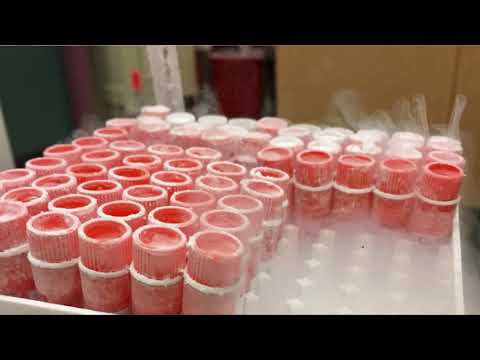
Thompson’s lab sent us a frozen package
full of vials of cells and each one of
these little vials contains millions of
reprogrammed stem cells and there were
some that had this mutation but then
there were others for which the mutation
had been corrected using a brand new
gene editing technology at the time
called CRISPR and so for the past couple
of years dr. Clegg and I have been
working on a disease model where we take
these mutated and corrected stem cells
make fully functioning eye cells and
then try to find the differences between
the two not only can we make one cell
type at a time but we can actually
produce entire small eyes in the lab
shown here is a cross-section complete
with the DNA in blue light sensing cells
in red and a protein we know causes the
disease in green we’re doing this not
just for the cells that I received but
also for other mutations that can cause
retinitis pigmentosa and other blinding
diseases entirely these two incredible
technological advancements skin derived
reprogrammed stem cells
and gene editing using CRISPR are
allowing us and other scientists to
answer molecular and cellular questions
about this disease that the field has
been struggling to resolve let’s be
clear it will be a lot of work before
these technologies are widely used in
patients my dream is for the future
treatment of degenerative disease to be
a simple and straightforward process you
could imagine a doctor takes a skin
sample or maybe something less invasive
like a cheek swab from a patient sends
those off to a scientist who can make as
many stem cells as you’d like
correct any mutations and then bring the
cells that the patient needs but in
order for this treatment to be a reality
we need to make sure we can make all of
these different cell types efficiently
that we can precisely edit the mutations
and that we can safely transplant the
cells back into the patients and while
this is in this somewhat distant future
this technology gives me hope and more
importantly it gives the patients hope
that future generations won’t have to
suffer from the same diseases that they
currently face and there’s value in hope
there’s value and going to a doctor’s
office and being given options rather
than a grim diagnosis with the invention
of reprogram cells we’re learning that
the ethical considerations of stem-cell
research should no longer be a concern I
invite you to embrace this technology
fully so we can further our potential to
improve lives and treat disease thank
you
[Applause]
[Music]
[Applause]
[Music]
Please follow and like us: