
[Music]
[Applause]
every time you breathe you are inhaling
more molecules than there are stars in
the known universe
so come hold the cosmos in your lungs
and expand your lungs your bodies your
blood comes from the bellies of exploded
stars they are the dregs of supernova
blooming with more energy than the Sun
will emit in its ten billion year
lifespan just one can outshine an entire
galaxy on its own supernovae are some of
the brightest objects known to man and
to man they mean bones they mean bodies
they mean the birthplace of elements
that build our very beings when you look
in the mirror you’re seeing a poem
composed by cosmic combustion come these
stellar epitaphs are spelling out our
names there are so many different ways
to learn science for example in that
poem you just heard six different
scientific facts and I’m willing to bet
that for everyone in this room that is
probably the first time you learned
about astronomy from a spoken word poem
art is just one of many powerful tools
that can be used to not only share
science but to make it more engaging and
more accessible for people with
disabilities I first became interested
in the world of accessibility through a
theater class I took at Ohio State’s the
class was called Shakespeare and autism
and it featured acting games designed by
Kelly hunter of the Royal Shakespeare
Company the book on the topic is shown
up here I had the pleasure of playing
these games with children on the autism
spectrum every week and I got to watch
these kids acts laugh grow and open up
and new and incredible ways the games
are designed to foster imaginative play
while working on the development of life
skills such as making eye contact and
recognizing facial expressions I fell in
love
with the way that art was reaching
people and helping to break down these
communication barriers so I decided to
fuse my love of art and my passion for
science education and to redesign these
games to teach the kids about different
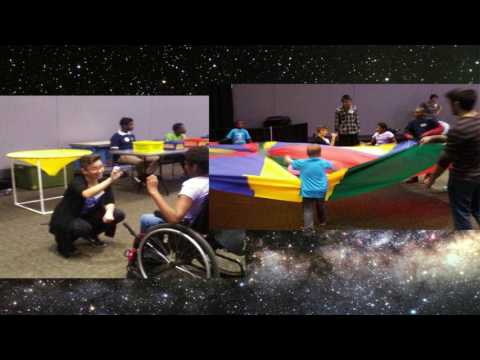
science concepts I recruited a team of
volunteers about half of whom are shown
here who all did an incredible job
playing these games with the children I
challenged these volunteers to be
radically silly and to risk
embarrassment because if teachers don’t
up open up then why should we expect the
same of our kids we would all start out
gathered around sitting in a circle like
you see here and then teaching artists
and kids would partner up one-on-one and
play acting games we acted out
everything from cells in our body to the
biggest planets in our solar system all
the while preserving the core essence of
the games which was to foster these life
skills while having a fun time
American Sign Language was also used to
make the event accessible for children
who are deaf but as I said earlier art
is just one way to make science more
accessible another important tool is the
sense of touch this year I began working
with an international team of scientists
and educators who designed the sky in
your hands a planetarium show focused
around blind audiences
it features an audio narration and this
3d printed model which has raised lines
bumps bumps and textures representing
our stars and constellations I worked
with cosig a science center in Columbus
Ohio to integrate the show into the
planetariums regular schedule as opposed
to just organizing a one-off special
event and we’re currently actually
producing about 200 of these 3d models
so that every single visitor regardless
of their vision status can experience
this tactile tour of the Stars this is
so important because we need to
normalize accessibility and a crucial
step in doing that is integrating it
into everyday practice so it is not only
accepted but expected in education
design the planetarium staff also added
captioning so the show can be accessed
by deaf and hard-of-hearing visitors
another sense I want to touch on is the
sense of sound sonification
is a revolutionary process by which we
can actually audible eyes data what that
means is we convert real scientific
information into parameters of sound and
analyze it with the ear this allows
people to not only learn about science
but to actually do science without
needing to rely on the sense of sight
and this is so crucial because at the
end of the day accessibility is about
not only welcoming people into learning
about our universe but also opening new
doors that marginalized audiences can
contribute to the investigation of our
universe and to this process of
discovery let me leave you with this if
science is important to you then no
matter who you are you have the
potential to be important to science
people deserve to know that not only is
there room for you in science there is a
need for you whether it be through 3d
printing art sound touch or otherwise
there are so many different ways to
learn and so many different ways to
access information however accessibility
issues are Pervez are present in all
fields not just in science and astronomy
does the industry in which you work or
the community in which you live have
barriers for people who are not hearing
sighted able-bodied and neurotypical and
do these barriers exist because they
have to or because no one is being
forced to consider new approaches just
because we don’t experience an obstacle
that doesn’t mean it’s not there it just
means we have the privilege of not
noticing it so and the spirit of
noticing and in the spirit of Awakening
through even this moment like it’s your
last time being told to treat every
moment like it’s your last breathe it in
like it’s your first like you are so
young like you are just beginning
because compared to the cosmic calendar
we will never be anything but new you
will always be a child to this you know
first we live in so don’t you ever be
afraid to wander like one you see us
humans have always searched for answers
in the unknown carving constellations
from the question marks in our spines
searching for our fingerprints in the
Stars maybe that does make us fools
maybe it means we’re just scared of what
lies beyond our telescopes but you
should note that the size of the average
shooting star is no bigger than your
fingerprint and it is a fact that when
you look up into the sky you are looking
into the past and the further out we
gaze the further back we are looking in
time we can climb through the history of
this universe and witness the ancestry
of existence
don’t miss this gorgeousness living in
our equations and charts don’t miss the
Bliss of human curiosity for it is our
greatest work of art thank you
[Applause]
[Music]
Please follow and like us: