
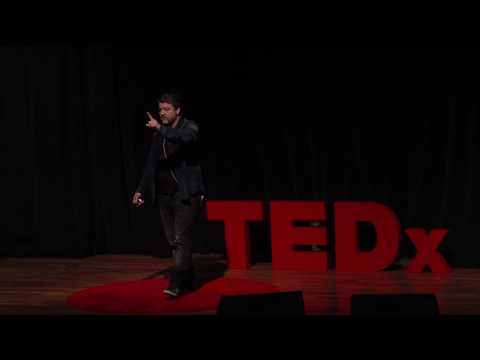
Translator: Daniel O. Netto Reviewer: Claudia Sander
Imagine with me:
Organic corn flour,
crushed stone mill Daniel Mona.
cured and smoked goose,
Housewife Romilda Prado New.
serrano artisan cheese,
Sao Jose dos Absent, his Antonio.
Products with name, surname and address;
products from.
Let me ask you something.
Who here of you know what you’re eating?
Who here knows where it comes from
and who is behind the food that’s on your plate?
When we know the origin of the food we are eating,
we realize
the taste is very related to the way that food was planted,
care, harvested and prepared.
Everything tastes better and it makes more sense.
I wanted to introduce some to you.
This is your Antonio.
Mr. Antonio is 58 years old
and has a beautiful wooden cheese factory in Sao Jose dos Absent.
It produces five kilograms of artisan cheese serrano raw milk,
it’s just what your cows give milk.
This recipe he learned from his father.
For over 200 years, the artisan cheese serrano
is a product of great economic, social and cultural
throughout the region of Cima da Serra de Campos.
It is the main source of income for many farmers,
but since 1952,
it can not be sold outside the municipality.
This incredible lady is the owner Romilda.
Romilda owner has a small farm in New Prado,
where she creates 100 geese per year.
It feeds these geese with sweet potato,
which she gives a beautiful color and a unique flavor to the meat.
Once a year, she slaughter some birds,
cure in salt for ten days,
then smokes on branches of fruit firewood for another ten days.
And this is the result goose breast cured and smoked.
This incredible delicacy is sold in a local market
for meager value,
along with their baked in the wood oven cucas
chimias prepared and the copper pan.
This is Daniel.
It has a small rural site in Canela,
called Mona.
Among creating organic sheep,
range chickens, vegetable gardens and orchards,
Daniel has a small plantation of maize landraces,
result of the exchange of native seeds with other producers in the network.
Daniel reap real ears of corn.
And he can grind, right there in the kitchen of his house,
an incredible organic cornmeal.
He eats everything,
or sold in informal markets.
This is me.
I am a cook for 20 years.
I started cooking outside Brazil
and when I returned,
I sell food in Styrofoam on the boardwalk, like walking.
A year later, I set up my first restaurant,
in a fisherman’s house.
And years later, I came to Porto Alegre mount the second restaurant.
When I lived on the beach, we consumed the shrimp in front of the pond,
the local fish,
and artisanal fishing octopus shore.
But what we all have in common?
In 2011, I decided to get out of my kitchen
in search of the ingredient in the fountain.
I thought it did not make much sense
waiting to get ingredients that did not know where they came from,
who produced them,
as they were made, that history had behind.
I pro inner
and I started researching more about the state of our culture.
The Rio Grande do Sul is amazing, and is not parochialism.
The Rio Grande do Sul has an incredible colonization
Italians in the Sierra, the Germans,
the Azores, the Portuguese,
the Spanish border, the Indians …
is a giant cauldron wealth of flavors and knowledge.
Hundreds of small families of artisan producers,
of people who do.
But these people know not charge for these ingredients.
Charge do not know and have often ashamed to charge,
why not give due weight to themselves.
They have no idea of the preciousness that their hands.
We understand that there must be a fair remuneration.
And by “just,” I understand that one should live in dignity than it produces.
Even more:
the children of these people must see that there is a future
keeping the family tradition.
Must see that it is possible to live than they do,
instead of going out pras cities, or pursue another activity.
A kilo of cheese serrano takes ten gallons of milk,
60 days to get ready,
and it is sold at R $ 15.
This account does not close.
The cured and smoked goose owner Romilda,
It takes a year to get ready,
and it costs the same as a normal ham.
I thought we had to do different.
We started to take these products inside our kitchen
and create dishes with them.
We believed that it was possible to add value to these dishes
with a bit of technique and creativity,
and generate an extra income
and an additional demand to the small producer.
We knew it could add value to these dishes,
charge more for them
and compensate small farmers much higher than the local market was paying.
So we created a project called: Internationally Location.
Basically, it values the regional culture
and the small artisan producer.
This project …
it moves us from time to time.
We understand, in this project,
we need to organize some supply chains,
such as the nature, ingredient, kitchen and man.
And we know that by doing so,
we can offer a good, clean and fair food:
a food that is good for those who produce,
good for those who prepare and good for those who eat.
This wheel has to turn.
Thinking about it, we have created a line of craft products,
using the inputs of small producers.
These products can be taken home,
and in them is counted some of the history behind the ingredient: those who produce,
how it’s done,
what’s behind all this food chain.
Says the famous words of Hippocrates: “We are what we eat”.
And our food too.
You see,
cheese produced in Absent
varies according to the quality of milk,
which varies according to the quality of the pasture,
which varies according to time of year.
In Sao Jose dos Absent,
in summer, the grass is green,
in winter, it is golden frost,
and, soon after, comes the controlled burns,
to which renew pasture pro next year.
That is, in the summer, milk has more fat,
and the cheese is creamier and tastier.
In winter, the milk is thinner,
and the cheese is lighter and drier.
Regardless of our choices,
if I’m carnivore, vegetarian, vegan …
I think important to always know where it comes from the food we are eating,
to reflect on his origin.
As a cook,
I think healthy eating a barbecue
a pasture cattle
a small producer, who know the whole process,
of creation, to slaughter.
I try to avoid meat confinement and big industry.
But on the other hand, I do not see much point in being vegetarian
and buy a common lettuce in the supermarket.
When we talk about food intolerances,
often, we talk about products that are no longer what they were long ago.
Wheat, for example.
The wheat was cut, stretched, stitched,
to become something unrecognizable.
If we had access to the primitive wheat,
one that does not contain gluten,
I believe that many of the diseases we have,
we would not have today.
But back: what we all have in common?
I, Daniel,
your Antonio, the owner Romilda?
I think we have in common
we continue to do what we do.
We sum, we share
and we work together.
I think
we are learning to know the size of the food
and worrying about having a whole food and truth on our table.
Today, his Antonio continues to produce its cheeses:
five kilograms.
But, after much pressure,
Now in February,
We were able to approve a bill
regulating the sale and production of serrano cheese throughout the state.
Mr. Antonio will now be able to sell their cheese quietly.
The owner Romilda continues to create the 100 geese it.
But now she’s famous,
and she learned that can charge well for it.
(Laughs)
He also learned to benefit the goose feathers to trade.
Also, the liver, we do pates and terrines redneck goose.
The blood returned to the old ingredient of traditional preparations,
such as the brown sauce.
I believe
she made some dreams now after 80 years.
Daniel learned carpentry
and makes beautiful boards for gastronomy.
Still tending the sheep and their garden.
But now it has a new Sunday lunch open to the public.
He is now preparing its traditional polenta
freshly ground,
with the lamb roasted in ground fire,
and your vegetables from the garden.
And I?
Following the project playing Internationally Location,
Antonio with her, Romilda the owner, Daniel,
and another 20 families.
I keep traveling less than you would like,
but I keep traveling, meeting people,
knowing some new products, knowing producers.
I will confess that I won some awards as a cook,
but none of them brings me happiness
I have to touch this project with these people.
I know I still have a long way ahead,
but we are on the right track.
And it was this journey,
I learned that we need to look back,
to be able to walk forward.
We need to keep our customs and traditions.
We must do what we have always done, but in a way a little different.
Learning from the conventional wisdom of the owner Romilda,
learn from our ancestors,
learn from our tradition
and our people.
Basically,
I think it’s more or less like food used to feed us decades ago.
With clean food,
direct from those who produce,
in his time, in his season,
and valuing what is around.
I want to leave here today a little provocation,
or look at our new way of eating,
which basically serve for us to think
what kind of food we have at our table in five or ten years,
what our children will eat.
I believe that more and more
we have the awareness of what we choose to eat,
our choices will determine
how we can feed us a real food.
And basically,
I think health is we know
where it comes from what we are eating.
Thank you.
(Applause)
Please follow and like us: