
Translator: Delia Cohen Reviewer: Ellen Maloney
Would it be fair to say that most of us in here believe in second chances?
Audience: Yes.
But, how many of us are willing to give second chances?
I’m a first-time offender,
convicted of second-degree murder and a gun enhancement
with a total sentence of 40 years and two life terms.
I want to convince you that first-time offenders convicted of a violent crime
are not necessarily violent people
and should be considered for a second chance.
To show you what I mean, I want to share a story of a boy who made the worst choice
at the worst time of his life.
This boy and his family are refugees from the Vietnam War.
They emigrate to the United States and settle in Oakland, California.
His parents did not understand any English
and often relied on neighbors, relatives, and friends for help.
As he grows older, his parents rely on him.
In attempting to live up to his parents’ expectations, he graduates high school,
enrolled into college, and worked.
Unexpectedly, his mother suffered from a paralyzing stroke,
and shortly thereafter, his high school sweetheart ends their relationship
because she no longer loves him.
Confused, overwhelmed, and devastated at his circumstances,
he decides to move out of his parents’ home to find himself.
Instead, he finds Johnny who recently paroled
and was struggling to find his place in society.
The two of them tried to make sense of their lives
while filling the void at bars, clubs, and parties.
About six months later, as he leaves a party with Johnny and Steven,
a group of people confronts them.
One of the people gets into a fight with Steven,
while the other rushed at him and Johnny.
At that moment, he takes a gun from Johnny
and, for the very first time, fires it, into the ground —
the one shot.
The bullet ricocheted, and he kills a young Vietnamese man
who had gone through a similar struggle like him.
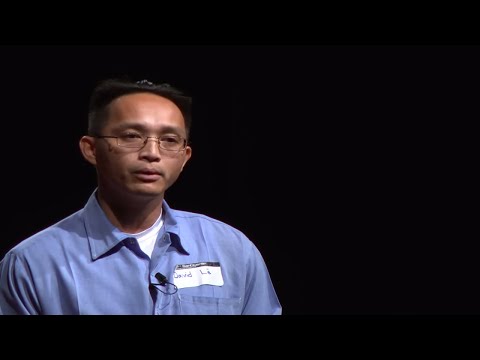
As you may have figured out, that boy is me.
I was a lost and angry person who sought acceptance in people
who were more or less in a worse place than I was.
This led me to commit a violent crime,
which categorized me as a violent offender.
But I’m not a violent person by nature.
About ten years into my incarceration,
I discovered there are incarcerated men, like me,
who behave nonviolently for ten years or more,
and even up to the day they parole.
Yet, they are still being labeled as a violent offender
because of their crime.
While the California Department of Corrections does recognize
that violent offenders can become less violent,
and eventually, no longer violent,
which they do when they reclassify our security levels
and move us to a lower-level security prison, like San Quentin.
Yet, our “violent offender” labels do not change.
As a result, it paints a distorted image of who we are
and that can be counterproductive to our rehabilitation process
and how society perceives us.
For example,
when incarcerated people parole, you often hear:
“It is the murderers, the hardened criminals, that are being released,”
when in fact, most of them are reformed individuals
who get out and most stay out.
Stanford research shows that lifers —
and lifers are people convicted of serious and violent crimes
and are sentenced to life in prison with the possibility of parole —
their recidivism rate is less than one per cent,
and of those who reoffend are for nonviolent crimes.
What’s more?
The California Department of Corrections’
Dr. O’Mara, who is a regional director of mental health,
she acknowledged that people convicted of violent crime for their first time
are not necessarily violent.
To put it another way, for most of us in here,
who are convicted of violent crimes are not as violent as people may think.
To accurately get a picture of who is and who is not violent
should not be determined only based on our crime
but who we are today as well in our overall behavior.
Because our behavior is a big factor in who we are, wouldn’t you agree?
Audience: Yeah.
(Applause)
I think so, too.
(Laughter)
I have shared with you the person that I was.
Let me share with you who I am today.
Today, I work, volunteer, and participate
in some of San Quentin’s self-help and educational programs
that were previously mentioned,
because as much as I want to be helped,
I want to be able to help other people as well.
Today, I’m a person who has matured through nine years of self-introspection.
Unlike my younger self, today I’m willing to face adversity.
I’m willing to ask for help when I know I cannot do it alone.
I have a desire to thrive and redeem myself.
I just need that second chance.
I invite people to not only see us for our crimes,
but for who we are today as well.
While the stigma of our crime clouds over our life every day,
I hope our desire for redemption and a second chance shows you
that we are not monsters, but people who made horrible choices.
While recent criminal justice reform efforts
in California within the past few years have helped to create laws and measures
that provide youth, repeated, and elderly offenders
with long-to-life sentences
a meaningful and realistic opportunity to earn parole,
I believe similar laws and policies
can be created for first-time offenders with long-to-life sentences, as well.
It can complement our rehabilitative effort and our desire to redeem ourselves.
I invite state and federal policymakers
to create bills like it into law.
I invite criminal justice reformers to lobby to lawmakers,
judges to approve it, and the public to support it.
I invite people to come into San Quentin and other prisons as well.
Listen to our stories, think about them,
share them.
Because at the end of the day,
you have the power to give us,
first-time offenders with long-to-life sentences,
hope and pave our road to a second chance and redemption.
Thank you for your time.
(Applause)
Please follow and like us: