
[Music]
the Battle of Shiloh in one sense it had
solved nothing except to keep the coffin
makers busy everywhere the sights and
the smells and blood and death with
upwards of 25,000 set the stage for
things to come
in the Civil War era when people spoke
of the Battle of Shiloh it was with a
kind of awe and reverence not because it
was the worst battle in terms of
casualties but because it was a place of
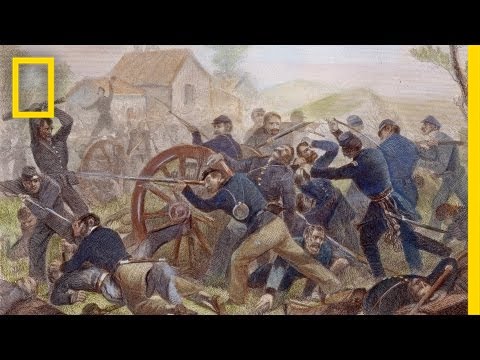
such dark Horrors in gloomy forest cut
up with deep ravines and swamps and
patched with deadly open farm fields and
slain bodies piled high upon each other
everywhere the sights and the smells of
blood and death mixed with the pungent
fragrance of early springtime general
ulysses s grant wrote afterward that
there were so many killed a man could
walk across a huge cotton field merely
by stepping on dead bodies without his
feet ever touching the ground the place
names of the battle had a chilling
resonation
the hornet’s nest the sunken road the
peach orchard bloody pond before the war
Pittsburg Landing was a remote hog and
cotton steamboat dock on the Tennessee
River but the battle took its name
actually from the Shiloh Church a
chenkin waterlogged meeting house not
much better than a respectable Iowa corn
crib but it was a house of God
and ironically in Hebrew its name means
place of peace one of the significant
things about shallow and there are many
is that it was so utterly shocking
through the nation did to both nations
as it were at the time for the first
time it showed Americans on both sides
that the war would not be over by
Christmas as the common saying went it
showed that there was no day t or shrewd
military man knew
that was going to put an end to the
conflict instead people began to realize
that by strolling a civil war they had
unleashed a vast monstrosity a sort of
long-term corpse factory it was going to
drench the country and blood for years
to come
after the Battle of Bull Run the only
other battle so far in the war people
were horrified at 5,000 casualties at
Bull Run
then came Shiloh with upwards of 25,000
casualties and set the stage for things
to come tactics and strategy in the
Civil War had not kept up with advances
in weaponry there’s an old military
maxim that says generals always fight
the last war which is quite true during
the first years of the American Civil
War military textbooks of the day
preached Napoleonic tactics it was 50
years outmoded that call for armies to
march with the most men to the sound of
the guns mostly they marched to the
slaughterhouse in early 1862 the war was
scarcely a year old
troops were green some perhaps had some
state militia training a few and fought
in the Mexican War 15 years earlier most
Union generals seemed afraid to attack
the rebels they seemed afraid for their
reputations all that is except ulysses s
grant grant was from Illinois where his
father kept a tannery in a
slaughterhouse and from the young age
grant was revolted by the sight of blood
at West Point he was an indifferent
student and when he entered the service
it was in the quartermaster Corps hardly
a conspicuous branch of the service but
during the Mexican War Grant stood out
distinguished himself for his personal
bravery in battle
but afterward at a series of Army Post
in California grant gained a reputation
as a drunkard and ultimately he was
forced to resign from the service in
civilian life he continued to fail he
failed as a farming failed as a
businessman if an he took a job is a
last resort in his father’s leather
goods store in Illinois which was where
war found him he was given a job at
first training state troops more
explicitly he was asked to take over
regiment of volunteers who were
described by the governor as a mob of
chicken thieves led by a drunkard
amazingly carnal grant whipped these
miscreants into shape and was given more
regiments which formed brigade he became
a brigadier general
he soon distinguished himself by taking
a small army to capture the rebel force
Henry and Fort Donaldson on the
Tennessee and Cumberland rivers
respectively which opened those
waterways to Union vessels and then
using Union gunboats and steam
transports he pushed south until he came
to Pittsburg Landing grants army now
consisted of about 50,000 men his
instructions were to wait at Pittsburg
Landing for Union General Don Carlos
Buell and his army of 22,000 who were
marching overland from Nashville and
when combined their forces would be
irresistible to anything the Confederacy
could throw at it less than 20 miles
south was the Mississippi town of
Corinth where the rebel General Andrew
Sidney Johnston had gathered about
45,000 rebel soldiers as a
second-in-command Johnson had been sent
a delightfully named General Pierre
Gustav Teuton Beauregard hiroba Nasus
and no
as the quaint Creole the Confederates
knew that Buell join grant the Union
forces would be too strong to conquer
Johnson wanted to wait for another rebel
army of 10,000 that was marching its way
from Arkansas but Beauregard urging
immediate attack on Grant and Johnson
agreed rain and mass confusion delayed
the Confederate attack by three days
possibly a fatal error but somehow by
April 6th 1862 they managed to sneak
this huge rebel army into the woods less
than a mile from the Union Ford
positions at dawn the rebel assault
began there were three Confederate
battle lines each two miles long
stirring site each containing about ten
to twelve thousand men one Yankee
soldiers said that the rebels looked as
if to be on parade they marched out of
the tree line their bands playing a
drummers drumming the flags waving
thousands of bayonets blending in the
morning sunlight officers on horseback
and above all the chilling rebel yell
something primal I bet that rebel yell
Indian possibly it was once described as
sounding like a pack of 50,000 yelping
beagles but whatever it was it was so
uncanny coming through the woods it was
said to cause a shiver to anyone with an
ear sight
how the Federal Army got surprised has
never been satisfactorily explained
grants engineer laid out camps with a
mind toward sanitation and convenience
like Boy Scouts rather than for defense
in fact there were many warnings of a
rebel presence but these were not heeded
General William Tecumseh Sherman
actually had one sergeant arrested for
promoting false rumors it was on April
the 6th 1862 a lovely spring morning
peach orchards and dogwoods were in
blossom and the forest floor was
carpeted with violets in the Union camps
men were finishing breakfast they were
shining shoes are cleaning their rifles
in some cases attending Sunday services
many diarists report how many birds were
singing that morning there was not a
cloud in the sky but on the horizon it
grew darker as the rebel hosts advanced
in the Confederate lines was
eighteen-year-old Henry Morton Stanley
who one day would become famous as the
great African Explorer who discovered
dr. Livingstone at least he ran into him
darkest Africa just before the battle
Stanley reached down and picked its
handful of violets tucked them in chat
ban he means that any Yankee seeing him
with flowers in his hair would hesitate
to shoot him later Stanley was to say of
the so called glory of war it was all a
glittering lie
they’re well-known writers in both
armies that day general Lew Wallace of
Indiana was commanding the division
under Grant he would go on to write the
most popular novel of the 19th century
ben-hur ambrose bierce was a young
lieutenant Buell’s army who one day
become among the most popular of the
american writers who would publish a
million other works the so called
Devil’s dictionary which is still in
print and there was Sam Houston jr. the
son of the man known as the father of
Texas who were called it with his
regiment marched into the heavy Union
fire our line actually seemed to wither
and curl up what a remarkable
description at first the rebel attack
was immensely successful Union divisions
have batted back more than a mile and
thrown on one another in a fearful
slaughter in a matter of minutes six a
sixth gun Union battery Auto Ribery
reported 50 bits Gunners were killed all
of its horses except to reserve but by
late morning General Grant had reached
the battlefield from the mansion nine
miles downriver where he had kept his
headquarters afterward he would receive
severe criticism for not staying close
to his army both flanks of the Federal
Army were giving way but in the center
was a deadly pocket of resistance that
came to be known as the hornet’s nest
and near it the sunken road where the
rebels expended themselves in attack
after attack after attack only to see
their dead heaped in piles before the
ferocious Union cannon fire there was a
nine year old girl on the battlefield
that day her name was Elsie Duncan the
family owned a farm in the vicinity of
Pittsburg Landing they had been caught
in the surprise like everyone else and
else who remembered years later in a
memoir that the battle began at our
front gate and swept through leaving
behind the bodies of dead men and dead
horses by mid-afternoon on
April 6th general Johnson commanding
Federal Army of the mana Confederate
Army alligator Lee was killed while
personally leading a charge against the
hornet’s nest
he had a regiment of Tennesseans who
refused to fight he said Tennesseans who
would not fight I’ll lead them and he
did today it would be unthinkable in
military sites it takes us losses
against an enemy strongpoints
by fired maneuver today you would simply
isolate by passively with the wither but
they weren’t using today’s tactics
Johnson general Johnson took him on his
horse took a bullet through the back of
his knee he didn’t even know he’d been
hit but it severed an artery and he bled
to death the supreme irony was that only
a few minutes before he had sent his
personal physician away to tend to some
Yankee wounded if his physician had been
there he could have tied that wound off
in a few moments and in Johnson would
have lived but general Beauregard now
took charge and the fighting continued
by late that afternoon the hornet’s nest
had been taken by the rebels along with
an entire Union division and its
commander an apprentice at last as the
Sun began to set the Confederate
onslaught had cornered what remained it
of grants army with its back to the wall
at the landing itself and the rebels
prepared for one last great charge that
would end the mountain and destroy the
Union Army but this never happened
general Buell had arrived across the
Tennessee River late that afternoon and
his army began crossing on steamboat to
supplant the thinned-out racks of
general Grant’s force and as the rebels
were gathered for a final charge they
thought would have ended the fight word
came from general Beauregard the
ceasefire and retire from the firing
line unfortunately for the southern
force this new Confederate commander had
remained at shallow Church two miles
away from the present fighting he had
sent a telegram that afternoon to
Jefferson Davis in Richmond saying the
day is ours premature yeah Beauregard
felt that they had been successful F
that day and he could easily finish off
grant in the morning imagine his
surprise next day word got back that
Grant had been reinforced with 10 at
20,000 fresh men on the field
Beauregard with his own losses could
scarcely count that many men in his army
at that point all morning the fresh
Yankee army pushed back the rebels first
to their original lines and then beyond
about 2:00 p.m. one of Beauregard’s
aides suggested that they might best
call it a day
and the great Creole agreed replying I
intend to withdraw within 10 minutes
time thus ended the Battle of Shiloh in
one sense it had solved nothing except
to keep the coffin makers busy there was
no triumphal surrender no captured
destruction of the rebel army but grant
still held his field – about 12,000
casualties and Beauregard staggered back
to Christ with about the same number of
kill wounded and captured
grant had escaped destruction by very
narrow margin and it was his own fault
for not fortifying for not patrolling to
the south where the enemy was known to
reside on the other hand grants tenacity
saved the Union a deep embarrassment if
not a catastrophe if grant had been
forced to surrender there was a little
between the Confederate Army in the
great cities in the Midwest Chicago
Cincinnati even Cleveland the state of
Kentucky almost certainly would have
been lost in the Union and probably
Missouri as well a calamity Lincoln
would have been forced to pull his
armies out of Virginia at the worst
possible moment and so Lincoln and the
nation had grant to think that that did
not happen but but when the casualty
figures from shallow became known great
scorn and shame was heaped on grant by
the press and by the politicians while
rumors spread that Union soldiers had
been so surprised they were bayonetted
to death in their tents in their sleep
everyone was calling for grants head on
the false rumor that he had been drunk
during the Belle époque refer Lincoln
is supposed to reply did grant William
drunk found out what kind of whiskey he
drinks and send a barrel to rest of my
generals if there is no proof that
Lincoln actually said that there is
evidence and I’ve seen it that he
confronted grants detractors with these
words I can’t spare that man he fights
with the battle over went on to greater
things at Vicksburg and then East to
take command of all the federal armies
and to face Robin Ely in Virginia
grant himself had been one of those to
believe that the war would be be short
and one great battle would decide it
Shiloh changed his mind after that grant
concluded that the war would not be won
until
the entire South was in his word
subjugated or totally crushed and that
inform Grant’s future tactics and
strategy most especially the fearful
slaughter in Virginia in 1864 it had
become at last a war of attrition so
there you have it the Battle of Shiloh
and if there is any overarching
significance to that battle I think it
might be this that once again it
demonstrates Americans or an exceptional
people that they are willing to fight
and to die if necessary for ideas rather
than for conquest of territory and for
ideals rather than pillage and plunder
an exceptional distinction by any
measure thank you
[Music]
[Applause]
[Music]
Oh
Please follow and like us: