
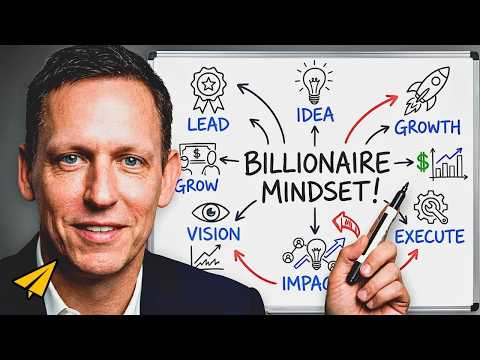
– He’s an American entrepreneur, venture capitalist,
and hedge fund manager.
– He co-founded PayPal, with Max Levchin and Elon Musk.
– He’s ranked fourth on the Forbs Midas list of 2014,
at 2.2 billion dollars.
– He’s Peter Thiel and here
are his top ten rules for success.
(swooshing)
– You are the entrepreneur of your life.
And you can, you can decide you know,
what you’re going to do, what you’re going to prioritize,
and you should never forget that you have
a tremendous amount of freedom as it is
to make these very basic decisions
on what you’re going to do with your life.
You can start anytime you want.
The most critical thing for every start up
is to be doing one thing uniquely well,
better than anyone else in the world.
Technology’s a fundamentally global business
and the really great technology companies,
are doing something significantly better
than anybody else in the world and you want to be
in that sort of position.
I think if you’re just starting a business,
one of the questions that’s always valuable to answer
is what do you know that’s true that nobody
else understands or more prosaically,
what great business exists that nobody is building?
One part that I’m always very focused on
is sort of, the structure of these companies
and how well are people aligned?
So you can and making sure that people are you know
aligned properly, not just that they say they are.
I think this is sort of a very, a very legal kind of a
framework to think about;
what are peoples’ incentives, you know,
are they going to be aligned or not
and I think you want to both have formal alignment,
where you set the structure right,
and you want to have informal alignment,
where the people would naturally try to work together well
in one way or another.
And I think that somehow tends to get obscured
in all these other ways.
You know there’s always, there’s always a, there’s always a
pre-history question I like to ask founders of companies
which is how did you, how did you um, meet,
what’s the pre-history of the company before you got started
and I find that to be a really instructive set of questions
to ask; a bad answer is something like, you know,
we met a week ago at a social networking function
at a business networking function.
We decided to start a company because we both
wanted to be entrepreneurs.
You know that’s like saying,
I married the first person I met at the slot machines
in Las Vegas and you might hit the jackpot,
but it’s probably a really bad idea.
A much better answer is you know, we’ve been talking
about his for a long time.
You know, maybe one of us is more on the tech side,
the other ones more on the business side.
We have these sort of complimentary skills
and so I think this question of alignment and structure
is incredibly important.
I think that all, if you’re a founder or entrepreneur,
what you want to aim for is monopoly.
You want to aim to build a company that is one of a kind.
That’s so far differentiated from the competition
that it’s not even competing.
And I this conventionalism is always with capitals
and competition are somehow synonyms;
I believe they’re antonyms.
A capitalist is someone whose in the business of
accumulating capital; a world of perfect competition
is a world where all the profits are competed away.
If you want to compete like crazy then you should just
open a restaurant in Chicago.
And um, and I think the great companies like Google,
so the paradigm example I use,
has had no serious competition in Search since 2002
when it definitively distance itself
from Yahoo and Microsoft and as a result it’s been
generating enormous cash flows for the last 12 years.
But yeah, there probably are a lot of people who end up
trying to be somewhat fake entrepreneurs
where the goal is to be an entrepreneur.
If you ask people what do you want to do with your life?
What do you want to do when you grow up?
I want to be an entrepreneur,
which I always think is a somewhat too common,
disturbingly somewhat too common
and I think you know it’s a, it’s saying that you
want to be entrepreneur sort of like saying
I want to be rich or I want to be famous.
You know, nobody in their right mind starts a company
for the sake of starting a company.
You start a company because there’s a very important
problem to solve that’s not getting solved
in large you know, governmental or nonprofit
or for profit institutions and that’s why
you actually need to start a new company.
Just starting a company for the sake of doing so
is a really odd thing to do.
On an individual level I think it is always,
it’s always really good if there’s something
that you’re incredibly passionate about
and just sort of are find to be intrinsically interesting
and the people pursue that and so the,
you know one of the resolutions I came up with
a number of years ago was to always
value substance over status; substance over prestige.
And you know if I sort of was giving my younger self advice
on what to, what to do or how to think about ones’ life,
I probably, I think I you know, I probably would still
go to Stanford, I might still go to law school.
But I’d ask sort of, I’d ask a lot more questions
why I was doing these things and I think
I think if I was honest about it,
too much of it was driven by, by prestige and status
and not quite enough about really the substance of
trying to learn things.
I have sort of this, I sort of just think of it as this
sort of crazy rolling quarter life crisis
and sort of culminated in this big New York law firm
where you know, from the outside everybody wanted to get in.
From the inside everybody wanted to get out.
You know, after, I lasted seven months and three days
and after, when I left one of the people down the hall said,
it’s so reassuring to see you leave Peter.
I had no idea it was possible to escape from Alcatraz.
Which again, and again I, and all you had to do was go
through the front door, but our identity,
people’s identities get so wrapped up in
the things they compete for that it was inconceivable
for people to actually do that
and then the question was you know,
well how had I ended up there?
Why had I not thought about that more?
And I think it was that I had taken too many of these
shortcuts of valuing sort of what was prestigious,
what was conventional over what I really wanted to do.
So I think always substance over status.
And this is why I think competitions always this very
two edged thing; when you compete ferociously,
you will get better at that which you are competing on,
but you will always narrow your focus
to beating the people around you
and it often comes at this very hight price
of losing sight of what is more important
or perhaps more valuable.
The general theme I would suggest is that all trends
are overrated and so if you think about current trends
in technology, you know,
health care, I.T. software, education software, overrated.
SAS enterprise software really overrated.
Big data, cloud computing, if you hear those words
you need to think fraud; you need to run away
as fast as you possibly can.
And the reason these buzzwords tell you
that something, these buzzwords are sort of like a tell
in poker that people are bluffing
and that there’s nothing, that the business
is not undifferentiated because the buzzwords tell you
that it is one company of a category that’s undifferentiated
from the others in that category and therefore,
are symptomatic somehow of a lot of competition
and a bad business idea.
And so you know, you don’t want to be the fourth online
pet food company, you don’t want to be the tenth
tin foam solar panel company, you don’t want to be
the one-thousandth restaurant in San Francisco
and so there’s something about if you can describe
what a company is doing very straight forwardly
by referencing these buzzwords, these categories
that already exist.
That’s actually a sign that it’s a pretty bad,
that it’s a pretty bad idea.
I think there’s a problem in western Europe where,
where failure is, it’s too impossible to fail.
Once you fail you can never, you can never start over.
I think there’s an opposite version of this in California
where I think sometimes people are a little bit too
facile about failure because I think it actually is always
incredibly damaging to people and if you work
really hard at something and it doesn’t work
that’s, you know, that’s going to be psychologically
damaging, you know, people have less confidence.
All sorts of reasons why that tends to be,
that tends quite bad.
I think that when people, I don’t think there’s that much
you learn from failure by the way because
it’s typically overdetermined; it’s like why is technology
slowing down, why did you fail?
It’s typically five separate reasons:
you work with the wrong people, the idea was bad,
the timing was wrong, it wasn’t a monopoly,
the product didn’t work, and okay,
next time I’m working with different people.
You figure out one of the five things,
you’re likely to fail again.
So I think, I think failure is not something
we can learn very much from.
I think that’s sort of a myth that I would challenge.
But what I think you should do
when something goes badly wrong is
you just keep going; you do something else
and you don’t dwell on the past.
Already in the time of Shakespeare the word ape
meant both primate and to imitate
and there is something very deep in human nature
that is imitated; it’s how, it has a lot of good things,
it’s how language gets learned by kids.
It’s how culture gets transmitted in our society.
But it also can lead to sort of a lot of insane behavior.
It can lead to the madness of crowds, to bubbles,
to sort of mass delusions of one sort or another
and I think it can, I think it’s advertising.
We always think of, we always tell ourselves
that we’re not that prone to this
and I think that’s something I would encourage all of us
to rethink; you know, we always think of
advertising as something that just afflicts other people,
that never afflicts ourselves.
I think this is very far from the case and so,
and so, the monopoly competition is not just this
intellectual failure, it’s also this thing where
you have a tiny door where everyone’s trying to rush through
and there may be around the corner a vast
and a secret gate that no ones taking
and you should always find the secret path
and go ahead and take that.
– Thank you guys so much for watching.
– Now we made this video because Chain Wan Chung
on YouTube asked Evan to make it.
If you have a famous entrepreneur
that you really really really want Evan to make a video on
leave it in the comments below.
– I’d also love to know which of Peter Thiel’s top ten rules
hit you the most; leave it in the comments.
We’re going to join in the discussion.
Thank you so much for watching.
Continue to believe and we’ll see you soon.
(swooshing)
Please follow and like us: