
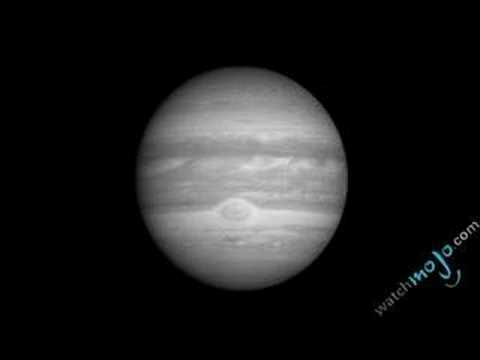
Jupiter is the fifth planet in the Solar
System and the first of the gas planets
this means that it is not primarily
composed of solid matter the majority of
the mass is in the form of gaseous
hydrogen and helium Jupiter is also the
largest planet in the solar system with
an equatorial diameter of nearly a
hundred and forty-three thousand
kilometers that mates it over 11 times
the size of Earth Jupiter mates its
orbit of the Sun and 4333 days however
its rotational period is the fastest of
any planet it makes a full rotation on
its axis in under 10 hours earth-based
telescopes are able to see what is
called the Great Red Spot on Jupiter
this is in fact a huge storm that is
larger than the size of Earth that has
been going on for over three hundred and
forty years mathematical models say the
storm is stable and may be a permanent
fixture on the planet Jupiter has at
least 63 moons but extensive research
has been done on Europa because of its
possibility of having a liquid ocean
Please follow and like us: