
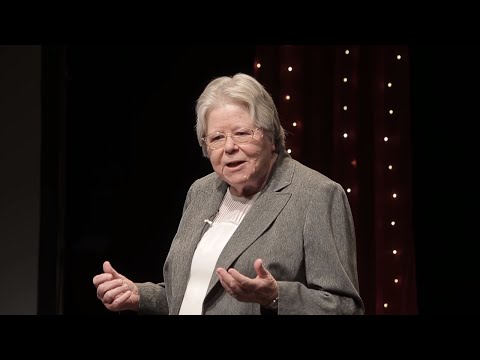
[Music]
you
as sous EDD I am an infrared astronomer
by occupation so you might think that I
would be talking about flips and
astronomy for example something like
Galileo who found that the Sun was at
the center of our solar system unlike
but the belief at the time or perhaps
something like what Vera Rubin
discovered she found that the stars and
the galaxies in our universe were
unfolded in the gravitational grip of
dark matter matter that is not luminous
like the ordinary matter we know in fact
we now know today that the universe is
comprised of only five percent of
ordinary matter the other ninety five
percent is partially the dark matter
that Vera found but also something even
more mysterious called dark energy this
was a rather substantial change no I’m
not going to talk about things like that
even though I just did what I’m going to
talk about instead our flips and
definitions that have defined young
women as they pursue careers in science
Vera received her PhD in 1954 that was a
time when most women did not in fact
have PhDs in astronomy consequently she
spent a lot of her time mentoring young
women trying to convince them to move
forward to work in astronomy or some
other scientific career she was fairly
successful except that even today a very
small percentage of the faculty at
universities around the u.s. are women
let me give a personal example when I
first went to the University of
Rochester in 1971 I was the only women
woman out of 30 in the department today
varus as I say spent a lot of time
mentoring young women and in fact there
were several things she had to say about
it one of them was worldwide half of the
brains are in women not surprising but
she not to be outdone a chain and
ancient Chinese person said women hold
up half the sky so I also spend time
mentoring young women in our department
not surprisingly and I tell them that
it’s not unfeminine to be an astronomer
when I after I said things like that I
started thinking about what is the
definition of to be feminine well
femininity is define as the trait of
behaving in a way that is typical of
women there is so much room for
interpretation and that particular
definition I mean for example how about
meet dependent submissive on assertive
all of those things I don’t however
believe that that is a reasonable way to
look at femininity in fact I’ve always
felt that women have to be assertive to
get ahead in science otherwise you
cannot succeed and so it’s it’s a
definition that needs flipping
definitely needs slipping now another
thing that I started thinking of when we
started talking or considering vera and
her mentoring is what does how his
mentor defined well interestingly enough
a mentor is defined as a person who is
experienced and trusted as an advisor
now that’s fine that would be a
perfectly good definition if you left it
there however the example given is he
was her trusted advisor until his death
the implication being of course that
mentors could only be male and then
looking at the verb to mentor to advise
or train someone especially a younger
colleague well that too is open to
interpretation and the rest of the time
my time here I’ll be talking about how
younger is not necessary in a mentor
even though in this picture we have a
male an older male and some younger
folks in the image when I was a high
school student STEM subjects were not
very popular with my peers in fact it
turned out that my boyfriend at the time
who was on the football team was advised
by his colleagues not to date me because
they said she’s a brain now now I’m not
sure whether they meant that was because
I was studying STEM subjects or whether
it was because I was a girl who was
studying STEM subjects fortunately my
mentor at the time my mother told me to
ignore them they’re ignorant and that
was fine when I went on to university I
was lucky enough in my third year to
work for a wonderful woman Helen Sawyer
hog there’s a picture of Helen she was a
wonderful astronomer a noted educator
and she taught to us by example not by
words nobody used the words self-esteem
in those days it was just by by
observing how things went and so I
learned a lot and I learned that you
should that you should not worry about
such things as whether you can pursue a
career in science and get married this
is the sort of thing that was the
concern of my colleagues when I was
young it sounds ridiculous today but at
that time that was that was the truth
however we still we still have women
young women who are concerned about
their role in life they think of
astronomy as a male-dominated field
which it is and they they wondered
whether they are going to be able to
succeed my my experience is that we have
a lot to learn from a variety of our
mentors brought both women and the young
and I wanted to tell you about my
experience next when I went to the
University of Rochester it turns out
that computers started to become a very
important part of our life in astronomy
and today of course they dominate it but
at the time in nineteen fifty two or
three women were computers here’s an
example of the women at JPL you may have
seen for example the the current movie a
hidden figures where we have women
computers Helen that my mentor Helen
Sawyer Hagen the next image was a human
computer herself in 1929 at the Harvard
College Observatory but something
started happening early on when we
wanted to run a program we carried a box
of punch cards over to the mainframe
computer in order to run our programs
desktops didn’t exist laptops didn’t
exist ipad certainly didn’t exist even
handheld computers did not exist but
they started to appear and then the
internet appeared wonderful and then the
first browsers appeared
not anything like our current browsers
but wonderful nonetheless but the thing
that transitioned me the most was that
the young students started arriving on
our campuses and they had grown up with
computers and they were so much more
able than I was to be able to cope with
this and so the young students became my
mentors I mean to this day I have met
students who are my mentors in this case
this is a picture of my current mentor
Amy Meinzer 34 years my junior she
wasn’t even born when I arrived at the
University of Rochester she’s holding in
her hands two cups on the left-hand side
it’s a visible image you can’t tell us
but one is hot and one is cold well it’s
coffee one is liquid nitrogen on the
right we have we have an infrared image
of amy i am an infrared astronomer after
all so i have to show you that you can
see much different things in the
infrared and the liquid nitrogen is
black the coffee is white and Amy’s nose
is cold but amy has a lot to recommend
her she is a brilliant young woman she
is the principal investigator of an
experiment with which I am associated in
fact our group has developed the cameras
for this mission it’s called neo Pam
here’s neo cam this is a artists
conception of what it will be the red
dots you see in the picture those are
asteroids finding asteroids be fine
before they find us neo cam the
experiment that Amy is the principal on
is looking for these Neos near-earth
objects that have been diverted from
their normal orbits between Mars and
Jupiter into orbits that cross the earth
orbit and that
the case they might hit us that’s not a
good thing the dinosaurs for example
became extinct because of a very large
near-earth object a long time ago neo
chem should be able to find most of the
meals that are a hundred and forty
meters in size and larger but let me put
that into perspective a hundred and
forty meters would demolish New York
City I mean for example and it will see
smaller ones as well but we don’t even
know about 140 meter ones today much
less the smaller ones occasionally as in
the next slide you’ll see the
Chelyabinsk meter hurtling through the
sky unexpectedly we didn’t know it was
going to even impact it caused some
destruction in the sense that it broke
windows and a few people were injured
but nobody died and so that was a good
thing we have to be able to find these
things so that NASA can divert them and
you have to know where they are in order
to be able to divert them you have to
have good orbits for them that’s what
Neil cam is all about amy has complete
command of all of the details not only
the asteroid science but also the launch
vehicle the detector arrays that are in
the cameras the optics everything she is
a wonderful mentor to me so as you can
tell I’m not exactly the youngest
speaker today and the fact is that it
might be just because my mint mentors of
my youth have been dead for some years
that I may think now that you can learn
from the young but I don’t believe
that’s the case I believe we all have
something to learn from the young for
example I have five granddaughters
ranging in age from 19 to 32 they teach
me a lot mainly because their life
experiences have been so different from
mine
for example they teach me about changed
concepts of marriage of raising children
that gender need not be biological that
the workforce may be virtual they have
many things to teach me as my youngest
my oldest granddaughter the 32 year old
said to me when she read an early
version of this talk we all benefit if
we’re open to learning from whoever the
sources and so she was thinking of
whether you’re young or whether you’re
old that’s entirely correct miranda is
right and so I just want to leave her
generation with the idea that femininity
is not impaired by be pursuing your
goals being a scientist that’s one thing
the second thing is your mentors need
not be male they need not be old they
can be young and it’s my responsibility
as a member of my generation to make
sure that these outmoded definitions are
flipped thank you [Applause]