
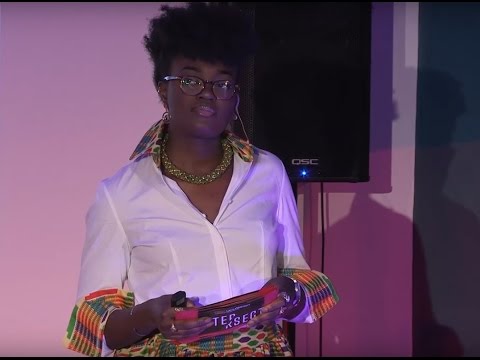
story it’s a journey that I went on I
didn’t know I was actually on till it
hit me right in the face four years ago
I was diagnosed with idiopathic
intracranial hypertension I know it
sounds like a mouthful to say and I
actually took it while to rehearse this
but I I H is a neurological disorder and
it means that there’s a high pressure in
my skull
if the opacity means that the cause of
the raised pressure is unknown unknown
now I’m not a doctor so I’m not even
going to attempt to pronounce this word
so for now we’re going to call it CSF
CSF is the clear liquidy fluid that
cushions your brain my body was
producing way too much CSF and in that
moment I found myself in the hospital
for days turned weeks turn months I
hated it the headaches vomiting stiff
neck it felt like someone was constantly
drilling into my head the pain from iih
is likened to that of a brain tumor so
the most severe long-term problems is
blindness I specifically remember this
one time and me my mum were in the
hospital and the doctor was saying that
this disorder was commonly seen in
Caucasian overweight middle-aged women
so you can only imagine me my mum
well one way the pressure is actually
relieved is by a procedure called a
lumbar puncture I don’t know if any one
of you ever had one of these but imagine
it like a spinal tap
the CSF if you remember that big word I
can’t pronounce runs through your spine
and this procedure involves pushing a
very long needle may I say through your
spinal cord to release the pressure very
simply like a tap it often felt like it
would zinging zhuang like someone was
playing operations on me with no idea as
to why I was going through such pain
such procedures with an disorder that
was unknown I started to blame myself
was like that stress from University was
i overweight did I go out too much it
was my fault it was you Nicole you did
this to yourself
in myself blame I began to isolate
myself I didn’t want to see anyone speak
to anyone
I found a dark hole of self-pity and
anguish and you know what it felt like
home
within this darkness I continued to
blame myself and that led to self
affliction and self affliction led to
self-harm I became anxious of the
concept of being ill again or even going
back to hospital I would avoid even the
most common cold because a headache
wasn’t a pick a paracetamol to get
better headache it was ten times
stronger it broke me sometimes I
couldn’t even leave my own house at that
time I had no idea how my physical
health would affect my mental health my
mental state of mind how I saw myself
blamed myself and harmed myself how many
of you have like cut yourself shaving
you know when you’re in a rush
trying to do something there’s foam
everywhere there’s nails everywhere and
then BOOM
you cut yourself what if that wasn’t a
mistake
you cut yourself on purpose through all
the pain my idiopathic intracranial
hypertension had brought to me I didn’t
feel a thing
pain became pleasure every time I peeled
away at my skin I would peel away at my
issues and attempt to resolve them but
those problems were still there it was
one of the worst waves to solve the
issue that I was going through it led to
feeling ashamed I would wear long sleeve
clothes and turtlenecks to hide my scars
I was scared I was and most of all I was
disgusted with myself too embarrassed to
tell my friends and family I found
comfort in the company of strangers
speaking to other young black women
became my six these conversations became
the catalyst of everything I was about
to do next
within these conversations I began to
unpack the black bridges experience to
understand how its considered within our
community a long-standing stigma of
mental health comes from a deep-rooted
cultural understanding of our mentality
where I come from if you have a mental
health issue it means you’ve got an evil
evil evil spirit inside of you so many
the expectation of being strong is a
burden too strong for us to carry
everyone expects me to be strong all the
in the UK black Caribbean and black
African 16 to 64 years of age are twice
as likely to be diagnosed with a
business psychotic disorder compared to
white adults twice as likely so when
this troubling statistic combined with
the conversations being had I set out to
unmask the truths about our mental
health to further unpack the black
British experience I found similarities
and the conversations I was having this
project became a very personal project a
journey connected to me this project is
me unmask women is an exhibition
channeling the black British female
experience focusing on mental health
other than the very simple fact that I
am a beautiful black woman and this
project is spiritually and mentally
connected to me I found that when it
came to speaking about women
specifically black women our voices were
not being heard
now racism and sexism cannot be seen as
two different entities in very many ways
they intersect with one another
specifically when you look at black
women as a far marginalized group as we
are we experience both racism and sexism
when we dissect economic masculinity men
are seen to be strong resilient and
invulnerable however it’s really
interesting when we look at black women
specifically within the black community
we are also seen to be strong resilient
I’ve always found that with creativity
in art there is no right or wrong it’s
whatever you want it to be we understand
art because it makes us feel a certain
way either in that moment or later in
our lives art is subjective in his book
titled art British art critic Clive Bell
theorized that the emotion that one
feels when he or she sees of work of art
is subjective through it to be our it
needs to produce aesthetic emotion for
many art is a healing tool a way for
cater and look after our psychological
well-being
however for black women one way we are
voicing our experience is is by
explaining and exploring our black
identity through art photographer Adam a
Jala explores the notion of the black
female identity by looking into the
black hair culture her project identity
is about black hair salons in South
London the series allows us to celebrate
our features which are usually targets
for microaggressions you know the
everyday slurs and insults either
intentional or unintentional that black
women deal with on a daily basis having
to suppress these comments in everything
that we do puts a massive strain on our
well-being this was just one example of
how the black experience caters to our
mental well-being to be able to break
down the stigma of mental health created
open conversation and creatively explore
the black experience art plays a pivotal
role in creating a safe open platform
when we combine something that we don’t
really understand with an art form that
we can understand
we unearthed a beautiful dialogue which
cannot be ignored we must continue to
push this conversation further create
more art that speaks volumes to our
issues very simply do more if my
personal journey has taught me anything
it’s that my physical health is just as
important as my mental health in fact
how can we even separate the two we need
to normalize how we see mental health so
obvious don’t feel scared and ashamed to
come and talk about their issues let’s
create a world where it’s okay not to be
okay hi my name is Nicole krentcil I am
NOT okay but that is okay thank you very
much
[Applause]
you [Music]