
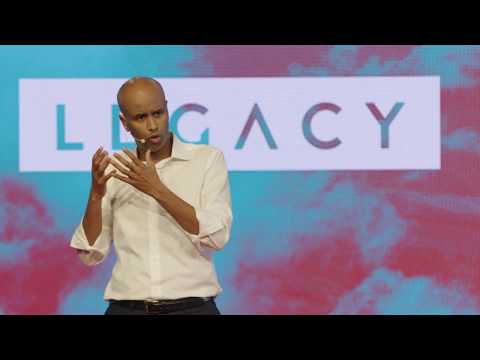
I was 15 years old when Somalia was
going through a civil war there was
chaos and violence everywhere my parents
and I decided that we had no choice but
to flee we gathered a few belongings got
on the back of a big truck with a few
other families left Somalia never to
return after a very long journey I
landed in Canada at the age of 16 by
myself as a refugee I found that way
after that I landed on the indigenous
territory of the Mississauga’s of new
credit I was going through conflicting
emotions on one hand I felt that I was
worried
would I be accepted in this new country
would I succeed but on the other hand I
was excited about a chance to restart my
life and the chance to make new friends
I was 16 after all the very next day
what I didn’t get used to and still
can’t get used to is that cold Canadian
winter that at the time Canadians were
experiencing that here the coldest
Canadian winter in a very long time the
very next day I tried to mail a letter
to my mother and someone told me to go
to a mailbox I had never seen a mailbox
in my life and I was I was trying
struggling to insert that letter in
there in the middle of this snowstorm a
young Canadian woman left her baby in a
stroller raised towards me and helped me
do that that was my first experience of
true Canadian generosity a few days
later I went to the laundromat I had
never seen a laundry machine before I
asked people how do I operate this thing
and these guys told me you need a loonie
I got worried I thought what is a loon
is it a crazy person trying to bring a
crazy person here and after almost
leaving the establishment another
Canadian reached out and helped me do my
wash cycle unfortunately they didn’t
stay long enough to help me figure out
the dryer
so I ended up walking back to my
apartment with a bunch of wet clothes
but regardless I was so happy that
someone reached out to me in my time of
need I I went to high school joined the
track and field team and myself the
teammates on the and the coach banded
together and bought me a winter jacket
and over the years making my way through
high school I relied on social
assistance and social housing when I
went to university I commuted two hours
each way to pump gas at a minimum-wage
job for six dollars and 85 cents but I
used social housing to also get through
University and through using the
generosity and the supports of Canadians
the community services are working
incredibly hard I’m now able to stand in
front of you as the Member of Parliament
for York southwestern and even more
incredibly as Canada’s Minister of
immigration refugees and citizenship
thank you the second part of my journey
is one that may not be familiar to many
of you it is the journey of a country
that is incredibly generous and
welcoming and diverse but continues to
have challenges in addressing systemic
racism and true inclusion and at the
time I lived in Regent Park Canada’s
oldest and largest social housing
neighborhood and on many days on many
evenings I would go for walks and doing
the majority of those walks a police car
would screech to a halt right in front
of me and the police officer would swing
his door in a dramatic fashion come at
me running same manner every single time
and asked me where are you going what
are you doing what do you have in your
pockets
show me your ID and when I talked to a
number of my friends then the ones who
had the same skin color as myself
confirmed for me that they did indeed go
through racial profiling and carding
regularly
and every single time that happened to
me it was more humiliating than the
first time it happened because your
neighbors are looking at you strangers
are passing by with a car through their
car windows they’re wondering what did
this guy do to deserve being held on the
side of the road but I did nothing
I was only stopped because of the color
of my skin and a few did a few years
later I worked hard and was lucky enough
to be hired as a political staffer and
we were at a reception where the only
political staff in the room was me who
was black and a prominent Canadian came
to me and asked me are you an
entertainer I found the question to be
strange but I was polite enough to say
no I’m not I I smile and I said I’m a
political staffer he smirked and said
how did you get that job he couldn’t
believe it I said well I worked hard I
went to university and Here I am he
asked again with another smirk and said
no really how did you get that job and I
said again with a very polite answer
I worked hard went to school and applied
for this job he walked away shaking his
head and didn’t ask that question of any
other political staffer in the room a
few years later I became a lawyer and I
was representing a client in Ontario
Superior Court and I wrote the name of
my client and my name to be called at
the right time by the clerk and after a
few hours of not being called at during
the court recess I asked the clerk why
is my name not being called she looked
at the two names and said oh sorry we we
thought you were one of the accused they
accused being the only other black
individuals in the courtroom who were
who were like me when these incidents
happen imagine walking on the street and
having a parent pull there pull their
child closer to themselves because
you’re walking by being followed in a
grocery store because of the color of
your skin imagine because of the of the
color of your skin being pulled over by
constantly these incidents are
debilitating they wear you down and they
make you feel like the other and even
though I got used to a lot of that it
wasn’t right and it isn’t right and so
it’s one thing to talk about identity
it’s one thing to talk about racism and
privilege it’s another to really live
the black experience in Canada so the
experiences of people of color the
struggles they face every day with
microaggressions are real the despair
they they they go through sometimes is
real the feeling that you have that some
of the structures around you on the
systems are working against you is real
so how do you reconcile this amazing
generous welcoming diverse country with
these realities faced by some of our
citizens I can go to Parliament Hill
today and hold my head high and work
seamlessly among my colleagues shake
hands with world leaders but to this day
still worried about getting pulled over
by police but I chose to reflect on what
is best about Canada and I worked hard
in Regent Park to come together use the
beauty of the system to organize
advocate and work with my neighbors to
access a five hundred million dollar
fund and we were able to revitalize not
only the buildings but the community our
home region Park and today today today I
have lawyer friends who are moving into
Regent Park buying condominiums the
experiences of generosity as well as
these other experiences that are
debilitating are both real and as a
country we have to remember that
although we remain generous and
welcoming we have a long way to go in
our treatment of visible minorities and
our challenge with systemic racism but
did you know
that in canada 9.5 percent of federal
black inmates are federal inmates are
black even though black canadians only
constitute 3 percent of our population
did you know that between 2003 to 2013
the number of black inmates in federal
prisons went up by 80 percent eighty
percent think about that did you know
that black canadians are three times
more likely to find themselves in a
low-income household than european
canadians what do these statistics tell
us it tells us that we are not a perfect
country that we have problems but does
that mean that Canada is not great no I
believe Canada is great because we want
to do better and we don’t believe in
hiding our flaws that is why we have to
have discussions on race identity
privilege we have to acknowledge that
racial discrimination and a lack of
inclusion exists we have to acknowledge
that privilege is real we have to
acknowledge that not each one of us has
the same opportunities and the same
social supports these conversations are
difficult they are uncomfortable but we
need to have those conversations because
if we don’t it is as if we’re saying
that we’re invisible that is what it
means when you hear the cry of people
who say black lives matter and so when
you examine Canada and you examine what
it means to be a great country I
challenge you to reevaluate what
greatness means we have read we have
defined greatness in a wrong manner we
should define greatness and look at your
personal and professional lives look at
the leaders that you see do you consider
a leader great when he or she thumbs
heard his or her chest and proclaims
their greatness for everyone to hear or
do you consider a leader great who
acknowledges his or her flaws who
intently and who inspires people to
action I challenge each one of you a lot
of people come to me and say we can’t
fix the semi crazies and I’m only one
person it’s abstract it’s big but we can
all check our unconscious biases like
the parent who pulls their child closer
when a black man passes by I challenge
each one of you in addition to examining
your strengths look at your weaknesses
and I know it’s hard because it puts you
in a vulnerable situation but be
vulnerable because through that
vulnerability you’ll be able to develop
from within and you can move forward and
being vulnerable as a country is
powerful on the international stage
because when countries become vulnerable
and expose their flaws to transnational
problems like climate change or our
approach to our indigenous brothers and
sisters it’s only then that we can work
together to correct those flaws and this
is not just an idea of national
greatness it is an idea of individual
success and I’ll repeat myself be
vulnerable be vulnerable be vulnerable
because through that vulnerability you
are able to develop and build from
within build yourself build your family
your community and yes your country
Canada my name is Ahmed Hussein and
black a Muslim I’m a refugee I’m
Canadian and I am proud thank you very
much
[Applause]
Please follow and like us: