
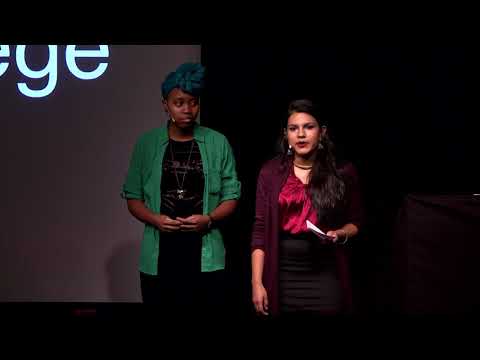
good afternoon everyone I’m outta he I’m
Dylan
I’m Jana I’m Becky and today we’re gonna
talk about what it was like to study
abroad as a woman of color as a part of
our university curricula we each spent
one semester at a host institution
outside of the US namely in China and
Japan there are many topics we could
discuss in relation to our study abroad
experience but we wanted to focus how on
how intersectionality or a lack thereof
affected our time abroad how II think
and talk about race and identity is
situated in history and geography
citizens of oppression can look very
different from one cultural context to
the next so the concept of identity is
dynamic culture informs language and
language for its culture when abroad we
didn’t always have the words to describe
who we are and the kinds of oppressions
we face as we move through the world
even though we’ve been studying Mandarin
and Japanese for some time now it was a
challenge to describe ourselves in a way
that was more than just skin deep in
English I can use the word
intersectionality to describe that I am
black and a woman and part of an
immigrant family
however intersectionality didn’t even
exist in English until very recently
only being popularized in the last
decade and a half so what does
intersectionality mean outside the
United States context what shape does it
take in cultures that think about race
and identity differently the term itself
is gradually finding voice in other
languages for example in Japanese you
would say intersectionality but that
sounds like a loan word that’s because
it is and it’s not translated too well
in Mandarin either tío testing means
something on the lines of a little
crossroads and identity these partials
oftentimes – literally translated terms
speak to why we as one of color
oftentimes had trouble explaining who we
are – people in Japan and China and this
fed into why we had hesitations about
going abroad in the first place I had
reservations about going abroad to China
because it was a hard decision to make
then the easier option of going to
Europe where there’s more visible
diversity in China I thought it was
highly unlikely that I’d meet anyone who
looked even slightly similar to me much
less anyone with their hair and locs and
ties to the Caribbean and America this
fear sat in opposition to the fact that
going abroad to China for a second time
would really improve my ability
speak Mandarin in law in the long run
well with all of this in mind I still
decided to board the plane and take my
black American ass to Beijing before I
left for study abroad I was afraid of
how beauty standards in Japan might
define the way that I was perceived I
had an idea that some people might stare
at me or what they might say to me or
that I’d have pictures taken of me
without my permission
but I hope that it wouldn’t be as
stressful as I’d imagined since I was
extremely excited to finally go to Japan
after years of study before I left for
study abroad I was confident that I
would encounter some of the same
stereotypes about Indian people as I
have elsewhere and that most people I
interacted with would be shocked to come
across a young brown girl who can speak
Japanese this would be my first time in
Japan and I couldn’t have been more keen
to finally see all of those places that
had only been reading about thus far but
I wanted to be better prepared
unfortunately most of those around me
who had embarked on a similar adventure
surprise-surprise who were white men
before I left for study abroad I was
anxious I had never been to Japan before
so to ameliorate my anxiety I scoured
the internet for resources and
experiences of people who share similar
identities to me based on what I saw of
black bodies being represented in
Japanese media I knew how black
Americans are perceived but I had no
clue as a Kenyan American how Africans
are perceived or whether that even
mattered at all because blackness is
such a beautiful spectrum but I hope
that Tokyo’s international draw would at
least reduce the surprise of seeing a
black person in Japan all this to say is
that we know what our bodies mean in a
u.s. context but the subtleties of our
identities were lost in translation
without intersectionality we are just
brown female foreign a spectacle for
example when I was in Beijing and her
roommate who was white had blonde hair
and was also American like myself one
night we went out and this Chinese woman
stops and asked well we’re both from we
were strong that we’re both American she
looks for me to my roommate and then
back at me with a rather confused
expression on herself Shama
what she didn’t foresee is to ask how
both of us looking the way we did how we
could possibly be from the same country
because in China black people can only
be African this interaction and many
others like it made me really frustrated
that it
my identity could be so easily dismissed
as a lie even as I spoke my truth oh
yeah or gendell sure you got him a Goren
yes I am both American and black while I
studied abroad in Kyoto I found it
difficult to escape unsolicited
attention this was to say that as a
foreigner in Japan I knew to some extent
that I would be paid attention to but
what I couldn’t anticipate was to become
the target of a variety of negative
comments this was only exacerbated by
the fact that many people thought I
couldn’t speak Japanese and so would
often insult me right in front of my
face
on one of the first days of being in
Japan I decided that I wanted to eat at
the student cafeteria my group and I had
been out all day filling out paperwork
and I was famished while trying to
decide what to eat though I noticed that
a group of cafeteria workers were
mocking me staring at me pointing miming
the parts of my body that were different
from theirs and laughing I lost my
appetite put my tray down and didn’t eat
being in public in Japan was a constant
act of courage Japanese society is
perceived stereotypically to be
extremely polite but the way I was
treated often didn’t measure up to what
in my cultural context is considered to
be polite
I found myself asking who determines
which bodies are allowed to be in public
without being ridiculed or harassed who
deemed that I was unworthy there was
only one answer that I could come up
with and I had to do with my particular
kind of foreignness studying abroad in
Tokyo I found myself constantly
negotiating between being hyper visible
and invisible
even though Tokyo is the largest
metropolis in the world I would often
hear people remark ah
Nihon Ichiro nahi tomo yo yo nay oh
there are brown people in Japan too in
this moment there are over 120,000 South
Asians in Japan and yet my presence felt
unprecedented
I found myself hungering for recognition
I craved the sensation of being seen in
all of my fullness and yet when people
saw my face
all they could think of was that spicy
naan and curry said that they had the
other day my identity was flattened to a
brownness that was just the most easy to
consume often upon first introduced to
people they would exclaim that I looked
just like Jasmine Jasmine from Disney’s
Aladdin if only I had a magic carpet to
show them a whole new world then when I
would explain to people that I’m Indian
and I’m a full-time college student in
America now studying away in Tokyo they
would often be quite confused this felt
like too many different places and
movements to manage but I’m not an
exchange student in America
my parents do still live in India my
imagination roams across borders and
time zones and I consider myself
something of a local in New Delhi in st.
Paul Minnesota and now in Tokyo my sense
of belonging is multiple sheep’s wool
unkempt dirty unprofessional these were
words used to describe my hair growing
up I quickly learned that societal
expectations in my hair were often at
odds but if in the u.s. I experience
questions about my hair whether it be
raft and braids or natural or
straightened I know the questions in
Japan were inevitable so to make things
easier for myself i braided my hair and
went the week I landed in Tokyo I was
hungry I wanted to go grab a snack by my
dorm at the nearest convenience store as
I’m waiting in line to check out I feel
my braids being lifted into the air and
I turned to see an older Japanese man
bewildered hey naughty could it what’s
this ah saguenay a younger woman as if
she joins him on my scalp frankly I was
shocked I know what got me this it’s my
hair my hair was the constant topic of
discussion whether I’m at the park with
friends
so are those dreadlocks no then what are
they I’m waiting across the street Wow
your perm looks amazing it’s not a perm
it’s my hair I’m in the dorm bathroom
twisting my hair before bed being
although that by my floor mates there
are moments when I was on the train and
people were plotting to touch my hair
behind me as if I didn’t understand
Japanese leading me to gently swat away
curious hands I was called Nicki Minaj
Beyonce hip hop any form of blackness
they could throw on to me but I knew
that their intentions were not ill but
the conversations and the touching and
the stairs were exhausting I’m more than
just my hair modified identities affect
how he walks through the world but it
was often the case that our most visible
characteristic became our most defining
with intersectionality we get to be more
we get to be students sisters daughters
mentors activists both Colonials
technologists multicultural capable
intelligent creative resilient we become
more colorful vibrant and rounded we
began to learn how to communicate our
identity across lines of difference and
misunderstanding but so often we were
met with pure resistance many were
unwilling to reconsider their
preconceived notions in the face of
globalization as we know it bodies and
cultures travel across borders like
never before although some of us can
belong anywhere we go for others there’s
still more of a struggle to find out a
place no one expected us to understand
much less speak Mandarin or Japanese but
we can and do we chose to take up space
in places where our bodies were
constantly questioned offended and
misunderstood which means being in these
spaces a challenge we had to find new
ways to negotiate an express difference
and you know just to ask questions about
what it means to be in the way we are in
different parts of the world many of our
fears and hesitations were realized but
we had to find the strength within our
journeys to overcome those obstacles we
are not fragments each of us is greater
than the sum of our parts whether or not
people recognize this or have the
cultural vocabulary for it does not take
it away from us we expanded our
perspectives our minds grew as did the
minds of those around us and our
experiences did
us with more questions and answers like
how can we you know have conversations
about race and ethnicity in a context
outside of the United States as the
world globalizes how will culture and
language expand to include ways to think
and talk about marginalized populations
we each worked hard to be able to study
abroad how do we make the most of our
time in spite of becoming the target of
negative comments and racial
insensitivity the defogger was and is
not that of the white men so how can our
institutions think beyond the norm and
begin to Center the lived experiences of
racialized and gender identities of
people like us thank you
[Applause]
Please follow and like us: