
so about five years ago I found myself
in this room and it was at Google
headquarters and I was collaborating
with some of the most are the top
innovators in the world some Nobel
laureates it was such a small crowd and
I was wondering to myself why am I here
why am I why was I chosen to be amongst
these people he’s amazing amazing
individuals and I thought to myself even
deeper and I said how was that kid in
elementary school like I kicked out and
transferred to another elementary school
so I grew up on a farm in south-central
Pennsylvania and the closest town was
about a hundred and seventy people and
it was a whole there wasn’t a whole lot
that I knew about the world I knew a lot
about country life which was which was
great but my mind in my brain I
constantly wanted to know more and while
I was in school I was very disconnected
school was very mundane and boring to me
it just didn’t really makes sense I said
why do I need to learn all these things
in school and I thought to myself was
like okay I don’t know where I’m gonna
go I don’t know what I’m gonna do in the
world and it was right after I graduated
high school that there was all this
opportunity out there that I had no idea
existed there was something I didn’t
even know when I was in high school that
I could go into the military and be an
officer in the military no one told me
this I was in this little pocket in
Pennsylvania and there’s just I just
didn’t get any of this information so
I’m like I feel like I was robbed you
know as a kid so so later in life you
know things went well and I realized
that there’s a lot of kids like me you
know as I grew up and you know through
through my life
there’s a lot of kids like me at school
and they’re very disengaged they’re very
bored things are different nowadays like
oh my you know I was bored in school but
you know
we didn’t have all this opportunity for
technology and we have all these things
at our fingertips so can imagine a kid
that can get all their information on
this pencil that they use right and
their minds are there they’re bored and
for the most part they’re really really
bored so I thought about this you know
it really does take a village to raise a
child and what I mean by that is there’s
I think nowadays there’s so many ways
that we can tie content into a child’s
learning now imagine we have so many
research questions and there’s so much
data available imagine if we were able
to incorporate that into the classroom
imagine if kids had an opportunity to
contribute to society by answering real
research questions from real data
questions so take for instance Olivia
and Olivia in their classmates they’re
actually working with real neuroscience
methods and actually mapping neurons
they’re doing real science in the
classroom along with doing real science
in the classroom the teachers are
marrying this with a curriculum in the
way they should learn and engage and
they’re contributing potentially to
science
now imagine that and imagine if you’re
in high school and you’re able to help a
researcher figure out how a brain works
I mean it’s one of the top questions
that we have nowadays right how do that
it’s one of the most complex questions
imagine if we had tens of thousands of
kids in school in high school
helping research understand how the
brain works I think that’s pretty
awesome I think it’s pretty powerful but
the other piece of this is is what does
it do for Olivia and her classmates that
gives imagine the tag line that they can
put on their resume in high school
before they even go into college they
can say I’ve done the same thing as a
postdoc has done and look how valuable
that would be to a research
– – so if we have so many things
available to us why are we sticking with
traditional ways of teaching I don’t
understand it I don’t really get it I
think this is very easy for us to
incorporate here’s another situation so
this gal Kegel so she’s a very smart kid
but I sat down with her and she told me
she goes you know I never really
experienced anything I go to school and
I not good you know do what I’m supposed
to do with my studies and my books but
it really doesn’t make sense to me and
it wasn’t until she actually married up
with a lack of better terms she met up
with a biologist and the biologist took
her out in the field along with other
students and showed her all these
different areas in biology and something
dawned on her she is oh my gosh you know
biology is really interesting to me but
my passion is in fashion design and she
thought oh wow there’s so many
interesting colors there’s so many
interesting things about biology what if
I incorporate this into my fashion
design so she did so Kay Jo is a part of
the Permian High School in Odessa Texas
so many of you may have known about
Friday Night Lights and it’s also part
of a district that has 58% at-risk
students what does that risk mean that
means they’re at rest risk from
graduating from high school – think
about that again these kids they have
what it takes we are all born with the
same amount of brain mass and it’s just
a matter what how can we in really
engage kids to get them excited and get
them interested in the learning process
and just like hey Joel here it only took
a couple minutes from a researchers time
to sit down with her and show her a new
light that actually is changing her life
because as I speak right now she’s
competing in States for her design in
these students here are doing something
that’s called citizen science and
citizen science is a fantastic tool it’s
a fantastic tool for teachers to bring
in real research data questions into the
classroom where kids have the
opportunity to contribute to society
they can get inspired they can have
tangible learning experiences they have
ownership in their education and in
shark finder these fifth-grade kids have
an opportunity to be published in a
scientific publication by undergraduates
at the University of Maryland how cool
would that be and many of these kids
that are working with shark finder are
gonna be acknowledged in publications
raise your hand if you ever found a
first occurrence of a species I don’t
see I don’t see too many hands coming up
in there there’s gonna be a lot of
fifth-grade kids that are gonna get a
first occurrence of a species and
published in publication from
undergraduates at University of Maryland
I think that’s just awesome it’s pretty
powerful
I think that’s that’s a way that we can
really get kids jazzed up in education
is if they are a part of something
they’re a part of the community it’s
never too young to make an amazing
discovery now a lot of you might think
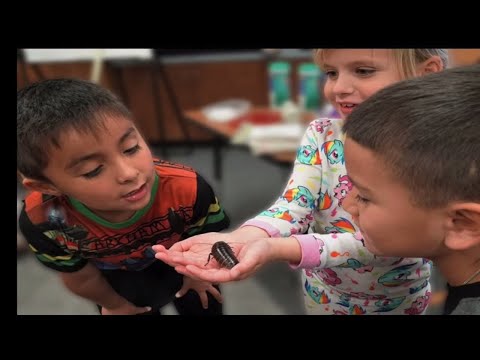
this is kind of disgusting these kiddos
here absolutely loved it these are first
grade kids and they’re holding a very
large cockroach and they’re tasked with
raising cockroaches in school so matched
in raising you notice pite a lot of
schools that are trying to get rid of
the cockroaches but these kids are
actually raising cockroaches but why
they’re doing it for neuroscience what
they’re doing is they’re raising these
cockroaches and the cockroaches will
become the specimens for secondary
students to do electrophysiology
experiments imagine your middle school
kid coming home and saying I’m doing
electrophysiology but they just blow
your mind as a parent my kid is doing
electrophysiology in middle school
this is happening these young
first-grade kids learn the nomenclature
about neuroscience they learn about life
cycles they learn about surgery they
learn about housing her husbandry of
animals and animal behavior life cycles
of an animal they’re creating the
cockroach hospital because when the
cockroach has come back from doing their
backyard brains Do It Yourself nerve
physiology or electrophysiology they’re
going back into the cockroach hospital
where there Greg leg will actually grow
back in 80 days so in turn after 80 days
they can go back out to surgery I think
that’s really cool there’s a lot of
components there I mean as parent as
parents and adults we might think that’s
a little little crazy but you know what
it’s it’s amazing look at their faces
all these kids are like this in
elementary school first great they’re
all excited they’re intrigued we take
that away from kids when we put them in
the classroom we take away that that a
sense of discovery or that want to
actually touch and feel something that
maybe an adult might we might think is
disgusting let him go let him explore so
I mean these were just a few examples of
engagement and kids with with real
research data experiences giving kids
ownership in their education and there’s
just tens of thousands of things out
there that we can tackle there’s a lot
of research questions around climate
change there’s tons to learn about
paleontology the brain like I mentioned
there’s so much to know and to learn why
can’t we better embed that into our
school system why can’t we make that a
part of learning why can’t we give those
kids that opportunity to make amazing
discoveries at a young age as after all
kids really do pick education we just
got to give them the content we got to
give them those opportunities education
thank you [Applause]
Please follow and like us: