
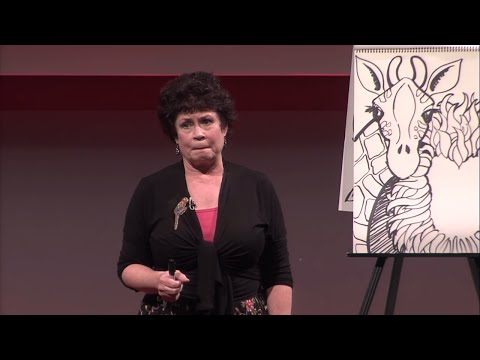
well here I am about to do a TEDx
presentation which means I’ve committed
myself to the most feared situation as
regarded by our modern civilization I’m
referring of course to speaking in
public believe me every possible
negative outcome is flashing through my
brain right now my insides feel like
this you laugh because you get it why do
you get it what on earth just happened
here I throw a couple of lines up on a
piece of paper and you respond they
become a magic bridge from inside of my
head to inside of yours you could
explain it by saying oh we were taught
to recognize those lines you know like
letters but that form of literacy let’s
let’s go back when people weren’t quite
so literate the 1400s Leonardo da Vinci
drew cartoons he did caricatures called
grotesques and people got at them we
could go back to a port city in the
first century dozens of different
languages are spoken in the streets of
Pompeii and people would stand and look
at the walls and they recognized those
lines too they got it we could go back
twenty thousand thirty thousand years to
the caves of Lascaux France or Altamira
Spain look up the ceilings and see the
scenes depicted there the hunt people
got it then you know folks Facebook is
nothing new we have been posting images
for what could be 700,000 years if you
look at some of the documentation from
in India I think that humans have been
drawn to make their mark forever and you
responded to this why well you could say
artistic genius well you could if you
did I think you were channeling my
grandmother no it’s not it’s not talent
or is it teaching that built that bridge
it has a lot to do with science
now the sciences and I include math in
that umbrella the sciences give
structure to everything we understand
including the Arts on the other hand the
arts give meaning to everything we
understand including the sciences two
sides of the same coin I look at them as
the bones and the flesh that comprise
the body of knowledge we have created as
people and when those are joined
together as partners when they are fully
integrated that body leaps to its feet
it comes to life it becomes animated and
a great way to show you how that works
is through character design now
regardless of how an illustrator or an
artist arrives at a character I think
most would agree that a very crucial
area is the face we humans are
hard-wired for faces all of us have this
sort of internal formula we use it’s a
geometric equation that we apply
whenever we see a face and it’s all
based on survival sometimes on ours or
wondering what they do for theirs now in
science as an art form follows function
so those forms we see the geometric
shapes their sizes and how they relate
to each other give us an idea what that
animal eats it’s all based on nutrition
and although I hate the word diet
in the end a group of cells has to die
for an animal to survive so let me take
you back to some of those caves I
mentioned a few moments ago prehistoric
times that’s where you live and you are
leaving your cave because you are hungry
and you’re looking for something to eat
nearby yeah a twig snaps you look up
into the foliage and you see a pair of
eyes watching you these eyes are
elliptically shaped they are vertical in
the way they sit from your position and
you watch for a moment and notice that
they possibly have long thick eyelashes
as the rest of a face emerges you note
that there is a mouth beneath those eyes
and that it has full flexible lips
strong lips good for latching on to
something like a plant you’re looking at
an herbivore eyes are set far apart for
peripheral vision that’s because they
are problem seekers they’re always on
the lookout for a problem about to come
if these lips curled back you would
notice that there are centrally located
dominant teeth good for clumping on a
plant and pulling it the lips that latch
the teeth that pull and you relax just a
little bit herbivores can hurt you but
they are not there to eat you on the
other end of the stick we’ve got another
problem you’re in the cave and you’re
about to leave again and you’re hungry
you get ready you notice there that twig
snaps and there in the foliage is a
different set of eyes these eyes are
deep set
they’re close together facing forward
they’re focused on you your heart just
about stops as a face emerges you notice
a triangular shape nose and very thin
stiff narrow lips you’re looking at the
face of a carnivore you are in trouble
if their whole face works they’ll peel
those lips back to reveal canine teeth
set distally apart so here you’ve got a
v-shape and here you’ve got an inverted
V shape as far as the main parts of what
these animals do to survive and whenever
we start thinking of human traits for an
herbivore behavior you might say it is
an animal that is unknowing that an
animal that is ignorant or innocent such
as oh you’re grandma’s little lamb or
she froze like a deer in the headlights
or do not be a jackass again at
tonight’s party however if you’re
looking at a carnivore and you give
someone carnivorous traits they usually
have to do with a solution seeker which
is what I see carnivores is being
they’ve got a plan whether it’s in place
or they’ve accomplished it they’ve got
one so Richard the lion-hearted or don’t
try to weasel your way out of this one
so we’ll use these animal traits as for
human behaviors and cartoonists know
this whenever they’re going to create a
character they try to manipulate how
you’ll respond by combining some of
these Disney has a movie out called
spirit and in it there’s a horse who’s
very independent and very very
strong-willed Disney gives the horse
eyebrows and pulls the eyes closer
together so that when the horse is angry
or focused the brows go down and the
ellipses become
horizontal on the other hand think of
Clifford the Big Red Dog
he has vertical ellipses for his eyes
and when he smiles the gums look all
nice and soft and floppy because he has
no teeth the worst he’s going to do is
bruise a banana but what about omnivores
what about us
well cartoonists get to go to town on
the options there but actually our
facial features start out kind of or
vigorous and we live our whole lives and
end up at the other end of that spectrum
so let me start with babies now we
humans have a very low bar for cute ASSA
tea when it comes to baby mammals
including our own I mean after all
they’re small and they’re warm and
they’re cuddly and they’re completely
vulnerable how do you draw something
like that
well once again an artist uses math and
science for these things when babies are
born they’re kind of half-baked and so
their brain is only 25% of what it’s
going to be as an adult however here’s
the big difference
the eyes are 70% of adults eyes when a
child is born so they have to be placed
really far apart since they take up so
much room in that little skull not much
is going on yet with cartilage or with
bones so they have little bitty button
noses and those lips well without any
teeth to stretch them out baby’s mouths
are full and flexible they’re nice and
strong after all think of the latching
that they’re going to need to do and we
just think they’re darling if you’re
going to draw a character that is infant
or small you use a 1 2 4 head ratio if
you’re going to make one that
little kids really like so that they
identify with it being even younger or
smaller you might use a 1 to 3 head
ratio paint them blue call them Smurfs
if you want to do something real
disturbing with babies you create a doll
that’s 1 to 4 heads high and then you
give it teeth and call it Chucky that
pulls my strings I’m creeped out I don’t
know about you now on the other end
things start to happen when you’re going
to create a character and let’s say you
have one that grows on up becomes an
adolescent during those years our teeth
form and they start in the center of our
mouths and then the jaw fills out and
gets bigger the brain keeps growing you
get longer arms longer legs kids look a
whole lot alike though during those
formative years but when hormones kick
in everything changes now one universal
as far as creating a beautiful or
attractive character has to do with
symmetry in either sex symmetrical
features are always the most attractive
there are a lot of other nuances though
that cartoonists might use that will
enhance or detract from that as they
build a characters face again based on
the science young men will end up with
lots more bone and cartilage so their
ears start looking bigger their noses
seem to grow and they get I browse which
makes their eyes look deeper set with
the bigger noses they look a little
closer together and of course muscle is
laid down and I’m sure everybody’s
noticed the thing that they sport the
first minute they can are the little
bitty crummy beardy moustachy things so
we’ll give this fellow a little bit of
and here you have a young man probably
looking for scooby-doo right so what is
it that makes him procreational material
is again it’s easy with the symmetry
it’s it’s the thing that lifts the
character up and out of the shallow end
of the gene pool and drops them into the
hot tub well if a young woman is not
symmetrical enough she turns to
cosmetics gals like to do all sorts of
extras coloring their hair growing it
out long and then what is it that they
push women to do with cosmetics oh wait
it’s get your lips to look full flexible
strong good for oh and and then their
eyes so we have a mouth that’s spool
flexible and strong and the eyes you
want them big wide far apart with a big
thick fringe of eyelashes to go with it
too oh and here we have the hottie you
know it makes me wonder sometim if the
makeup is about beauty and symmetry or
if it might be about trying to be less
threatening to the opposite sex time
goes on if you’re fortunate and this may
not sound so fortunate because full
maturity happens the brain completes its
journey it’s as big as it’s going to get
you’ve had two sets of teeth come
stretching that jaw and a combination of
genetics life experiences and gravity
show up in a character so gravity starts
pulling all that cartilage down ears
look longer and the nose looks a whole
lot bigger eyes they’re fat they’re
full-sized end up with heavy
wrinkles placing them deeper in a face
as the tissue keeps getting softer and
thinner and wrinkling eyebrows have gone
a little bit wild maybe and a character
begins to have deeper lines in a face
these lines
I’ll make this guy a little happier here
have a stolid philtrum there where the
mouth is sealed at the center a lip and
teeth tend to have receding gums so they
look longer this looks more like a
muzzle in a face and cartoonists use all
of these lines at all times every chance
they get in order to build a bridge from
them to you so the next time you happen
to be watching cartoons and you laugh at
roadrunner or you tear up when Harry
Potter and Dobby say farewell think
about the science beneath the sketch and
let the animation animate you thank you
so much
[Applause] [Music]