
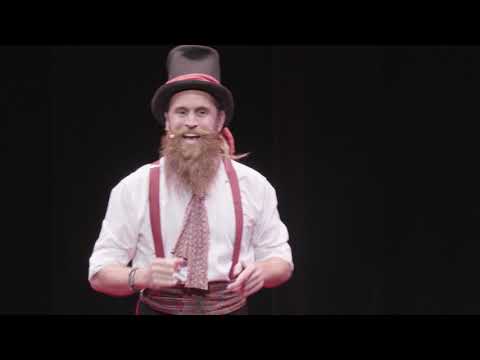
Translator: Theresa Ranft Reviewer: Mirjana Čutura
How can a game of ‘Duck, Duck, Goose’
save the world?
How can or can even –
how can singing a simple song save somebody’s life?
Well, for the past 10 years,
myself and a team of clowns, musicians, dancers and performers
have travelled over four continents, 23 countries
and worked with more than 115,000 kids.
And I’ve seen first-hand that both a game and a song can do exactly that.
You see, bringing back play to communities in crisis
can have such a profound effect
as to literally change the direction of somebody’s life.
Think about it, for children that have lost everything –
lost their homes, missed their education,
lost members of their family,
and sometimes even more heartbreakingly,
in front of their own eyes, lost members of their family –
returning to a state of childhood can be a matter of life and death.
I first realised just quite how powerful play was
about a year into setting up The Flying Seagull Project.
I was in Romania,
and we were working with a group of adults with learning difficulties.
Communication was quite mixed, so I thought, ‘You know what?
We’ll use some music, we’ll start simple.’
So, I beat the drum and clapped my hands and asked them their name.
They clapped their hands and told me their name,
and round about we went till everyone told me their names.
Nothing exceptional in that, everybody joined in.
About an hour later, when I finished the session,
I looked around at the staff and noticed
that they had this kind of bizarre look on their face
of somewhere between confusion and excitement.
The guy who was running the centre came over and said,
‘What did you do?’
I thought it was something wrong, so blamed Matt.
I said, ‘He did it. Nothing to do with me!’
Then they explained to me that the third member of the circle –
a young man who told me that his name was Stefan –
hadn’t spoken in the seven or eight years that he’d been attending that group.
Never uttered a syllable.
Not ‘Thank you’, not ‘Hello’, not ‘Can I have a water?’
Nothing.
And he asked me again, ‘How did you make Stefan talk?’
I said, ‘It wasn’t me, it was the game.
We played a game, and Stefan wanted to play too.’
Now, we jump forward a whole load of years, and it’s 2015,
and the refugee crisis in Europe had not only caught our attention
in the same way for everybody on the continent,
but it had roused a deep sense of need
for us to reach out and to help the kids that were caught up in this terrible spot,
to offer them the same warmth and love and support through play
that we’d been offering around the world for almost a decade already.
So, we teamed up with our long-term partners, Humanitas charity,
and with their doctors and our clowns,
we took a health and happiness crew across Europe,
stopping in camps –
something for the mind, something for the body.
Every time we came to a stop, online and on the ground,
we kept hearing the same thing:
‘You need to go to Idomeni. You’re needed in Idomeni.’
Idomeni, it turns out is a small town, tiny,
just on the border of Greece and Macedonia.
And it was here
that when Europe closed its borders and the doors were shut,
that the thousands of desperate families
and people en route to Sweden, UK, Germany – wherever it was –
they had to find a temporary home right there and then.
Now, this number swelled to something like 14,000 at one point.
In that number were the elderly, newborn babies, children,
people with disability.
I mean, everybody, every section of society was present
in this muddy, waterlogged, desperate,
violent, toxic field on the side of a border
that we called a camp.
Now, amongst those numbers,
there were 3,000 children – more, actually.
And those kids were in a state of a total emergency.
Imagine, they’ve got medical needs – yeah, loads, numerous.
But they also have this other need.
It’s a need for joy, it’s a need for them to feel happy.
It’s been months since they’ve probably even smiled.
That’s not good enough.
Think about what they’ve been through.
They’ve left their homes.
They’ve raced across a country with bombs and militias all around them,
crossed countless borders.
Some of them crossed the ocean itself,
always racing away from a danger that they know behind them,
but also blindfolded, sprinting towards who knows what in front.
Terrified, scared, never safe, never warm, never comfortable.
It’s horrible.
By the time they reached us,
what I had was a group of kids in a state of ongoing trauma.
Now, there were some places on-site –
a few of the grassroots organisations that tried to offer children’s activities.
But, in the state that they were in,
it was almost impossible for them to join in
even basic activities, like school.
Okay. Number one – you’ve got to get to school,
and to get to school,
you have to cross a camp that is dangerous and toxic,
and you run the risk of either bumping into a gang fight –
which happens almost every day –
or worse, you could bump into border guards
who, let’s say, were a little generous with their tear gas rations.
Now, even if you get to school, then you’ve got to sit down and learn,
which you’ve never done before,
or if you have done it, it’s so long ago that the habit’s long lost.
They needed something different,
they needed something healthy and dynamic and energetic
that they could just let out some of that stress
and then cool off and go to school.
But I think the thing that strikes me the most –
and it’s with me to this day and I guess for many years to come –
is their faces.
Where they should be the faces of kids –
you know, they should be playful and mischievous and cheeky –
instead of that, what we had is the faces of stressed out, worn out,
almost elderly adults
with the weight and the wisdom of the world behind their eyes.
But they weren’t 60 and 70, they were 6 and 7,
and they shouldn’t know
and they shouldn’t have seen what they had.
We made the call, all of us agreed: we’ll stay.
And right up until probably two months later until the eviction,
we would go into the camp every day, eight to ten sessions a day,
four or five camps in the area,
and before 9 o’clock, you’d hear the sound of a trumpet …
(Imitating trumpet)
(Shouting in Arabic)
which is Arabic for ‘Circle! Circle!’
These kids would come pouring out, racing from their tents into a circle
for what we’d call ‘playtime’.
But I’ve got 500 kids now, from baby till 18.
What do you do?
Simple games that are fast enough for them but simple enough for them,
so ‘Duck, Duck, Goose’ or ‘Quack, Quack, Woof’
as it became known.
(Chuckles) ‘Quack, quack, woof!’
‘What?’ ‘Woof, mister. Go!’
‘Okay.’
But it became the sound of every day.
There were outbursts of bubbles,
there were moments of magic, there were the sounds of songs –
we did everything we could think of.
And then some days, it was just too bleak.
The weather had been too bad,
or the violence had been too relentless the night before.
On those days, we didn’t bother with games.
We just called them into a circle,
and we would find their voices,
and we would find a way to release and to roar
and to establish and state their place on this earth,
and we’d bellowed songs together,
and we’d let all that tension go until we could settle again into laughter.
(Video begins)
(All) Oooh!
Ash Perrin: Fee! (All) Fee!
AP: Fee-fi! (All) Fee-fi!
AP: Fee-fi-fo! (All) Fee-fi-fo!
AP: (singing) Coomalata, coomalata, coomalata vista!
(All) Coomalata, coomalata, coomalata vista!
AP: Yeah, yeah, yeah, la vista! (All) Yeah, yeah, yeah, la vista!
AP: Whoa! (All) Whoa!
AP: Hey! (All) Hey!
(Repeating faster)
(All) (increasing) Whoaaaa!
(All) Whoaaaa!
(Video ends)
(Applause)
Now, it seems quite a radical approach,
but it was natural, somehow it was the right thing to do.
Just shout a bit. Why not?
The one story that really sums the whole experience up
and why it’s so valuable:
There was a little boy – we were midway through a show,
and right in the middle, you smell tear gas.
After the first time you smell it, you know it.
The kids were normally the ones:
‘Mister, mister, go, go! Problem, problem, go!’
This little boy: ‘Go, mister!’
He grabbed my jacket: ‘This way.’
I could see the men and the poles and police pouring in,
so I just followed the kid.
We sprinted out, me and my guys,
carrying our suitcases under this train and over a hill
to the car park.
And here’s the moment of absolute magic.
He then calls us into a circle.
He does ‘call and response’ with me, sits me down
and performs a magic trick that he’s been practising
because he thinks we might be worried by what had happened.
(Audience) Aaah!
(Applause)
That’s what it’s all about.
And it wasn’t always easy.
The first weeks, you’re in this spot with the biggest names in the NGO world.
And every day, I’d think to myself, ‘Are we good enough?
Are we qualified to be delivering this here, now?
Are we?
Are we offering something valid enough for a situation as serious as this is?’
But then you drive into the camp in the mornings,
and I’d see the kids racing from their tents and shacks,
calling each other into a circle
so that when we got out of the car,
they’d already be singing the words to our songs.
That’s validation enough,
that’s motivation enough for us to keep going every day.
And we did until they were evicted,
and we stood waving a sign: ‘We love you’ as the buses took them away.
Now, there’s all sorts of papers and books all over the world
that talk about what does play do.
What physiologically, neurologically, scientifically – and they’re amazing.
But I want to simplify it.
Bodies and minds that feel good, heal good.
It’s that simple.
Let’s look at childhood.
During childhood, there’s some really important moments,
really important elements that have to happen.
One is the right to playact or make-believe.
You play games where you pretend you’re really angry
or like ‘I’m totally in love.’
You try them all out, you try the edges of your personality.
Now, these are really important
because you figure out who you want to be,
where your strengths and weaknesses are.
You try out what you might like to try when you’re older:
I’m a policeman, I’m a train driver, I’m a ballet dancer,
I’m a musician, I’m a whatever.
But in these moments, more than just the playfulness,
it’s more than just for fun,
there’s something that happens in it – your social bonds with other people,
your moments where you think, ‘Could I be that?’
Then just occasionally,
there’s that glimmer, that shoot of energy,
and in that moment, you go, ‘I want to be a teacher.’
‘I want to be a fireman.’
‘I want to design satellites’ – whatever it is.
And it’s the dreams that we have as children
that form the foundations for who we become as adults.
That’s why it’s so important.
The kids I’ve worked with over the last decade, all over the world,
they haven’t had time for dreaming, they haven’t been encouraged to.
Sometimes it just isn’t safe enough – they’re surviving.
There’s no time for thinking what they might be.
This is terrible on two levels:
One, if you don’t have a hope or a dream for your future,
then how can we expect them to feel positive
towards a society that we hope they become part of?
Number two, worse for me, I think:
If you don’t feel anything of what you could be or who you are,
how can you feel positive about yourself?
How can you hope for anything?
On a personal level, that’s tragedy enough,
I think that’s terrible.
But on a global level, on a society level,
we are missing such a vast spectrum of possibility for us all.
Take this 18-year-old in Holland.
He’s been in the news a lot, Boyan Slat.
He dreamt up and turned into reality an artificial coastline
that’s going to float in the sea
and is going to use the tides of the sea
to bring all the rubbish we’ve chucked in there and take it out.
What?
That is amazing!
The confidence and the encouragement
he must have had and the life that he’d had
to believe in that imaginative process,
to be that innovative.
And he may as well just have changed the oceanic landscape forever.
Now, our kids and our teenagers following us into adulthood,
they need that relentless encouragement
because they’ve got big problems that we made
and haven’t managed to solve yet, and they’ve got to do it.
The seed of that is planted through play in childhood.
Now, physically, it’s a bit more obvious what happens in play.
You run around, you’re probably okay physically.
But it actually goes further than that.
Laughter, for example.
The European Journal of Pediatrics, in 2015,
published this article that shared the findings of a trial
into the effectiveness of clown therapy in the medical room
for kids and their anxiety levels.
Now, what they found
was it massively reduced the anxiety levels, hugely.
Kids were not scared during the diagnosis,
they were less stressed during the operations, their recovery process.
And as such – this is important, I love these words –
Laughter and humour should be considered
as a beneficial addition to medical practice.
Laughter and humour really is the best medicine.
It’s not even a cliché, it’s proved.
Now, for kids coming out of a traumatised or crisis background,
rebuilding their confidence through real play, I think,
is probably the most effective and the most direct medicine
for what they’ve been through.
Some of these kids – their stomachs are so knotted, their minds so tense
that it takes me weeks, sometimes even months
just to get them to join the circle and join in a game.
But they have to if they’re going to move past the experiences so far.
They have to do this as kids,
as kids would, in the language of kids, which is play.
And I believe and have seen first-hand
that dynamic, I mean like real dirty-knees, cheeky,
run-around, jump-and-shout, pick-your-nose, be-a-bit-rude play
is the most respectful and the most dignified offer
that we can make the kids in that situation.
Because childhood is not a luxury that should be enjoyed by a few.
It is a right that should be accessed by everybody.
And by putting up big top tents and blowing up bouncy castles
and bubbles and magic shows and all the other stuff me and my crew do,
I’ve made sure, and intend to continue that,
that the kids that we meet have access to that childhood
and have those moments of dreaming.
And what I deeply hope is that anybody involved
in the strategising of the delivery of care in a crisis zone
where there’s kids involved
will more sensibly believe and deliver a provision of real play.
Look, it’s this simple, I’ll leave you with this thought:
Look back and picture when you were younger.
What had the biggest impact on you?
Was it, ‘Ah, my father had a fantastic central heating system in the house,
and it kept us warm for the worst of winters’? No!
Is it, ‘Oh, we had a great car, really fuel economic.
School run was a breeze’?
It wasn’t that.
It’s the moment of playful, warm, loving encouragement
from an adult in your life.
Maybe your mum, your dad,
maybe your sports coach or your music teacher.
For me, moments were with my godfather, Jeff,
laying on the lawn at the front of the house,
his arms and legs in a knot that I’d tied him in.
My mum’s going, ‘Come in, Jeff, come on!’
He said, ‘I can’t, because Ash has tied me in a knot.’
It sounds crazy, but in that moment, I was valuable.
In that moment, play counted,
and in that moment, my personality was relevant.
And that’s why it’s so important, and that’s what shapes us.
In this world we’re in,
I think we need to really squeeze in far more play than we are –
play in your workplace, play in your home,
play in the car, play in the supermarket.
At the very least,
you’ll find there’s a few more smiles on a few more faces.
But at the very most,
you may just change somebody’s perspective on who they are
and change their lives.
Now, we’re limited only by the idea that we have of ourself.
I think that idea is something we can do a lot more playing with.
So, I ask you, I beg you,
and I kind of even insist:
go and be playful.
Play more, play together, and play as often as you can.
Thank you for your time.
(Cheers) (Applause)
Please follow and like us: