
how many of you here had a science
background you know like took science in
11th grade 12th grade almost all of you
and how many of you indulgence a music
or dance or writing some sort of art
that’s a large number some of you will
relate thank you so much
there’s not much there anyway so I’m not
gonna talk about myself primarily
because there’s not much I’m gonna talk
we talked to you about a friend of mine
I’m going to start with the story so I
have a friend he graduated from this
College IT and you know he was your 7
pointer student trying to maintain his
grades go to class pass his classes all
of that sounds like your average student
right not really see this boy could
write and he could write really well he
also had a knack of asking questions
sometimes the right one sometimes the
wrong ones mostly the wrong ones but he
did this he liked what he did and he
went on he wrote he wrote for people he
wrote for media organizations he became
the editor-in-chief of one the founding
editor of another and so fun so forth
and today he studying journalism at the
New York University full scholarship
where he was offered the same course by
almost all Ivy League colleges well I’m
going to talk about this because of one
thing okay think India remains to be the
largest producer of Engineers across the
world its 2017 and we still have that
fact with us now see this started back
in 1947 when you know the country was in
a state of rebuilding so we needed
engineers we needed scientists we needed
roads we need two dams there’s so much
we needed to set up some infrastructure
but today when aesthetics is already
proven its role in you know how
consumers a society we are do we really
not see that there is no lies in the
number of art graduates across the
country that is something that we need
to question now you see the reason for
this is because even though the world
has moved forward we are still stuck
here
we have okay for example the way I asked
you with this question
there are people who are photographers
who are engineers there are musicians
who are engineers there are actors who
are engineers we have had an RBA
governor who was an engineer we have
even had a president who was an engineer
and I’m gonna quote John Lennon I’m
gonna just say this word imagine now
imagine if these people could have done
you know if these people could have
studied whatever they’d like to whatever
they did later from day one how good
they could have been just imagine for a
second and why haven’t they well that’s
primarily because as a society we have
placed so much emphasis on the sciences
and commerce for that matter that we’ve
failed to realize the importance of Arts
in the indian education system you see
in India at least majority of middle
class India we go by very specific
demarcations we have Marx we have
creates we have GPS and we decide that
the brightest takes science the next
once the tape comes the ones who are
left behind the get ours in India
there’s an opinion which says that you
don’t take arts you get it when there is
nowhere else to go right and that is the
that is the exact opinion that we need
to change today okay there was this joke
okay this one time I was in Facebook and
I read this that in India you can be
three things you can be a doctor an
engineer or it is Greece and however
funny that might be it still makes you
think right like in a society where we
encourage to make in India we still rely
heavily on our inputs we import product
design we import movie inspirations for
that matter we import so much that it’s
so it’s only been like five years that
we actually started you know taking a
look back into our own culture and
realizing what is wrong and the reason
for this is that there is a stigma
attached to being an artist because
first of all we need to get rid of the
stigma because science named Malika is
not an appropriate response to somebody
telling you they hacks and they had an
arts education in high school right and
what this is the other one thing okay
I’m gonna ask you a question
think of an artist close your eyes and
think of an artist what is that one
image that comes to your mind and you
know some of you most of you will think
of somebody who has
long and kam care and like a beard and
you know lives in a house alone with
probably battling depression addicted to
alcohol all of these things you know
poor all of that ever question why
because that’s what we think artists
earth hobos or people with no aim in
life more importantly that’s what we
think unsuccessful people look like we
equate unsuccessful people with artists
and that is the idea that we need to
change right
you see image of unsuccessful is a
concept that we’ve got on as a society
and that is that one thing that we need
to question that is the one thing we
need to change not all artists sound
successful obviously and there is this
rigid bias towards the arts and you know
it’s understandable because we are very
practical country we are a middle-class
third-world country and we think of arts
as beauty and aesthetics and we think of
science as utility and while these are
very fair generalizations to make it’s
very rare to find ideas that you know
that are so far apart that they can’t be
converged into something which is much
greater okay and since a lot of you will
not agree with what I’m saying I’m gonna
give you an example
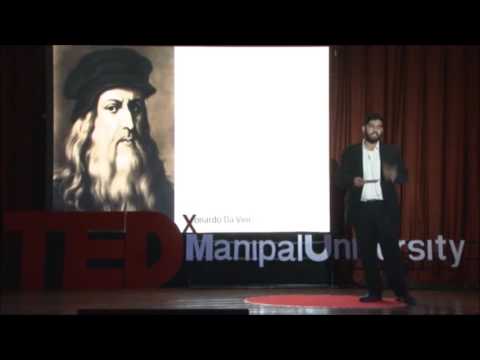
this man is Leonardo da Vinci he was a
painter an artist an inventor engineer
and so much more right and this is one
of his most famous works it’s called the
Vitruvian Man it basically shows a man
overly in with the two images of the
same man one with his limbs outstretched
inscribed in a circle and a square and
you know with demarkation and everything
now why is this important because
Leonardo da Vinci was an inventor who
made art into a science he cut up bodies
just to study Anatomy he was somebody
who included his study of proportion and
mathematics and you know he just took it
all together to create art this is where
he quantified the then-popular units of
measurement the cubit the pace the palm
the foot which today’s world is
analogous to the meter or the inch right
here’s a man who made an omni doctor a
plane which flies like a bird has a man
who made
the first working model of wrote a
parachute prototype of the helicopter
and so much more why because he took
arts he took the sciences
he took engineering he took physics he
took mathematics he took Anatomy he took
whatever he could he learned and then
put it all together to create things
that was so beautiful today we can only
stare at them and wonder right okay I’m
gonna talk about another Italian man now
but this one is more recent his name is
Dominic over chin Anza and that’s a
funny name but what he does is cool it’s
really cool
so he works with the an organization
called Dante which is the delivery of
advance network technology to Europe or
something now what’s cool about him is
that he’s a he holds a PhD in particle
physics he also is a trained classical
composer and these these sound very
different right he works with large data
he works with NASA he’s worked on the
Voyager one the Voyager 2 his work with
Sun on the Large Hadron Collider his
work with meteorological departments
across the world and what he does is his
job is to find anomalies in that data
all of this data at least most of it is
very repetitive it has a certain pattern
to it because you get the same data over
and over again it’s very difficult to
find that one mistake right so what he
does is he creates a musical scroll out
of it it’s like a movie soundtrack
because he says and I’m gonna quote him
now it’s very difficult to find that one
mistake in a graph but that same one
mistake can be found very easily fits in
a melody right so he’s a man who took
music who took physics put it together
to solve problems and that’s why all of
us are here today to solve a problem
right okay some of you still look
slightly unconvinced I’m going to try
again poetry poetry is an acceptable art
form yeah
now poetry in general is judged by the
metre that it possesses or to
oversimplify it it’s the number of
syllables in each line right it’s the
balance that it possesses
if you look at most classical
architecture the beauty of that
architecture lies in the fact that it is
symmetric about say you know it has
either is symmetric all has elements of
symmetry or as designed in such a way
that it looks
aesthetically pleasing and again music
music has beats music has rhythm music
has repetition that are pleasing to the
eye you know where else we find balance
symmetry unity and all these principles
machines okay take a look at this this
is a perfectly symmetric balance machine
airplanes need to be balanced engines
need to be symmetric buildings need to
be to be stable a building needs to be
you know symmetric about an axis we
forget that engineering requires design
– you know the principles of balance
unity all of these principles apply just
as much to the sciences as they to the
arts and as we dig deeper we find out
that it’s always connected ok think
about cinema now cinema is something
that I love because I believe it’s one
of the purest art forms there is there
is so much to see there is so much to
hear there’s so much to imagine to take
in right it’s an experience can you
create that cinema without technology
can you create that art without
technology from the most complex of
cameras to computers to the simplest of
things like a light or your remote you
need technology and this can be said for
almost all of modern art to make a
digital impact you need the help of
technology today ok you know when you
say make a shape on even by a PowerPoint
or when you make a drum beat on a music
production software what we fail to
realize is through made that one shape
there was at least a 20 to 30 lines of
code written to get that one beat right
there was so much physics and math put
into it that we have all overlooked
there’s another thing which you know
just gets me really angry we have as
Indian engineers as Indian software
engineers we have worked everywhere we
have created softwares we have created
almost all possible kinds of software
but when it comes to Indian software’s
we have created things that can compete
with say Microsoft Office we have
created things which can compete with
say AutoCAD or you know utility
softwares we are yet to create something
that can compete with the Adobe Creative
Suite
we are yet to create something that can
compete with say FL studio’ or any music
production software for that matter I
just know the one so you see what
happens is art and Sciences they’re
intertwined and it’s not like arc
downplays science or science undermines
arts they work in tandem they work in
balance they balance each other out
there’s this German scientist okay some
of you might heard of him Einstein was
his name now this guy he once said that
after a certain level of technical skill
is achieved Arts and Sciences they
condense plasticity in form because
almost all great scientists can be
considered greatest artists and since we
have talked a lot about this this was
I’m going to talk about something else
now I’m going to ask you another
question what comes first practice or
principle okay so sorry I think I’ve not
made myself clear okay think about it do
you write down a certain statement do
you write down an equation or do you go
back observe it do I need to stop okay
so do you do you write down a statement
do you get to an equation first or do
you first observe it happen do you first
take those values do you first quantify
the entire thing
I mean gravity existed before Newton
discovered it it’s not like he invented
it right so in nature we’ve always seen
see the thing is we need to observe
before we quantify we need to observe in
labs we need to observe in nature to
realize that science or you know and a
decision or a technology needs to be
first practiced before it’s converted
into a principle right and what happens
is we need to question it we need to
question the status quo what happens is
today in schools we taught that you know
there is there are certain set of
questions there is a singular way to
approach them and this is how
step-by-step you will get to the answer
how about you questioned see arts or the
humanities give you that mindset to
question it to be skeptical about it to
think about it in a different way to
creatively dissect the solution because
to arrive to
solution you need to design a solution
right now what is important today is how
we question it because the questioning
has always been better for both the
sciences and the arts
Copernicus questioned the model of the
solar system the litleo question the
model of the Flat Earth and both of them
over time however they were stoned to
death but you know over time this was
proved that they were right and how did
it happen because they questioned it
okay I’m going to show you something
else now this okay most of you can see
this red red dots blue dots green or
yellow dots white dots this is your
current Indian education system you have
the science you have commerce you have
arts you have say liberal arts whatever
you want that you can break it down into
more things how about I take one from
the top and put it there and you know
it’s something like this looks weird
looks slightly a facade some of you
can’t even make the difference out how
about I do this how about I do this now
there’s a pattern there you all see the
pattern you all understand that there is
two things existing together there is a
coexistence because that’s what we need
to address right we need to move from
this lateral focus towards one field and
we need to move to a more inclusive more
diverse a more holistic idea of
Education right okay for example in a
university what we some of us like some
universities already do it especially
engineering colleges excuse me
especially engineering colleges you need
to include the concept of minors because
they a mechanical engineer a major in
mechanical engineer is also a minor in
music theory he can create he can take
the principles of both of them and
create a musical instrument a
communication desireth so an IT engineer
also takes up communication design so
whatever he codes whatever he puts in
screen also looks good on screen right
Industrial Design is a field untapped
and what happens is after all of this
when we go back we will listen to this
we’ll forget about it but what we really
need to do today is demolish an ideology
demolish the ideology that you’re mark
somehow
indicative of your intelligence because
you see what we need to understand is
that just because a child cannot solve a
math equation doesn’t mean it’s not
intelligent because intelligence is not
solving equations at solving problems
and even though a math major may not be
good every good good at math they are
both solving problems in their own way
and that is what we need to understand
right we need to question we need to
rethink our ideologies and today if you
go down if you go back then I would just
like to take I would like you to take
back this one thing it’s a question of
where do we want to go as a nation let’s
talk about on a bigger scale here do we
want to be a generation do we want to
have a generation of people who are
frustrated will we spend four to six
years of their life doing something they
don’t want and then move into something
more productive or do we want to break
away from this mediocrity do we want to
you know make a generation full of
people who are so passionate about what
they do that they’d work wonders and you
don’t think about it it’s its overall
development of you the people around you
the society the nation just scale it up
I’m gonna end it with just one statement
right arts and sciences they’ve always
been intertwined they’ll always be
intertwined and if you consider
otherwise or if you want to convince
somebody otherwise it’s nothing but
create disrespect to both the fields thank you