
child was playing games I used to play a
lot of video games but the problem with
that was I was so into video games I
used to search for a new game day in and
day out it was during one of these
searches that I came across a tool like
scratch which worked in three steps you
need to imagine program and share using
these three steps you could build your
own game it was after using this app
that I realized building a game was more
fun than playing one using scratch made
me realize the power of programming I
started I got involved more into
programming the coming years I started
taking online documentation referring
YouTube tutorials for Android
development finally taking open online
courses from Coursera and edex for
learning other computing platforms from
all this I started to gain new
experiences one of the things that
motivated me most was running my program
successfully without another like more
most programmers at the end of the day
this is how I is to fill no syntax
errors ok that’s surprising after many
years in my ninth grade I started going
into a new field of computer science
which is called as computer vision
computer vision is a field of computer
science that deals with making or
getting analyzing data from video or
images captured using a computer it was
in 2014 that Intel Hite announced the
intel realsense challenge I was in my
ninth grade back then it was a challenge
put up by Intel to come up with
innovative ways to use gesture
recognition technology I developed
interact which is a tool which allows
visually impaired users to come control
their computer without the need of a
physical keyboard or a mouse this this
came by because I had
through various academic papers and
about gesture recognition technologies
and I thought why not make something for
the visual impaired I didn’t expect
anything to come out of this I submitted
it to the intel realsense challenge
after four to five months of inactive or
no response from Intel I got this mail
suggesting that I had been selected as
one of the finalists for the intel
realsense challenge that year this was
the first time I realized that a tool I
built at home for the visually impaired
could make a actual positive impact on a
person’s life this was one of the first
moments I started to realize the power
of solving problems at home this two
words was something I wasn’t used to
open sourcing open sourcing meant that I
take my project which I worked a lot on
and I put out the hardware and the
software for free to other people so
that they can modify it and use it for
their own purposes I was skeptical at
first but I truly understood the power
of programming open sourcing only once I
tried it I open source a technology
which allows you to control your
computer like Tony Stark does so this
got many people interested and I was
able to get a wider which then what I
was able to receive before this is a
tool which allows you to control your
lights at home using gestures both of
this are fully open sourced on github
and I realized the true power of open
sourcing after open sourcing these two
projects I was able to get a wider reach
and I was able to interact with
developers in a new way which I couldn’t
do before since then I open sourced more
than 10 hardware projects on github
Instructables and hackster and through
this I was able to get support from
Intel Microsoft and MediaTek who provide
free hardware to developers who
open-sourcing getting involved with the
maker culture during my beginning of my
10th standard introduced me to a lot of
innovation labs research labs around the
world one of them that I was
specifically interested was the MIT
Media Lab in Boston the MIT Media Lab is
a heaven for a maker it’s a place where
they come up with innovative solutions
to real-world problems with by using
technologies in ways most people think
are impossible it was the next year in
my dueling marathon after my 10th grade
had finished I was invited to work with
MIT Media Lab in Maharashtra for finding
solutions for real-world problems faced
at large gatherings the event was called
the MIT come baton come Bhutan is a
hackathon or a buildeth on where you
were developers from all over the world
come from all over India and from the
world the researchers come together and
find solutions to problem says that
large gatherings we worked on two
problems specifically they were QR code
based cashless payment system and a
child tracking technology which allows
us to track children who have potential
to get lost in large gathering today you
can see cashless payments almost
everywhere due to OD monetization but
back then it was still in its baby or
infancy stage coming back from the event
I realized that curiosity is the
stairway towards finding a solution till
then I had a common approach to
programming that was by learning
algorithms by finding out how things are
done step by step but after coming back
from the workshop I realized the right
after coming back from the event I was
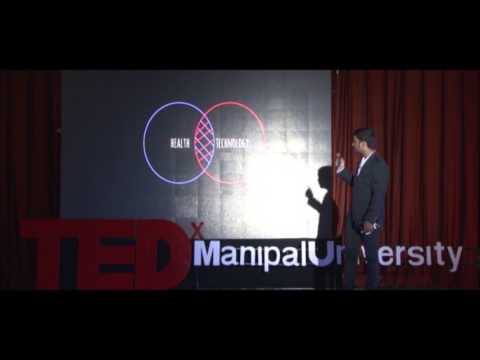
interested in two areas specifically
they were health and technology I was
figuring out what could be the
intersection what could be in the
intersection what can I find that is
interesting in the intersection between
health and technology for this I started
looking back at my earlier days in
school most of you might have a similar
experience it was in my seventh grade
that I had first looked through a
microscope during our biology class but
the problem was there was only one
microscope and we all had to stand in a
line to go and look through the
microscope but when I did get a chance
to look to the microscope the experience
was amazing it was something which I had
never seen before I was able to look at
things from a new perspective this is
how I felt after looking through the
microscope then I started looking
thinking of this problem the problem was
current microscopes are bulky they are
expensive and they are hard to use and
maintain so I discussed about this
problem with my friend Chaitanya we got
we started brainstorming on this project
and we wanted to figure out how could we
build a microscope I was using the same
approach that was this was the first
time I used the approach of asking
questions I asked can I build a
microscope at home what tools do I need
to build a microscope at home the answer
was right in front of my eyes I wanted a
platform or a tool which was powerful
enough to do the computing necessary for
building a digital microscope and that
tool is something which all of you have
said of smartphone the smartphone sales
had crossed the billion mark the year in
which I was intemperate that was me only
two years ago and this meant that if we
were able to build a microscope on top
of a smartphone we could have a
microscope that everyone could have at
their home without the need of any
external buying a new completely new
microscope we started working on this we
develop madney ware which stands for
magnification variable magnifier is the
world’s first variable digital binocular
microscope we have a 3d printed lens
holder with the lens 100 excellence we
could have multiple lenses and we attach
it to the a beer holder of Google
cardboard or any virtual reality headset
the lens is aligned with the smartphone
and the smartphone runs the app
developed by us which does all the
processing work this were the first
results that we got out of mic magnifier
this motivated us to continue working on
magnify as we were electronic hobbies
the first thing we wanted to look into
was how would a copper wire look under
magnifier so we we were able to see
copper wire magnified a grasshopper leg
and the grasshopper wing but this was a
fun part having a microscope at your
home meant you could look at whatever
you wanted so I took some soil crystals
placed it under the microscope
I took a potato field who takes the
potato here so I started looking at how
it was how it love normally it was fuzzy
then the feature of most camera apps
these days they have filters we take
filters often for granted for Instagram
or Facebook
but this filter we don’t usually use so
I applied the negative filter due to the
contrast adjustments I was able to
easily distinguish the soil crystal from
the background so this was a feature
which we included to magnify this was an
experiment that was something that was
really meaningful to us because this was
something which we do in our school the
onion peel experiment we were able to
recreate it with the right kind of
position at home the fun part about
magna virus the features we can add to
magnify is limited by our imagination so
we included a feature called as
projection microscopy where we use a
smartphone’s flashlight as a source of
illumination for projecting any specimen
placed in front of Magnum F onto a wall
and this is a specimen of an ant which
was going through my table so I took it
place it in front of the smartphone’s
flashlight through Magnum air you can
project it onto a wall virtual
microscopy the problem with most
microscopes in schools or the
inaccessibility of microscopes is that
the students don’t have access to slides
most schools don’t have slides or
microscopes so we wanted to find a quick
solution to this and that is virtual
microscopy virtual microscopy allows you
to use view a specimen in 360 degree
interacted with with it without the need
of preparing a specimen or without the
need of having any slides or a
microscope I would like to show a live
demonstration of virtual microscopy
Magne we are up for running virtual
microscopy and I take the phone I place
it in inside the cardboard and I just
wear it around my head now I am able to
look at the entire specimen in 360
degree interact with it and make my
observations this was one of the fastest
additions we could add to magnify this
meant that we only had to include a
software feature to magnify in a
nutshell
Magne where is low-cost it’s variable
it works entirely through voice commands
which meant that you can control this
microscope just by using voice commands
for taking our image for zooming and
zooming out for auto focusing and for
live streaming to any part of the world
in real-time we submitted magnifier to
the Google science fair that year and we
were selected among the top 90 regional
finalists and to our surprise a uk-based
newspaper also wrote an article on Magni
worth mentioning about what they found
interesting about magnifier today I
would like to make an announcement which
we both are excited about that is we are
going to open sourced magnifier which
means
[Applause]
Machiavelli is going to be completely
free anyone anyone in the world can take
Magni we’re build it using those common
materials and make their own
modifications to magnify since then we
both started working on a lot of
projects and one of them were a
smartphone based tool for rain imaging
which means that you can use your smart
phone right now to image winds for this
we have been selected to represent and
we are happy to represent Team India at
the Intel science and engineering self
into the 2017 I would like to come back
to what I learnt as a child which was to
imagine program and share from all these
three the thing which taught me the true
power of programming was sharing I
realized that sharing allowed you to
reach get a wider reach interact with
new people and make connections that you
didn’t have before as in at the end of
the day what I realized was if you can
cause a positive impact with your work
on one person’s life it means you are
doing the right thing sometimes it might
take five years to see the impact
sometimes ten years but it is never
going to happen if you don’t give it a try