
[Music]
you
when you hear the word border what are
some of the images that flash through
your mind what’s your immediate gut
reaction where does it take you do you
think of immigration lines passports and
the process of crossing borders into
another country do you think of
checkpoints barbed wire Border Patrol
and the process of blocking people from
entering a nation-state do you think of
physical boundaries or psychological
ones is the idea of borders always
grounded in reality or can it be a
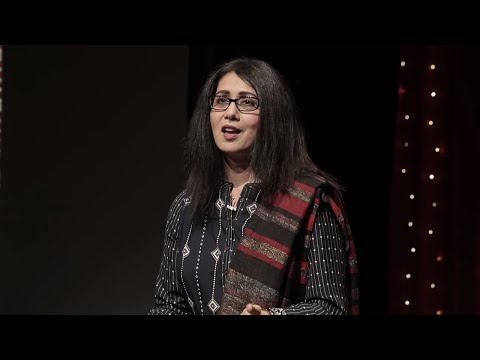
figment of our imagination I’m an artist
and filmmaker and I was born in Lahore
it’s the cultural metropolis treasured
in the Indian subcontinent and now a
major city in Pakistan Lahore is old
congested noisy it’s summers are
unbearably hot that is until the monsoon
rains arrive they roll down from the sky
in thick sheets of water and wash
everything Lahore is mangoes magical
crickets and nights steeped in the sweet
scent of jasmine it’s the city where
myth and reality brush up against each
other continuously but I actually grew
up in Belgium in the cool and sleepy
suburbs of voluble Sanibel that’s when
life became exclusively French and my
childhood a blend of Christmas cookies
European pop music if you can believe it
and a uniformly accepted sense of what
it meant to be Belgian I was the only
student of color the only Muslim in my
class for most of primary school and
that created a strange disconnect in my
own understanding of who I was a double
consciousness so to speak we shifted
back to Pakistan for a few years and
then after college I moved to the US and
fell in love with New York
not only could I feel and respond to its
energy its high concentration of people
and ideas but I also found its mishmash
and multiplicities to be oddly
reassuring they aligned very closely
with my own interior diversity being
from so many different places and
therefore from no particular place at
all as you can imagine borders are
meaningless to me they divide and limit
by speaking in a very colorless binary
language we have citizens and
undocumented aliens we have legal versus
illegal human beings we look two lines
drawn in the sand in order to form a
movable national identities in order to
separate what is known and safe from
what is foreign and dangerous yet human
beings are anything but fixed or easily
definable each and every one of us is
complex and full of contradictions our
gender sexual orientation education
profession the languages we speak the
books we read the religions we embrace
or don’t embrace the partnerships we
choose to form in marriage or otherwise
how we parent or connect with our
neighbors and community whether we smoke
or not exercise or not vote or not all
of these decisions these affiliations
and ways of being in the world
I like discrete circles that overlap and
continue to stir and form new
intersections that define us what a
ridiculous notion it is then to combine
millions of people with millions of
shifting identities and call them one
monolithic nation based presumptuously
on the geometry of maps I worked on a
film about the partition of India for
more than seven years and therefore I
had plenty of time to think about
nationalism and borders what used to be
the
continent or most of South Asia was
colonized by the British for two
centuries as their global power began to
dissipate and the call for independence
became louder and louder the British
decided to leave India in 1947 along
with plans for a very quick exit they
also drew lines that cut across villages
and farmland and created a Muslim
majority Pakistan and a Hindu majority
India as people began to move across the
border in the midst of complete chaos
riots broke out between 12 to 20 million
people were displaced and more than 1
million killed in a matter of months
after the partition both India and
Pakistan had to reinvent themselves
almost in opposition to each other what
had always been a deeply diverse place
now had to be reimagined as two separate
countries with sharply defined singular
identities those who didn’t fit in were
forcefully integrated by using state
violence it’s such a contradiction the
partition was supposed to take care of
the minority problem by separating what
was different but in fact it only
exacerbated the persecution of
perhaps it’s my rebellion against
boundaries and sameness which have
propelled my work in the direction of
multimedia collage my last series of
artwork was called
this heirloom and not only did it blur
the edges between different materials
and cultures it also crossed over
separations in time and space I
recreated my own family history by using
old photographs and placing my ancestors
in landscapes that were unquestionably
South Asian my mother’s family is
originally from India my father’s family
is from what became Bacchus
by locating my ancestors on the wrong
side of the border I was able to subvert
and overcome geographic boundaries and
limits this for example is my maternal
grandfather he went to a legal
University in India he spoke fluent
English Bordeaux and Sanskrit he was a
lawyer but also an excellent tennis
player he passed away soon after the
partition my mother believes he died of
a broken heart I never knew him
I’ve seated him in Lahore in Pakistan in
front of one of the gates to the walled
city this is my paternal grandfather he
owns some land in central Punjab on the
Pakistani side and studied English
literature in Lahore in Pakistan I still
come across some of his books in my
father’s library I’ve placed him in
front of the JAMA mosque in India art
can help us imagine a better world and
that’s what I tried to do with this
series it’s a bridging of memories but
it’s also an effacement of borders I’m
sure many of you are thinking if not
borders then what what about love I like
its capacious nests its ability to come
clean about all that has happened in the
past in order to move forward together
love has no use for walls or borders
it’s about diffusion melding harmonizing
it doesn’t hem in it spreads outward
Adrian rich speaks beautifully about the
edges that blur in one of her poems when
I hear those words I visualise edges
that bleed and blur into one another
criss crossing lines and feels a lot
like collage work rich talks about human
boundaries she talks about how the
body’s pain is not the same as the pain
on the streets yet it’s possible for us
to connect our
own personal experience to that of
humanity if we watch the edges that blur
if we negotiate the distance between us
and are able to see ourselves in the
other I know it takes confidence it
perhaps even a certain level of courage
it certainly forces us to step out of
our comfort zone but in the end it’s so
worth it for once we dare to love
there’s no more room for fear or borders
thank [Applause]
Please follow and like us: