
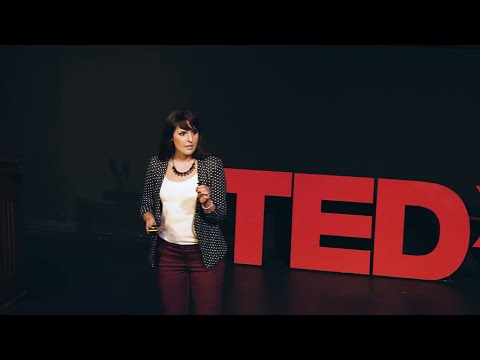
I’m so excited to be with you here today
and talk a little bit about diversity
but before I tell you anything about
myself I actually have a question that I
want to ask you about myself if you had
to guess where do you think I come from
Italy Germany oh good
Argentina I love it thank you
Russia those are all really really
wonderful guesses but I think the
interesting part is that there was not
actually a consensus there was so many
there were so many different opinions
right and there wasn’t an obvious
response an easy way to pin me down and
my admits ethnicity for somebody who is
fairly generically white and doesn’t
have much of an accent and also has less
name that’s not really reflective of
their ethnicity mine is my current last
name is a courtesy of my wonderful
husband it’s really hard to pin down
where they come from I am actually
Ukrainian not as in born in America to
Ukrainian parents Ukrainian I mean born
and raised fresh of the boat Ukrainian I
came here only about eight years ago to
pursue my graduate education at ECU from
a master’s and then at Penn State for my
PhD when I came here my experiences with
cultural shock adjustment to the new
environment and trying to figure out who
I was in this new country were so
profound that I did what any other
academic would do I made these questions
the topic of my dissertation I spent the
next four years researching immigration
immigrant adjustment and cross-cultural
identity issues and what I found was
actually pretty traumatizing
according to dr. Celia Fowler cough who
is a scholar as well as a practicing
therapist immigrants are about four
times more likely to experience social
anxiety depression substance abuse
and suicidal thoughts and actions all
because of their struggles and
adjustment and their struggles with
identity why does it get so bad other
pair of pair of scholars iron jet and
they try to offer us a little bit of an
understanding by suggesting a concept of
identity continuity which is basically a
connection between who we were in the
past to who we are now they showed that
identity continuity is an integral part
of our psychological well-being and the
physical act of relocation to another
country massively ruptures identity
continuity to understand why that
happens we need to understand a little
bit more about identity Jean Feeney who
is a leading scholar in the area of
identity and ethnicity says that
identity actually has two different
components an internal component and an
external component an internal component
basically is who I think I am an
external component is who you think I am
but since there’s really no way of
getting into somebody else’s head it’s
really about what I think you think I am
that makes sense right and so for me for
example that would be thinking of myself
as a Ukrainian through and through but
also realizing that people around me
don’t see me that way I’m pretty sure my
own husband thinks that I’m fairly
well-adjusted American and expects me to
behave and think accordingly but I’m not
American and I never will be because I
came here so late in life and so the
closeted Ukrainian within me suffers
from continuous non recognition and when
so much of our external identity becomes
misplaced this is when our internal
identity starts suffering and we start
experiencing all these psychological
issues just how much of the external
identity can be misplaced I’m going to
give you an example I’m going to show
you an image and I want you to just
think to yourself about what you see in
this image this picture was shared at a
graduate research seminar on critical
thinking here at Texas A&M and the
speaker asked the exact same question
what do you see in this Victor
I think I said something along the lines
of well there is a man on the side of
the road fixing a trunk something very
obvious like that and then other
responses started coming in and somebody
said well this is a third-world country
like why would you say that and they say
well we’ll look at the colored color
colorfully painted walls I was like that
looks like pretty much every other
Street I saw in Hawaii or in Palm Beach
somebody else mentioned we’ll look at
how dilapidated the truck is that he’s
fixing I think you’re trying to tell me
their own dilapidated trucks in Texas
because I get stuck behind one every
single day in Houston and so play the
devil’s advocate like that for a little
while until one comment came in well
this can be in America because Americans
are not creative and they’re wasteful
and they wouldn’t try to fix this truck
and they would just throw it away and
buy a new one I really didn’t have much
just after that because when you have so
much assumption and judgment flying in
the air there’s really no appropriate
way to respond to that so would like you
to return back to the things you thought
when you first saw this picture and see
if you made any of the assumptions about
this situation they were not readily
present in the image and now knowing how
much psychological distress it can bring
to people when you place those
assumptions of external identity on them
is it even ethical to do so let’s go
through some brief statistics just in
the United States the number of
immigrants increased from 77 million to
244 million between 1960s in early 2000s
at this point about 15 percent of the
population here is foreign-born but if
you really think about it deeper if
you’re not Native American that means
your family came here from somewhere and
that means that with different lengths
of time all of us in here are immigrants
so how is a nation form then
how do we bring together all of this
diversity to create this beautiful
tapestry that is the American Society
the process through which immigrants or
any people adjust to another culture is
called acculturation John berry created
a theory of acculturation and he
suggested that there are four different
paths to acculturation depending on how
much somebody is willing to acquire the
host society so societies culture and
how much they’re willing to maintain
their own home culture so for example if
somebody comes to the US and believes
that their success depends on becoming
as American as quickly as possible they
would pursue the path of assimilation if
on the other hand somebody comes in and
they completely reject the host culture
they only talk to people from their own
culture they consume their own media
they live in ethnic enclaves like
Chinatown and Little Italy and Brighton
Beach they are pursuing the path of
separation the most psychologically
stressful scenario is rejection of both
cultures called marginalization it’s
similar to a feeling of I don’t yet
belong here but I no longer belong there
it’s a very psychologically difficult
place to be according to Barry the most
labor-intensive but also the most
successfully adaptive path is
integration where an immigrant literally
picks and chooses the best qualities
from different cultures to become the
most successful unique individual that
they can be I decided that pursuing US
education would make me successful here
but there will not come a day when I’m
going to give up Ukrainian food so I
pick and choose things that make me
successful so this is already complex
right we have people that can default to
any of these four paths at any time what
brings another level of complexity to
the diversity that we face today is that
people come to us from countries who
have different levels of cultural
distance to this society
a Dutch sociologist Geert Hofstede a
created a model of cultural differences
and said that there are actually six
dimensions on which cultures differ from
one another
there’s individualism collectivism
masculinity femininity long-term versus
short-term orientation power distance
and uncertainty avoidance six different
dimensions with a scale from zero to
hundred that’s a little bit of diversity
if I’ve ever seen one
so to keep it close to home I’m going to
give you an example between Ukraine and
the United States
what Geert Hofstede they did is he took
on this massive project when he went and
surveyed countries all around the world
and developed scales and there was a
very nifty online tool where you can go
and plug in two countries and it will
show you just how different on each
dimension those countries are so for
example on power distance the u.s. is
very low this is a society where
equality freedom of speech speaking up
for yourself are very highly valued
right students get participation points
for speaking up challenging the
professor asking questions in Ukraine a
professor walks into the room the class
stands up and doesn’t sit back down
until the professor says it’s okay to do
so so the level of power distance is
very different
similar with individualism collectivism
drastically different scores Ukraine has
spent seventy years being part of the
USSR and the collectivist ideology is
still very much alive United States is a
textbook example of an individualistic
culture similar differences exist for
masculinity feminity
uncertainty avoidance Americans are risk
takers there are so many inventions that
have been done here because people are
willing to take risks we’re going to fly
and crash a bunch of planes but we’re
going to be the first people who’s going
to lift off in the outer banks
Ukrainians are much more cautious what
my husband thinks is a type-a
personality is really high cultural
level of uncertainty
avoidance I don’t just want to know
you’re going to take out the trash I
want to know when I don’t like
uncertainty right same with long-term
and short-term orientation we think
about things in sort of more longer
timeframes whereas Americans kind of go
day by day which is reflected also in
the indulgence level Ukrainians because
they’re collectivistic and because
they’re long-term oriented we’re willing
to forego instant gratification for some
goal in the far future whereas with a
lot of convenience and driving and
bigger portions and a lots of sweet
things Americans are known as one of the
most indulgent cultures in the world so
with so much cultural difference being
able to produce an immigrant that
doesn’t really look or sound very
different on the surface
how are we to identify ourselves anymore
if ethnicity voice of origin cultural
ties are no longer the defining pillars
of our identity then what is and here in
America where so much of this complexity
and diversity is present how do we how
do we know what it is to be American
anymore we are such a progressive
society we develop technologies we reach
out into space we call it our last
frontier we’re saying we’re going to be
on Mars by 2020 but I believe that it is
here on earth that we face our last
challenge our last horizon which is a
society of acceptance and non judgment a
society where we don’t build walls and
don’t pray separation a society where
diversity itself becomes the pillar of
our identity so on this Earth Day I want
to leave you with a challenge as you go
through your day try to be aware and
notice those moments when your mind
tries to jump to assumptions and
judgments about somebody else just based
on a cursory look about them and try to
actually get to know them a little bit
more because on the diversity horizon
all identities shine bright
thank you
[Applause]
[Music] [Applause]